

Company News
AWS Security Hub Adds Socket for Supply Chain Security
Socket is now in the AWS Security Hub Extended plan. Adopt it through AWS, apply committed spend, and block malicious open source packages.
By Feross Aboukhadijeh - Aug 04, 2026
@uplink-code/vocabulary
Advanced tools
Uplink semantic vocabulary — zod schemas + TS types + JSON Schema + JSON-LD context for connector output types (Paystub, Employment, Coverage, Policy, Route, Vehicle, SportsActivity, Claim, AggregateStat).
Canonical entity types that connector bundles emit. Consumers (Trove, chatbots, dashboards, ETL, whatever) reason about output at the level of what a thing is rather than how a specific connector shaped its response.
Type identifiers use the uplink: URI prefix. Arrays are
denoted by [] suffix — e.g. uplink:Route[].
v1.
Breaking changes bump to uplink:Route/v2 — consumers can support
multiple versions during migration.outputType: 'uplink:Route[]' so consumers can discover typed outputs
without executing the action.vocabulary/
package.json @uplink-code/vocabulary (npm package)
tsconfig.build.json
README.md this file
schemas/
AggregateStat.json uplink:AggregateStat v1
Claim.json uplink:Claim v1
Coverage.json uplink:Coverage v1
Employment.json uplink:Employment v1
Paystub.json uplink:Paystub v1
Policy.json uplink:Policy v1
Route.json uplink:Route v1
SportsActivity.json uplink:SportsActivity v1
Vehicle.json uplink:Vehicle v1
src/
<type>.ts zod schema + inferred TS type per vocabulary type
context.ts JSON-LD @context map
ld.ts annotate() helper
index.ts re-exports
dist/ built JS + .d.ts (gitignored)
Each schemas/*.json file is a JSON Schema
(draft 2020-12); the $id field is the canonical type identifier.
The src/ directory carries the same shapes as zod schemas + inferred
TS types for runtime consumers — bundles import them via the published
package rather than re-declaring, so a change to a vocabulary type
lands in one place.
The two representations are kept in sync by hand today. When the vocabulary surface stabilizes, we'll pick one (zod or JSON Schema) as the source of truth and derive the other.
import { PaystubSchema, type Paystub, annotate } from "@uplink/vocabulary";

const paystub: Paystub = PaystubSchema.parse(raw);
return annotate(paystub, "uplink:Paystub/v1"); // stamps @context/@type
Bundles resolve @uplink/vocabulary via their deno.json imports map
to npm:@uplink-code/vocabulary@^0.1.0 — same pattern as
@uplink/connector.
annotate() is optional. It embeds the JSON-LD @context + @type
on the wire payload so downstream consumers (LLMs, partners, stored
records) can identify the type without side-channel metadata. If
ctx.transform() already tags the transform event with a
semanticModel, embedding is duplicative — skip it unless the payload
will be consumed outside the invocation context.
Any Node / TS repo installs @uplink-code/vocabulary from npm:
import { PaystubSchema, type Paystub } from "@uplink-code/vocabulary";
Consumers that only need the JSON Schemas (validators, code-gen for
other languages, docs) can point at
node_modules/@uplink-code/vocabulary/schemas/*.json.
The vocabulary is a package inside the connectors repo, published to
npm and GitHub Packages as @uplink-code/vocabulary. Bundles import
it via the @uplink/vocabulary alias (mapped in each bundle's
deno.json), matching the @uplink/connector pattern. Other repos
(fishbone, console, docs, iOS SDK) install @uplink-code/vocabulary
directly.
schemas/{Name}.json with $id: "uplink:{Name}/v1".src/{name}.ts, mirroring the JSON Schema.src/index.ts. Add the type to context.ts.package.json version. Merge to main → publish workflow ships it.outputType.FAQs
Uplink semantic vocabulary — zod schemas + TS types + JSON Schema + JSON-LD context for connector output types (Paystub, Employment, Coverage, Policy, Route, Vehicle, SportsActivity, Claim, AggregateStat).
We found that @uplink-code/vocabulary demonstrated a healthy version release cadence and project activity because the last version was released less than a year ago. It has 4 open source maintainers collaborating on the project.
Did you know?

Socket for GitHub automatically highlights issues in each pull request and monitors the health of all your open source dependencies. Discover the contents of your packages and block harmful activity before you install or update your dependencies.
Company News
Socket is now in the AWS Security Hub Extended plan. Adopt it through AWS, apply committed spend, and block malicious open source packages.
Research
/Security News
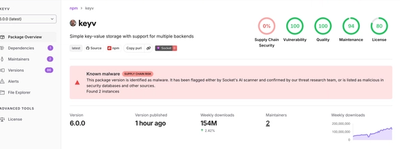
Popular npm packages keyv and cacheable compromised.

Security News
A misconfiguration gave three Anthropic models internet access, and one, believing it was in a simulation, shipped a credential-stealing package to PyPI.