
Product
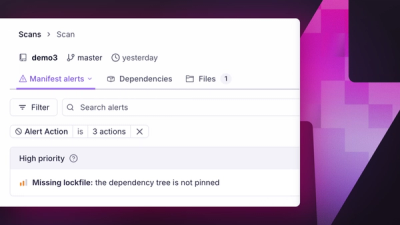
Introducing Manifest Alerts
Socket now detects supply chain risks in project manifests, starting with missing lockfiles that can make dependency installs non-reproducible.
By André Staltz, Trevor Norris - Jun 16, 2026
@useatlas/sdk
Advanced tools
TypeScript SDK for the Atlas text-to-SQL agent API.
bun add @useatlas/sdk
import { createAtlasClient } from "@useatlas/sdk";

const atlas = createAtlasClient({
  baseUrl: "https://api.example.com",
  apiKey: "my-key",
});

const result = await atlas.query("How many users signed up last week?");
console.log(result.answer);
console.log(result.sql);    // SQL queries the agent executed
console.log(result.data);   // Raw query results ({ columns, rows }[])
Pass either apiKey (simple key auth) or bearerToken (BYOT / managed auth):
// Simple API key
const atlas = createAtlasClient({ baseUrl: "...", apiKey: "my-key" });

// Bearer token (JWT from your auth provider)
const atlas = createAtlasClient({ baseUrl: "...", bearerToken: "eyJ..." });
| Method | Description |
|---|---|
atlas.query(question, opts?) | Run a synchronous query. Returns { answer, sql, data, steps, usage } |
atlas.streamQuery(question, opts?) | Stream a query as an async iterator of typed StreamEvents |
atlas.chat(messages, opts?) | Start a streaming chat session. Returns a raw Response with SSE body (AI SDK UI Message Stream Protocol) |
| Method | Description |
|---|---|
atlas.listTables() | List all queryable tables with column details. Returns { tables: TableInfo[] } |
const { tables } = await atlas.listTables();
for (const t of tables) {
  console.log(`${t.table}: ${t.description}`);
  for (const col of t.columns) {
    console.log(`  ${col.name} (${col.type}) — ${col.description}`);
  }
}
| Method | Description |
|---|---|
atlas.conversations.list(opts?) | List conversations (paginated) |
atlas.conversations.get(id) | Get a conversation with messages |
atlas.conversations.delete(id) | Delete a conversation |
atlas.conversations.star(id) | Star a conversation |
atlas.conversations.unstar(id) | Unstar a conversation |
| Method | Description |
|---|---|
atlas.scheduledTasks.list(opts?) | List scheduled tasks (paginated) |
atlas.scheduledTasks.get(id) | Get a task with recent runs |
atlas.scheduledTasks.create(input) | Create a scheduled task |
atlas.scheduledTasks.update(id, input) | Update a scheduled task |
atlas.scheduledTasks.delete(id) | Delete a scheduled task |
atlas.scheduledTasks.trigger(id) | Trigger immediate execution |
atlas.scheduledTasks.listRuns(id, opts?) | List past runs |
| Method | Description |
|---|---|
atlas.admin.overview() | Dashboard overview data |
atlas.admin.semantic.entities() | List semantic layer entities |
atlas.admin.semantic.entity(name) | Get entity detail |
atlas.admin.semantic.metrics() | List metrics |
atlas.admin.semantic.glossary() | Get glossary |
atlas.admin.semantic.catalog() | Get catalog |
atlas.admin.semantic.stats() | Aggregate semantic stats |
atlas.admin.connections() | List datasource connections |
atlas.admin.testConnection(id) | Test connection health |
atlas.admin.audit(opts?) | Query audit log |
atlas.admin.auditStats() | Aggregate audit stats |
atlas.admin.plugins() | List installed plugins |
atlas.admin.pluginHealth(id) | Check plugin health |
Use streamQuery() to receive typed events as the agent works:
import type { StreamEvent } from "@useatlas/sdk";

for await (const event of atlas.streamQuery("How many users signed up last week?")) {
  switch (event.type) {
    case "text":
      process.stdout.write(event.content);
      break;
    case "tool-call":
      console.log(`Calling ${event.name}`, event.args);
      break;
    case "tool-result":
      console.log(`${event.name} returned`, event.result);
      break;
    case "result":
      console.table(event.rows); // convenience: { columns, rows } from executeSQL
      break;
    case "error":
      // Mid-stream errors carry a typed `code` and a `retryAfterSeconds`
      // delta when the server emits a structured `ChatErrorInfo` body
      // (e.g. provider rate limiting). Older servers populate only `message`.
      console.error(event.code ?? "error", event.message);
      if (event.retryable && event.retryAfterSeconds !== undefined) {
        console.warn(`Server suggests retrying in ${event.retryAfterSeconds}s`);
      }
      break;
    case "parse-error":
      console.warn("Malformed SSE frame", event.raw);
      break;
    case "finish":
      console.log(`\nDone (${event.reason})`);
      break;
  }
}
streamQuery() uses a one-shot SSE connection over fetch. If the connection drops mid-stream:
for await loop before advancing, so any text, result, or tool-result events you've already processed are safe to keep.AtlasError with code network_error and a message starting with "Stream interrupted: ...".streamQuery() call to retry.import { AtlasError } from "@useatlas/sdk";
const collected: string[] = [];
try {
for await (const event of atlas.streamQuery("Revenue by region")) {
if (event.type === "text") collected.push(event.content);
if (event.type === "result") console.table(event.rows);
}
} catch (err) {
if (err instanceof AtlasError && err.code === "network_error") {
console.warn("Stream dropped — partial text:", collected.join(""));
// Decide whether to retry or use the partial data you have
} else {
throw err;
}
}
Pass an AbortSignal to cancel the stream. The signal aborts the underlying reader, and an AbortError is thrown from the for await loop. Events yielded before cancellation are already consumed by your code.
const controller = new AbortController();

// Cancel after 10 seconds
setTimeout(() => controller.abort(), 10_000);

try {
  for await (const event of atlas.streamQuery("...", { signal: controller.signal })) {
    if (event.type === "text") process.stdout.write(event.content);
  }
} catch (err) {
  if (err instanceof Error && err.name === "AbortError") {
    console.log("Stream cancelled");
  }
}
| Type | Fields | Description |
|---|---|---|
text | content | Text chunk from the agent |
tool-call | toolCallId, name, args | Agent is calling a tool |
tool-result | toolCallId, name, result | Tool returned a result |
result | columns, rows | Convenience event extracted from tool-result when executeSQL returns data. Both tool-result and result are emitted. |
error | message, code?, retryable?, retryAfterSeconds?, requestId? | Mid-stream error. When the server sends a structured ChatErrorInfo body (provider_rate_limit, provider_timeout, etc.) the typed code and upstream Retry-After delta travel alongside the human-readable message. Older servers populate only message. |
parse-error | raw, error | Client-side: an SSE frame contained invalid JSON. The raw data is preserved for debugging. |
finish | reason | Stream completed |
The chat route emits data-context-warning frames whenever the agent ran
past a non-fatal degradation — the org semantic layer or learned-patterns
lookup failed, or the workspace is approaching its plan budget — and the
run was allowed to proceed against reduced context. These are not stream
events from streamQuery(); they arrive on the AI-SDK UI Message Stream
channel that chat() returns. If you are routing a raw Response from
atlas.chat() through your own SSE consumer, parse each
data-context-warning frame body with parseContextWarning from
@useatlas/types:
import { parseContextWarning, type ChatContextWarning } from "@useatlas/types";

// Inside your SSE frame handler:
if (frame.type === "data-context-warning") {
  const warning: ChatContextWarning | null = parseContextWarning(frame.data);
  if (warning) {
    console.warn(`[${warning.code}]`, warning.title, warning.detail ?? "");
    // Surface a per-message warning banner — the answer is still usable
    // but was generated against reduced context. Do NOT treat it as a
    // hard error.
  } else {
    // Log on null so a future server-side wire-shape change (unknown
    // code, missing title, wrong severity literal) is observable in dev
    // rather than silently dropped. In production, gate this behind a
    // one-shot ref so a runaway stream of malformed frames doesn't
    // flood the console — see the in-tree `useContextWarnings` hook for
    // an example dedup pattern.
    console.warn("[atlas-sdk] dropped malformed data-context-warning frame", frame.data);
  }
}
The frame's severity: "warning" discriminator separates these from
data-error frames, so a single SSE consumer can route both without
misclassifying a degraded answer as a failure.
All methods throw AtlasError on failure. See the full Error Codes Reference for every error code, HTTP status, retry guidance, and a complete retry-with-backoff example.
import { AtlasError } from "@useatlas/sdk";

try {
  await atlas.query("...");
} catch (err) {
  if (err instanceof AtlasError) {
    console.error(err.code);     // e.g. "rate_limited", "auth_error"
    console.error(err.status);   // HTTP status code
    console.error(err.message);  // Human-readable message
    console.error(err.retryable); // true if retrying may help
  }
}
AtlasError Properties| Property | Type | Description |
|---|---|---|
code | AtlasErrorCode | Error code (e.g. rate_limited, network_error) |
status | number | HTTP status code (0 for client-side errors like network_error) |
message | string | Human-readable description |
retryable | boolean | Whether retrying the same request may succeed |
retryAfterSeconds | number | undefined | Server-suggested delay — only populated when the server includes retryAfterSeconds in the error response body (currently only for rate_limited). Always guard against undefined |
Use retryable for generic retry logic. For rate_limited, prefer the server-suggested delay when available, falling back to exponential backoff:
import { AtlasError } from "@useatlas/sdk";

try {
  await atlas.query("...");
} catch (err) {
  if (!(err instanceof AtlasError) || !err.retryable) throw err;

  // Use server delay if available, otherwise exponential backoff
  const delay = err.retryAfterSeconds != null
    ? err.retryAfterSeconds * 1000
    : 5000;
  await new Promise((r) => setTimeout(r, delay));
  await atlas.query("...");
}
MIT
FAQs
TypeScript SDK for the Atlas text-to-SQL agent API
We found that @useatlas/sdk demonstrated a healthy version release cadence and project activity because the last version was released less than a year ago. It has 1 open source maintainer collaborating on the project.
Did you know?

Socket for GitHub automatically highlights issues in each pull request and monitors the health of all your open source dependencies. Discover the contents of your packages and block harmful activity before you install or update your dependencies.
Product
Socket now detects supply chain risks in project manifests, starting with missing lockfiles that can make dependency installs non-reproducible.

Research
/Security News
The trojanized extensions use TinyGo-compiled WebAssembly and Solana transaction memos to resolve command-and-control infrastructure.

Security News
Anthropic says the directive cited national security concerns over a narrow jailbreak, but offered no specific technical details.