Security News
Re-Enabled GitHub Actions Expose Thousands of Repositories to Mini Shai-Hulud
Two compromised GitHub Actions were re-enabled with malicious tags intact, exposing thousands of downstream repositories to Mini Shai-Hulud.
@usebruno/oauth2-callback-server
Advanced tools
A simple Node.js server for handling OAuth2 callbacks for Bruno API client.
Start the server with npx (no installation required):
npx @usebruno/oauth2-callback-server
The server will start on port 8090 by default (or the next available port if 8090 is busy).
Specify a custom port:
npx @usebruno/oauth2-callback-server --port 8090
npx @usebruno/oauth2-callback-server -p 8090
Note: If you specify a port and it's already in use, the server will exit with an error.
Show help:
npx @usebruno/oauth2-callback-server --help
npx @usebruno/oauth2-callback-server -h
Or install locally and run:
npm install @usebruno/oauth2-callback-server
npx @usebruno/oauth2-callback-server
Or run directly with node:
node server.js
node server.js --port 8090
Visit http://localhost:<port>/callback to see the OAuth2 redirect page.
For local testing before publishing to npm:
cd /Users/lohit/Documents/code/oauth2-callback-server
npm link
npx @usebruno/oauth2-callback-server
When you visit /callback, the server serves an HTML page that automatically redirects the OAuth2 callback (including query parameters and hash fragments) to Bruno using the bruno:// protocol scheme.
FAQs
Simple OAuth2 callback server for Bruno
The npm package @usebruno/oauth2-callback-server receives a total of 212 weekly downloads. As such, @usebruno/oauth2-callback-server popularity was classified as not popular.
We found that @usebruno/oauth2-callback-server demonstrated a healthy version release cadence and project activity because the last version was released less than a year ago. It has 1 open source maintainer collaborating on the project.

Security News
Two compromised GitHub Actions were re-enabled with malicious tags intact, exposing thousands of downstream repositories to Mini Shai-Hulud.

Research
/Security News
A malicious Firefox extension fetches its payload after installation to evade detection, steal Google session cookies, and automate account takeover.

Research
/Security News
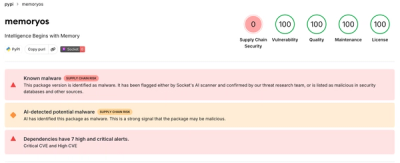
The compromise affects MemTensor's MemOS, an open source memory framework for large language models (LLMs) and AI agents. Both npm package @memtensor/memos-cloud-openclaw-plugin and the PyPI package MemoryOS are compromised. They drop cross-platform Go binaries that exfiltrate developer secrets.