

Research
/Security News
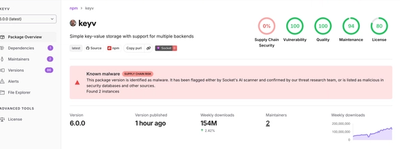
Popular npm Packages in the keyv and Cacheable Namespaces Compromised in Active Supply Chain Attack
Popular npm packages keyv and cacheable compromised.
By Socket Research Team - Aug 04, 2026
@valv/core
Advanced tools
The database-agnostic core of valv: the query grammar an LLM emits, the validator that checks it against your schema and policy, the policy injector, the shared SQL emitter, and the tool layer.

Most users install an adapter, not this package directly —
@valv/clickhouseor@valv/prismawrap core with introspection and a dialect. See the root README for the full guide. Reach for@valv/coredirectly only to build a custom adapter.
| Area | Exports |
|---|---|
| Orchestration | Valv (instantiated by adapters via createValv) |
| Query grammar | QuerySchema; types Query, Expr, SelectItem |
| Write grammar | InsertSchema, UpdateSchema, DeleteSchema; types Insert, Update, Delete, InjectedMutation |
| Policy | PolicyFn, PolicyResult, FieldPolicy, DefaultContext |
| Emission | emit, emitInsert/emitUpdate/emitDelete, the Dialect interface, BASE_FUNCTIONS, FnDef, ArgSpec |
| Output shape | resultSchema, ResultColumn |
| Tool formats | anthropic, openai, gemini formatters; NeutralTool, ToolToggle |
| Adapter contract | ValvAdapter, SchemaMap, CompiledQuery, BoundParam, MutationResult |
| Errors | ValidationError, PolicyViolationError; serializeResult |
Everything above the database is shared, so a new adapter is three methods plus a small dialect. The shared emit does clause assembly, parenthesisation, and parameter ordering — your dialect only says how to quote identifiers and render placeholders.
import type { ValvAdapter, SchemaMap, Query, CompiledQuery, FnDef, Dialect } from "@valv/core"
import { emit, BASE_FUNCTIONS } from "@valv/core"

const myDialect: Dialect = {
  quoteId: (id) => `"${id.replace(/"/g, '""')}"`,
  placeholder: (i) => `$${i + 1}`,
  // functions: { ...dialect-specific aggregates }
}

class MyAdapter implements ValvAdapter {
  async introspect(): Promise<SchemaMap> {
    // describe your tables → resources, fields (with coarse `type` + `nativeType`), relations
  }
  compile(query: Query, catalog: SchemaMap): CompiledQuery {
    return emit(query, catalog, myDialect)
  }
  async execute(sql: string, params?: unknown[]): Promise<unknown[]> {
    // run the parameterized statement, return rows
  }
  functions(): Record<string, FnDef> {
    return { ...BASE_FUNCTIONS, ...myDialect.functions }
  }
  // Optional — implement to support writes. The mutation is already validated
  // and policy-injected; emit it with emitInsert/emitUpdate/emitDelete and run it.
  // mutate?(m: InjectedMutation, catalog: SchemaMap): Promise<MutationResult>
}
Validation and policy injection never reach the adapter — security stays in core. A Dialect can also declare extra functions (FnDef: argument signature, return type, render), which become callable in the query grammar and are surfaced to the model through the query tool's enum. Writes are optional: implement mutate (the mutation arrives already validated and policy-injected) to opt in, or omit it for a read-only adapter.
InferResources derives resource names from a typed client, so a misspelled policy key is a compile error:
import type { InferResources } from "@valv/core"
const valv = await createValv<typeof prisma, Ctx>(prisma)  // policy keys autocomplete
MIT
FAQs
ORM + Access Control Layer for AI Agents
We found that @valv/core demonstrated a healthy version release cadence and project activity because the last version was released less than a year ago. It has 2 open source maintainers collaborating on the project.
Did you know?

Socket for GitHub automatically highlights issues in each pull request and monitors the health of all your open source dependencies. Discover the contents of your packages and block harmful activity before you install or update your dependencies.
Research
/Security News
Popular npm packages keyv and cacheable compromised.

Security News
A misconfiguration gave three Anthropic models internet access, and one, believing it was in a simulation, shipped a credential-stealing package to PyPI.

Security News
/Company News
Socket has joined the new Composer and Packagist sponsorship program as a launch sponsor, supporting the team that keeps PHP's package ecosystem secure.