

Research
/Security News
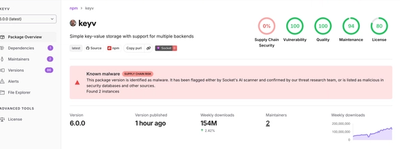
Popular npm Packages in the keyv and Cacheable Namespaces Compromised in Active Supply Chain Attack
Popular npm packages keyv and cacheable compromised.
By Socket Research Team - Aug 04, 2026
@valv/mcp-sdk
Advanced tools
Library to turn your app's database into an MCP server for coding agents (Claude Code) — adapter-agnostic, row-level security, zero SQL
Expose a valv instance you configure as an MCP server, so coding agents like Claude Code can query your database — with the same policies, field masking, and zero-SQL safety valv gives in-process.
It's a thin, adapter-agnostic wrapper around a configured Valv (Prisma or ClickHouse): tool definitions and dispatch both run through valv, so every call is policy-gated.

Just want to point an agent at a
DATABASE_URLwith no code? Use@valv/mcp. This package is for when you want your own client, typed policies, and per-request identity.
npm i @valv/mcp-sdk
# plus your adapter, e.g. @valv/prisma + @prisma/client (or @valv/clickhouse)
# plus `express` only if you use the HTTP transport
Build your valv instance (adapter + policies), then serve it. The agent gets the four tools — list_resources, search_resources, describe_resource, query — and discovers your schema at runtime.
// mcp.ts
import { PrismaClient } from "@prisma/client"
import { createValv } from "@valv/prisma"
import { startStdioServer } from "@valv/mcp-sdk"

const valv = await createValv(new PrismaClient(), { defaultPolicy: "deny-all" })
valv.policy("order", (ctx) => ({ read: { tenant_id: ctx.tenant.id } }))

await startStdioServer(valv, {
  // Resolved on every request — source identity from env vars, headers, etc.
  context: () => ({ user: { role: process.env.VALV_ROLE! }, tenant: { id: process.env.VALV_TENANT! } }),
})
Register it with your client:
{ "mcpServers": { "valv": { "command": "npx", "args": ["tsx", "mcp.ts"] } } }
startStdioServer(valv, options) / startHttpServer(valv, { ...options, port }) / createMcpServer(valv, options) (transport-agnostic Server) take:
| Option | Description |
|---|---|
context | A value or per-request resolver (sync or async) for the policy context. |
discovery | { list?, search?, describe?, create?, update?, delete? } — discovery tools default on (query always stays); the write tools default off, enable them here (and allow the op in policy). |
serverInfo | Advertised { name, version }. |
The context resolver is the key piece for multi-tenant servers: over HTTP it can read identity from each request's headers, so one server safely serves many callers. Errors are sanitized before reaching the agent — valv's own validation/policy messages pass through, anything else becomes a generic message.
MIT
FAQs
Library to turn your app's database into an MCP server for coding agents (Claude Code) — adapter-agnostic, row-level security, zero SQL
We found that @valv/mcp-sdk demonstrated a healthy version release cadence and project activity because the last version was released less than a year ago. It has 2 open source maintainers collaborating on the project.
Did you know?

Socket for GitHub automatically highlights issues in each pull request and monitors the health of all your open source dependencies. Discover the contents of your packages and block harmful activity before you install or update your dependencies.
Research
/Security News
Popular npm packages keyv and cacheable compromised.

Security News
A misconfiguration gave three Anthropic models internet access, and one, believing it was in a simulation, shipped a credential-stealing package to PyPI.

Security News
/Company News
Socket has joined the new Composer and Packagist sponsorship program as a launch sponsor, supporting the team that keeps PHP's package ecosystem secure.