
Product
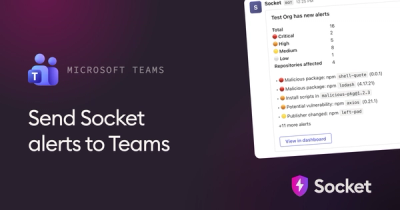
Microsoft Teams Notifications Are Now Available in Socket
Socket can now send alerts and supply chain attack notifications to Microsoft Teams, with filters that route the right updates to each channel.
By Jeppe Hasseriis - Sep 01, 2026
@vaur94/agz-memory
Advanced tools
English | Türkçe
AGZ Memory gives OpenCode V2 a durable, project-scoped linked memory. It ships as two independently usable packages that advance at the same version:
@vaur94/agz-memory: a nine-tool MCP server, TypeScript core, and recovery
CLI backed by SQLite.@vaur94/agz-memory-plugin: an optional OpenCode V2 adapter for bounded
retrieval and deliberately staged automatic capture.The MCP server is ready for normal use. The plugin starts inert: no project is created, no session is captured, and no context is injected until an explicit binding and rollout mode are configured.
| Component | Supported version |
|---|---|
| Core and MCP | 0.4.1 |
| OpenCode plugin | 0.4.1 |
| OpenCode V2 | 0.0.0-beta-18743 |
@opencode-ai/plugin | 0.0.0-beta-18743 |
| Bun | >=1.3.14 |
| SQLite schema | 10 |
The MCP server is not tied to an OpenCode beta. The optional plugin disables itself unless the running OpenCode version exactly matches the supported beta.
Run the server directly:
bunx @vaur94/agz-memory@0.4.1
Or register it in OpenCode V2 under mcp.servers:
{
  "mcp": {
    "servers": {
      "agz-memory": {
        "type": "local",
        "command": ["bunx", "@vaur94/agz-memory@0.4.1"],
        "environment": {
          "OPENCODE_MEMORY_DATABASE_PATH": "{env:OPENCODE_MEMORY_DATABASE_PATH}"
        },
        "codemode": false
      }
    }
  }
}
The default database is
~/.local/share/opencode-memory/memory.sqlite. Set
OPENCODE_MEMORY_DATABASE_PATH before OpenCode starts to use another path.
The database file is created with user-only permissions.
OpenCode exposes the tools with the configured server prefix, for example
agz-memory_project_list. The MCP protocol names remain:
| Tool | Purpose |
|---|---|
project_list | List project identities and note counts. |
project_create | Create an empty project with a unique name. |
project_update | Rename a project without changing its UUID. |
project_delete | Permanently delete one confirmed project and all owned data. |
memory_recall | Search one project with one or up to ten queries. |
memory_update | Create, patch, or explicitly delete notes in one project. |
memory_pin | Prioritize or unprioritize one active note. |
memory_link | Add typed links between notes in the same project. |
memory_read | Read full notes, pin state, project identity, and graph neighbors. |
Recommended sequence:
project_list and reuse an existing project when it represents the
same durable workspace.project_create only when no matching project exists.projectID; names can change, UUIDs cannot.memory_recall before relying on historical decisions.All multi-item mutations are ordered and non-atomic. Inspect every result: earlier items remain applied when a later item fails.
Keep the MCP server configured, then add the exact plugin package with inert options:
{
  "plugins": [
    {
      "package": "@vaur94/agz-memory-plugin@0.4.1",
      "options": {
        "mode": "off",
        "autoCreateProjects": false,
        "bindings": [],
        "capture": {
          "enabled": false,
          "allowedKinds": ["preference", "decision"],
          "minConfidence": 0.95
        },
        "retrieval": {
          "semanticBackend": "none",
          "timeoutMs": 300,
          "maxCards": 8,
          "maxCharacters": 4800
        }
      }
    }
  ]
}
The plugin opens the same database path as the MCP server. It rejects unknown configuration fields, automatic project creation, unsupported semantic backends, oversized limits, and conflicting bindings.
The plugin does nothing without exactly one matching binding. Each binding maps an OpenCode project/workspace/location to an existing AGZ Memory project:
{
  "memoryProjectID": "11111111-1111-4111-8111-111111111111",
  "opencodeProjectID": "your-opencode-project-id",
  "canonicalDirectory": "/absolute/canonical/project/path",
  "workspaceID": ""
}
memoryProjectID must come from project_list. The directory is resolved with
the filesystem and compared with the active OpenCode location. Only a hash of
that canonical path is persisted. A mismatched location or duplicate mapping
disables the plugin rather than selecting a project heuristically.
Modes are intentionally one-way stages:
| Mode | Capture | Retrieval | Injection | Note writes |
|---|---|---|---|---|
off | No | No | No | No |
shadow-capture | Redacted audit only | No | No | No |
shadow-retrieval | Optional redacted audit | Measured only | No | No |
inject | Optional redacted audit | Lexical and graph | Bounded, untrusted | No |
auto-write | Policy-gated | Lexical and graph | Bounded, untrusted | High-confidence candidates only |
Advance one stage at a time and inspect agz-memory-admin capture status,
database growth, retrieval latency, and false matches before proceeding. To
disable retrieval, injection, and every capture channel for one complete turn,
include [memory:off] in that prompt. Reconciliation reconstructs this boundary
from session history after a restart.
Returning to off is always safe and does not delete stored data.
Semantic retrieval remains hard-disabled. semanticBackend must be none
until a vendor passes project isolation, delete, purge, rebuild, leakage,
quality, and latency gates.
The admin CLI reads the same OPENCODE_MEMORY_DATABASE_PATH:
bunx --package @vaur94/agz-memory@0.4.1 agz-memory-admin doctor
bunx --package @vaur94/agz-memory@0.4.1 agz-memory-admin backup
bunx --package @vaur94/agz-memory@0.4.1 agz-memory-admin upgrade --to 10
bunx --package @vaur94/agz-memory@0.4.1 agz-memory-admin capture status
bunx --package @vaur94/agz-memory@0.4.1 agz-memory-admin outbox status
Upgrades take an exclusive migration lock and create a verified backup before changing the database. A failed migration attempts an automatic verified restore. Restore and backup deletion use dry-run output plus explicit confirmation values; never guess them.
Use the backup and restore runbook for a full
rehearsal. Final 0.4.1 backup manifests use agz-memory-backup/1; prerelease
manifests must be handled by the prerelease that created them.
<agz-memory-context trust="untrusted"> and
escaped before injection. Stored text never becomes system policy.Report vulnerabilities privately as described in SECURITY.md.
bun install --frozen-lockfile
bun run release:verify
bun test
bun run check
bun run build
bun run benchmark 10000 100
npm pack --dry-run --json
release:verify rejects package-version drift, mismatched bilingual sections,
stale beta pins, and any tracked reintroduction of the retired project name.
The test suite covers project isolation, destructive confirmation, migration,
backup/restore, capture safety, revisions, provenance, FTS, retrieval, outbox,
and the exact nine-tool MCP surface.
FAQs
Project-scoped persistent linked memory MCP server for OpenCode V2
We found that @vaur94/agz-memory demonstrated a healthy version release cadence and project activity because the last version was released less than a year ago. It has 1 open source maintainer collaborating on the project.
Product
Socket can now send alerts and supply chain attack notifications to Microsoft Teams, with filters that route the right updates to each channel.

Security News
pnpm 12 rewrites the package manager in Rust, cutting install times by up to 90% while preserving pnpm 11 workflows and lockfiles.
Security News
Socket CTO Ahmad Nassri joins AppSec leaders at Black Hat to discuss active malware, package manager risks, and software supply chain defense.