

Company News
AWS Security Hub Adds Socket for Supply Chain Security
Socket is now in the AWS Security Hub Extended plan. Adopt it through AWS, apply committed spend, and block malicious open source packages.
By Feross Aboukhadijeh - Aug 04, 2026
@vibelogin/mcp
Advanced tools
VibeLogin MCP server — zero-touch auth for AI coding agents (Cursor, Claude Desktop, Windsurf, Cline)
VibeLogin MCP server — zero-touch auth setup for AI coding agents (Cursor, Claude Desktop, Claude Code, Windsurf, Cline, Zed, …).
Spin up a VibeLogin project, configure auth methods, wire up Google OAuth, and scaffold a working sign-in flow into your codebase — all from inside your editor's chat, without leaving the IDE.
This is a Model Context Protocol server that exposes VibeLogin as a set of tools any MCP-capable agent can call. The agent decides when to use them based on the conversation; you just say "add login to my app" and it takes care of the rest.
The server runs as a local subprocess over stdio, talks to the VibeLogin console via a loopback OAuth flow (RFC 8252 + PKCE S256), and caches a refresh token under ~/.vibelogin/credentials.json so you only authorize once per month.
The server runs with bunx (or npx once published) — no global install needed.
bunx @vibelogin/mcp           # bun
npx  @vibelogin/mcp           # node
You'll wire that command into your MCP client config (see below). The first tool call opens a browser for one-click consent.
Add to ~/Library/Application Support/Claude/claude_desktop_config.json (macOS) or the equivalent on your OS:
{
  "mcpServers": {
    "vibelogin": {
      "command": "bunx",
      "args": ["@vibelogin/mcp"],
      "env": {
        "VIBELOGIN_API_URL": "https://api.vibelogin.com",
        "VIBELOGIN_CONSOLE_URL": "https://app.vibelogin.com"
      }
    }
  }
}
~/.cursor/mcp.json (or per-project .cursor/mcp.json):
{
  "mcpServers": {
    "vibelogin": {
      "command": "bunx",
      "args": ["@vibelogin/mcp"],
      "env": {
        "VIBELOGIN_API_URL": "https://api.vibelogin.com",
        "VIBELOGIN_CONSOLE_URL": "https://app.vibelogin.com"
      }
    }
  }
}
Same shape — every MCP client accepts a command + args + optional env map. Drop the snippet above into the client's MCP settings file.
Point at localhost:
"env": {
  "VIBELOGIN_API_URL": "http://localhost:3000",
  "VIBELOGIN_CONSOLE_URL": "http://localhost:3002"
}
| Variable | Default | Purpose |
|---|---|---|
VIBELOGIN_API_URL | http://localhost:3000 | Hono API base URL — what the platform tools talk to. |
VIBELOGIN_CONSOLE_URL | http://localhost:3002 | Console base URL — used for the loopback OAuth flow. |
VIBELOGIN_HOME | ~/.vibelogin | Where credentials are cached. |
All optional — sensible defaults for local dev. Set these in your MCP client config to point at staging or production.
~/.vibelogin/credentials.json has a valid (unexpired) access token, it's used as-is./api/agent/refresh (no browser, ~50ms).127.0.0.1:<random>https://app.vibelogin.com/agent/authorize?… in your browserThe credentials file is chmod 600 and rejected if the cached consoleUrl doesn't match the current VIBELOGIN_CONSOLE_URL (so switching between staging and prod can't reuse the wrong token).
Every tool definition contains an extensive description field with explicit step number / preconditions / call-before / call-after hints — the LLM running inside Cursor / Claude Desktop / Windsurf reads those when it's deciding what to do, you don't configure anything yourself.
For the most common request — "add VibeLogin to my app" — the four data-modifying tools are sequential and must run in this order:
STEP 1            STEP 2              STEP 3              STEP 4
list_projects ──► create_project ──► configure_auth ──► add_auth_to_project
   (read)           (write)             (write)              (write)
   always           skip if a           enable methods        scaffold code
   first            match exists        + Google OAuth        last
Why each step depends on the previous:
| Step | Why it must come first |
|---|---|
| 1 → 2 | Without list_projects you can't tell whether to create or reuse — running create_project blindly produces duplicates. |
| 2 → 3 | configure_auth needs a projectId that only exists after creation (or lookup). |
| 3 → 4 | add_auth_to_project scaffolds UI for whichever methods are enabled server-side. Skipping step 3 produces a sign-in page that hits METHOD_DISABLED at runtime. |
| 4 = end | After step 4 the user has working code; no further VibeLogin tools should be called unless they ask for changes. |
Re-entry points for follow-up requests (you don't restart at step 1):
| User says | Enter at | Notes |
|---|---|---|
| "What projects do I have?" | step 1 only | Read-only, stop after. |
| "I already created one in the dashboard, wire it up" | get_project → step 4 | Skip 1 + 2 + 3 if methods are already set. |
| "Turn on magic link" | step 3 | Need projectId — list_projects first if unknown. |
| "Hook up Google" | step 3 | First call without google to get the redirect URI; second call with credentials. |
| "Add VibeLogin to a NEW app" | step 1 | Full sequence. |
auth is implicit — almost never call it manuallyEvery other tool calls requireToken() internally, which transparently runs cached → refresh → browser-loopback with no agent involvement. Only invoke auth directly when:
code: "NOT_AUTHENTICATED" and you want to retry interactively.The server advertises six tools via tools/list. Agents pick which to call based on your conversation.
authManually run the loopback OAuth flow. You normally won't call this — requireToken triggers it automatically when needed.
| Param | Type | Required | Description |
|---|---|---|---|
clientName | string | no | Label shown on the consent screen (default "VibeLogin MCP"). |
noBrowser | boolean | no | Print the authorize URL to stderr instead of opening a browser. Useful for SSH / headless environments. |
create_projectCreates a new VibeLogin project in your org. Returns the project's id, slug, oauthSlug, environment, publishable key, and secret key (shown once).
| Param | Type | Required | Description |
|---|---|---|---|
name | string | yes | Human-readable project name. |
slug | string | no | URL-safe slug; auto-generated from name if omitted. |
environment | enum | no | production | development | staging (default production). |
list_projectsLists every project in your org. Use this when the agent needs to discover what already exists before creating something new.
No parameters.
get_projectLook up a single project by id, slug, or oauthSlug.
| Param | Type | Required | Description |
|---|---|---|---|
idOrSlug | string | yes | Project id, slug, or oauthSlug. |
configure_authToggle auth methods, set redirect URLs, and/or wire up Google OAuth. Field-level updates — anything you don't set is left untouched.
| Param | Type | Required | Description |
|---|---|---|---|
projectId | string | yes | The project's id. |
methods.emailPassword | boolean | no | Enable email + password sign-in. |
methods.magicLink | boolean | no | Enable magic link emails. |
methods.emailOtp | boolean | no | Enable 6-digit email OTP codes. |
methods.passwordReset | boolean | no | Enable password reset emails. |
methods.emailVerification | boolean | no | Require email verification on signup. |
google.clientId | string | with google | Google OAuth client ID (from Google Cloud Console). |
google.clientSecret | string | with google | Google OAuth client secret. |
google.enabled | boolean | no | Default true. |
redirectUrls | string[] | no | Overwrites the project's allowed redirect URL list. |
If you call this without google, the response includes the exact Google Cloud Console URL + redirect URI you need to set up the credentials.
add_auth_to_projectScaffold a working sign-in flow into your codebase. Detects the framework from package.json and writes non-destructive files (existing files are skipped, never clobbered).
Supported frameworks today: Next.js (App Router). Refused with guidance: Remix, Astro, Express, Vite, unknown.
| Param | Type | Required | Description |
|---|---|---|---|
projectDir | string | yes | Absolute path to the project root. |
slug | string | yes | The project's oauthSlug (from create_project). |
publishableKey | string | yes | The project's publishable key. |
appUrl | string | yes | Your app's origin (e.g. https://myapp.com). |
middleware.ts                       # hostedAuthMiddleware
app/auth/callback/route.ts          # createCallbackHandler
app/login/page.tsx                  # <VibeLogin />
.env.local.example                  # publishable key + secret placeholder
Next steps printed by the tool:
pnpm add @vibelogin/nextjs.env.local.example → .env.local, fill VIBELOGIN_SECRET_KEYpnpm dev → open /loginTool failures are returned as MCP isError: true results with a structured payload so agents can branch on the failure mode instead of regex-matching free text:
{
  "isError": true,
  "structuredContent": {
    "code": "UNSUPPORTED_FRAMEWORK",
    "message": "Automated scaffolding currently supports Next.js App Router. …",
    "details": { "detected": "remix", "reason": "found `@remix-run/*` in dependencies" }
  },
  "content": [
    { "type": "text", "text": "[UNSUPPORTED_FRAMEWORK] Automated scaffolding…" }
  ]
}
Current error codes:
| Code | When |
|---|---|
NOT_AUTHENTICATED | Loopback flow ran but no valid token was persisted. |
STATE_MISMATCH | OAuth callback state did not match — possible CSRF, aborted. |
UNSUPPORTED_FRAMEWORK | add_auth_to_project could not detect a supported framework. |
INTERNAL_ERROR | Anything else (details not populated). |
API-side failures (api_error: <code> — <msg>) are still returned as INTERNAL_ERROR; they will get their own codes in a future release.
You: "Add VibeLogin to this Next.js app. Email + password and Google sign-in."
Agent: (calls
create_project { name: "myapp", environment: "production" }) Createdmyapp(pk_live_…). (callsconfigure_auth { projectId, methods: { emailPassword: true } }) Email + password enabled. To turn on Google, I need a Client ID and Secret from Google Cloud Console — here's the redirect URI to authorize:https://api.vibelogin.com/oauth/myapp-xyz/google/callback. (after you paste creds:) (callsconfigure_auth { google: { clientId, clientSecret } }) (callsadd_auth_to_project { projectDir: ".", slug: "myapp-xyz", publishableKey: "pk_live_…", appUrl: "https://myapp.com" }) Scaffold complete (next). Wrotemiddleware.ts,app/auth/callback/route.ts,app/login/page.tsx,.env.local.example. Runpnpm add @vibelogin/nextjs && pnpm devand open/login.
You: "What projects do I have already?"
Agent: (calls
list_projects) You have 3:myapp(production),myapp-staging(staging),internal-tools(development).
┌──────────────┐  stdio JSON-RPC  ┌────────────────┐
│  IDE / Chat  │ ───────────────► │ @vibelogin/mcp │
│  (Cursor,    │ ◄─────────────── │   subprocess   │
│   Claude…)   │                  └────────┬───────┘
└──────────────┘                           │
                                           │ HTTPS
                                           ▼
                                  ┌─────────────────┐
                                  │ console         │
                                  │ /agent/authorize│  ◄── browser loopback
                                  │ /api/agent/token│      (PKCE S256)
                                  │ /api/agent/refresh│
                                  └────────┬────────┘
                                           │ issues HS256 platform JWT
                                           ▼
                                  ┌─────────────────┐
                                  │ Hono API        │
                                  │ /v1/platform/*  │
                                  └─────────────────┘
@modelcontextprotocol/sdk — the protocol subset we use is small and stable, and zero deps means bunx @vibelogin/mcp is instant.chmod 600 on ~/.vibelogin/credentials.json.VIBELOGIN_CONSOLE_URL doesn't match the URL it was issued against. Switching between staging and prod cannot accidentally reuse the wrong token.state value the server generated; mismatches abort with STATE_MISMATCH.# from the monorepo root
pnpm install
pnpm --filter @vibelogin/mcp build # tsc check (no emit)
# run the server directly (talks to local console + api)
bun packages/mcp/src/index.ts
# run the unit tests
cd packages/mcp && bun test
Tests cover the loopback flow (PKCE, URL builder, listener success/error/missing/timeout) and the stdio dispatcher.
Apache-2.0
FAQs
VibeLogin MCP server — zero-touch auth for AI coding agents (Cursor, Claude Desktop, Windsurf, Cline)
We found that @vibelogin/mcp demonstrated a healthy version release cadence and project activity because the last version was released less than a year ago. It has 1 open source maintainer collaborating on the project.
Did you know?

Socket for GitHub automatically highlights issues in each pull request and monitors the health of all your open source dependencies. Discover the contents of your packages and block harmful activity before you install or update your dependencies.
Company News
Socket is now in the AWS Security Hub Extended plan. Adopt it through AWS, apply committed spend, and block malicious open source packages.
Research
/Security News
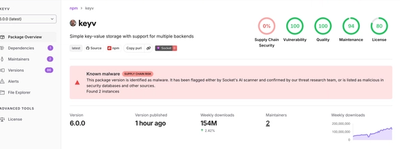
Popular npm packages keyv and cacheable compromised.

Security News
A misconfiguration gave three Anthropic models internet access, and one, believing it was in a simulation, shipped a credential-stealing package to PyPI.