

Research
/Security News
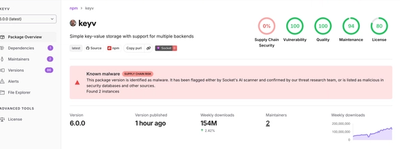
Popular npm Packages in the keyv and Cacheable Namespaces Compromised in Active Supply Chain Attack
Popular npm packages keyv and cacheable compromised.
By Socket Research Team - Aug 04, 2026
@voyagier/cli
Advanced tools
Agent-ready travel CLI — search, plan, quote, and book real trips (flights, hotels, activities) against the Voyagier platform. Built for AI agents: --json everywhere, uniform error codes, price-gated checkout, printable agent reference (voyagier agent-doc




Search flights, book activities, manage trip plans — from your terminal. Everything syncs to voyagier.com.
npm install -g voyagier # or the canonical package: @voyagier/cli
voyagier auth set-token <your-token>
voyagier doctor # confirm auth + schema reachability
voyagier is a convenience alias that tracks the latest compatible @voyagier/cli release (currently ^2). Pinning an exact version? Use the canonical package: npm install -g @voyagier/cli@<version>.
No install permissions (sandboxed agent, CI)? Every command works zero-install via npx:
VOYAGIER_TOKEN=<your-token> npx @voyagier/cli doctor --json
A trip plan is a goal graph: the plan ships with goals (flights, hotel, dates, destination, travellers) and you compose the trip by searching against those goals and selecting options. Searches are asynchronous — a search creates a selection, and options arrive shortly after, so you poll for them.
# 1) Resolve a client (idempotent by email)
voyagier clients upsert --email "smith@example.com" --name "Smith Family" \
  --type Individual --json

# 2) Scaffold a plan (creates the plan + default goal graph; optionally adds
#    travellers if you pass --travellers)
voyagier plan-trip --client "Smith Family" --title "Smith — Tokyo" --json
# Returns a scaffold summary: { ok, tripPlanId, title, travellerIds, scaffolded,
# note, url, nextSteps } — the nextSteps are the compose commands for this plan.

# 3) Add a traveller
voyagier travellers add --plan <PLAN_ID> --first John --last Smith \
  --type Adult --json

# 4) Search flights → poll for options → select
voyagier search flights --plan <PLAN_ID> --from JFK --to NRT \
  --date 2026-09-15 --return 2026-09-22 --json
# Returns a selectionId. Options are fetched asynchronously:
voyagier selection-options <SELECTION_ID> --wait --json
voyagier select --selection-id <SELECTION_ID> --option-id <OPTION_ID> --wait --json

# 5) Search a hotel → poll → select
voyagier search hotels --plan <PLAN_ID> --location Tokyo \
  --checkin 2026-09-15 --checkout 2026-09-22 --json
voyagier selection-options <SELECTION_ID> --wait --json
voyagier select --selection-id <SELECTION_ID> --option-id <OPTION_ID> --json

# 6) Inspect readiness at any time — one call: what's blocked, what's next
voyagier plan-status <PLAN_ID> --json

# 7) Pre-flight (dry-run: blockers + chargeable subtotal), then checkout (price gate required)
voyagier book <PLAN_ID> --dry-run --json                   # preview: blockers + chargeable subtotal; no gate needed
voyagier book <PLAN_ID> --expect-total <subtotal> --json   # checkout only at that exact price
voyagier book <PLAN_ID> --validate --expect-total <subtotal> --json  # strict: also abort if ANY item is non-bookable
| Selection | Bookable? | Source |
|---|---|---|
| Activity | ✅ per slot | Activity supplier |
| Hotel | ✅ via room-rate item | Accommodation supplier / advisor inventory (pick hotel → pick room; baseline rate auto-carted; rate-less listings stay display-only) |
| Flight | ✅ via Fare & Cabin item | Air supplier / GDS (fare-level item carted once all legs are picked; defaults to Economy) |
The cart materializes only bookable, fare/room-level options — the per-item isBookable flag is the live truth. Always run voyagier book <planId> --dry-run first for pre-flight checks (blockers + chargeable subtotal, no gate needed); --validate is a strictness modifier on the real booking that aborts if any item is non-bookable. A real checkout requires a price gate (--expect-total or --max-total) against the chargeable subtotal, and the checkout is always pinned to that gated set via itemIds — --types / --only-bookable narrow it server-side. Note: unpaid (Pending) checkout sessions are not visible to the CLI, so never retry a successful book. Cart items sourced from live-rate suppliers may report source: "OTHER" — that's normal, not an error.
| Command | Description |
|---|---|
voyagier doctor | Self-check: auth, schema, reachability, state, version |
voyagier clients | Advisor CRM (list, get, create, update, archive, upsert) |
voyagier plans | create, list, get, summary, delete; plans goals for the goal graph + readiness; plans bookable for pre-flight |
voyagier plan-trip | Scaffold a plan (plan + default goal graph; adds travellers only if --travellers is given) and print compose next-steps |
voyagier plan-status <planId> | One-shot readiness: BOOKED / READY_TO_BOOK / BLOCKED / IN_PROGRESS, ordered blockers, runnable next steps |
voyagier travellers | Add, list, update, remove travellers |
voyagier traveller-groups | Manage traveller groups (list, create, update, delete, members) |
voyagier traveller-choices | Inspect per-traveller selection choices for a plan |
voyagier search | Flights, hotels, activities, airports — creates a selection; options arrive async |
voyagier selection-options <selectionId> | Read / poll a selection's options (--wait to poll until ready) |
voyagier select | Choose an option (--selection-id <id> --option-id <id>, or by index; --wait to settle readiness after the pick) |
voyagier itinerary | Computed itinerary (sourced from tripPlanEvents) |
voyagier listings | Advisor inventory listings — recent change events, add to selection |
voyagier places | Search / get / attach / list / highlight (external places + internal catalog) |
voyagier cart | View cart with by-goal grouping and per-item bookability |
voyagier quote | Offer snapshot: itemized bookables + the exact total a gated book will enforce (--json includes the acceptance command) |
voyagier send | Email the client an invite link to the live trip (self-serve close; requires confirmation / --yes) |
voyagier book | Stripe checkout gated by --expect-total / --max-total; --validate, server-side --only-bookable / --types, --rebook |
voyagier bookings | View booking records |
voyagier chat | Interactive AI trip planning |
voyagier whoami | Identity + profile (live-verifies the token; --cached for offline reads) |
voyagier auth | Manage PAT / API URL |
voyagier agent-docs | Print full AI agent integration reference |
Most data-bearing commands accept --json for structured output (notable exceptions: chat, telemetry, several auth subcommands). Use --plan <id> on select to prevent cross-plan state corruption when running parallel workflows.
voyagier agent-docs    # full reference (AGENT.md)
npx @voyagier/cli agent-docs   # zero-install variant
Or read AGENT.md directly. It covers the goal-graph compose model, async option fetch, per-command JSON shapes, the error code table, and the bookability matrix.
The CLI ships an MCP stdio server that exposes the agent surface as tools, for hosts that speak the Model Context Protocol (Claude Desktop, Cursor, etc.):
voyagier mcp # run the stdio server (JSON-RPC on stdout)
It's a thin adapter: each tool call self-spawns the CLI as a subprocess with --json (the one exception is agent_docs, which runs without it), so the tools inherit the CLI's uniform error codes and price-gated checkout — zero behaviour drift. The MCP layer normalises every result into ONE canonical envelope: on success { ok: true, data: <object>, planContext? } (agent_docs markdown arrives as data.content), and on failure { ok: false, error: { code, message, details? } } with isError: true. Authentication flows through the environment (VOYAGIER_TOKEN / VOYAGIER_API_URL); the MCP layer never sees your token.
Claude Desktop (claude_desktop_config.json):
{
  "mcpServers": {
    "voyagier": {
      "command": "npx",
      "args": ["-y", "@voyagier/cli", "mcp"],
      "env": { "VOYAGIER_TOKEN": "voy_pat_xxxxx" }
    }
  }
}
Cursor (.cursor/mcp.json):
{
  "mcpServers": {
    "voyagier": {
      "command": "npx",
      "args": ["-y", "@voyagier/cli", "mcp"],
      "env": { "VOYAGIER_TOKEN": "voy_pat_xxxxx" }
    }
  }
}
| Tool | Maps to | Notes |
|---|---|---|
doctor | doctor | Health check: auth, schema, state, version. |
create_client | clients upsert | Idempotent by email; a plan needs a client. |
plan_trip | plan-trip | Scaffold a plan + goal graph; returns nextSteps. |
add_traveller | travellers add | Required before search. |
search_flights | search flights | Async — optionCount 0 means poll options. |
search_hotels | search hotels | Prices are stay totals, not nightly. |
search_activities | search activities | Bookable per slot. |
get_selection_options | selection-options | wait (default true) polls the async fetch to completion. |
select_option | select | Explicit-id mode; wait (default true) settles readiness. |
plan_status | plan-status | One-call "what's left before booking?". |
quote | quote | Advisor offer snapshot + acceptance block. |
book_dry_run | book --dry-run | Chargeable subtotal + blockers; no gate needed. |
book | book | Requires expect_total — price hard-gate, fails closed with PRICE_CHANGED. |
booking_status | book --status | Post-payment confirmation lookup. |
agent_docs | agent-docs | The full agent reference as markdown. |
sendis intentionally excluded from the MCP surface.voyagier sendemails a real client an invite link and is not idempotent — every call re-emails. That side effect is too consequential to expose behind an autonomous tool call; use the CLI directly (voyagier send <planId> --yes) when you mean it. The MCP close path isquote→book.
bookcannot be retried safely. Unpaid Stripe sessions are invisible to the pre-flight, so a retry mints a duplicate payable link. Treat a successfulbookas terminal.
| Variable | Description |
|---|---|
VOYAGIER_TOKEN | Personal access token (overrides config) |
VOYAGIER_API_URL | API base URL (default: https://travel.voyagier.com/api; the CLI appends /graphql) |
Thin client over Voyagier's GraphQL API — the same API the web app uses. Everything syncs both ways. A plan is a goal graph; searching composes selections against goals, and air, accommodation, activity, and places suppliers are all surfaced through one unified selection model.
Voyagier access is granted, not open signup — request access at voyagier.com/agents. That's the gate for advisors, trip-planner customers, and agent builders alike.
Once your account is granted API access, mint a personal access token at travel.voyagier.com/me/settings/tokens and you're in. Two account tiers use the CLI today:
voyagier clients); plans are created against a client (--client).voyagier plan-trip — no client setup, no --client flag. (voyagier whoami shows your tier.)Non-admin tokens expire (90 days max, 30 by default) — mint a fresh one when yours lapses.
Tip: prefer
voyagier login(interactive prompt) overvoyagier auth set-token <token>— it keeps your token out of shell history. For scripts, use theVOYAGIER_TOKENenv var.
Apache-2.0 — Copyright 2026 Voyagier, Inc. Use of Voyagier services through the CLI is subject to the Voyagier Terms of Service. "Voyagier" and the Voyagier logo are trademarks of Voyagier, Inc.; the Apache-2.0 license does not grant trademark rights.
FAQs
Agent-ready travel CLI — search, plan, quote, and book real trips (flights, hotels, activities) against the Voyagier platform. Built for AI agents: --json everywhere, uniform error codes, price-gated checkout, printable agent reference (voyagier agent-doc
The npm package @voyagier/cli receives a total of 1,765 weekly downloads. As such, @voyagier/cli popularity was classified as popular.
We found that @voyagier/cli demonstrated a healthy version release cadence and project activity because the last version was released less than a year ago. It has 2 open source maintainers collaborating on the project.
Did you know?

Socket for GitHub automatically highlights issues in each pull request and monitors the health of all your open source dependencies. Discover the contents of your packages and block harmful activity before you install or update your dependencies.
Research
/Security News
Popular npm packages keyv and cacheable compromised.

Security News
A misconfiguration gave three Anthropic models internet access, and one, believing it was in a simulation, shipped a credential-stealing package to PyPI.

Security News
/Company News
Socket has joined the new Composer and Packagist sponsorship program as a launch sponsor, supporting the team that keeps PHP's package ecosystem secure.