

Company News
AWS Security Hub Adds Socket for Supply Chain Security
Socket is now in the AWS Security Hub Extended plan. Adopt it through AWS, apply committed spend, and block malicious open source packages.
By Feross Aboukhadijeh - Aug 04, 2026
@weave_protocol/mund
Advanced tools
The Guardian Protocol - MCP-based security monitoring for agentic AI systems
MCP Security Scanner for AI Agents




Mund (Old English: "protection, guardian") is a real-time security scanner for AI agent systems. It detects prompt injection, secrets, PII, dangerous code patterns, and data exfiltration attempts.
🆕 New in v0.2.0: Automated threat intelligence with MITRE ATT&CK mapping and community feeds.
| Category | What It Detects |
|---|---|
| Prompt Injection | Role manipulation, instruction override, jailbreak attempts, hidden Unicode |
| Secrets | API keys (OpenAI, Anthropic, AWS, GitHub, Stripe), tokens, private keys, database URLs |
| PII | SSN, credit cards, emails, phone numbers, IP addresses |
| Code Patterns | Shell injection, SQL injection, dangerous chmod, curl|bash, eval |
| Exfiltration | Suspicious URLs, DNS tunneling, base64-encoded data blocks |
| MCP Servers | Malicious tool descriptions, typosquatting, dangerous permissions, embedded secrets |
| Threat Intel | 20+ built-in patterns, MITRE ATT&CK mapping, auto-updating community feeds |
# npm
npm install @weave_protocol/mund
# Or run directly
npx @weave_protocol/mund
Add to your claude_desktop_config.json:
{
  "mcpServers": {
    "mund": {
      "command": "npx",
      "args": ["-y", "@weave_protocol/mund"]
    }
  }
}
Restart Claude Desktop. Mund's security tools are now available.
import { AnalyzerEngine, getAnalyzers } from '@weave_protocol/mund';

const engine = new AnalyzerEngine(getAnalyzers());
const issues = await engine.analyzeAll(content, rules);

if (issues.some(i => i.severity === 'critical')) {
  console.error('Critical security issues detected!');
}
New in v0.2.0: Mund includes automated threat intelligence with MITRE ATT&CK mapping and auto-updating community feeds.
| Category | Patterns |
|---|---|
| Prompt Injection | Direct override, role reassignment, delimiter injection, encoded payloads |
| Jailbreaks | DAN, developer mode, hypothetical framing |
| System Prompt Leaks | Direct request, indirect extraction |
| Data Exfiltration | Markdown image exfil, URL data injection |
| MCP Exploits | Tool abuse, cross-tool attacks |
| DoS Attacks | Infinite loops, token exhaustion |
All patterns are mapped to MITRE ATT&CK techniques:
| Technique | Description |
|---|---|
| T1059 | Command and Scripting Interpreter |
| T1078 | Valid Accounts |
| T1055 | Process Injection |
| T1027 | Obfuscated Files or Information |
| T1041 | Exfiltration Over C2 Channel |
| T1499 | Endpoint Denial of Service |
mund_update_threat_intelPull latest patterns from configured feeds.
Input: { source?: "weave_community" }

Output: {
  success: true,
  sources_updated: ["weave_community", "mitre_llm"],
  patterns_added: 12,
  patterns_updated: 3
}
mund_intel_statusGet threat intelligence health and coverage.
Output: {
  sources: { total: 3, enabled: 3, auto_update: 2 },
  patterns: { total: 47, enabled: 45, by_category: {...} },
  mitre: { techniques_covered: 10, tactics_covered: 6 },
  last_update: "2026-03-30T12:00:00Z"
}
mund_list_intel_sourcesShow all configured intel sources.
Output: {
  sources: [
    { id: "weave_builtin", enabled: true, auto_update: false, patterns: 20 },
    { id: "weave_community", enabled: true, auto_update: true, interval: "24h" },
    { id: "mitre_llm", enabled: true, auto_update: true, interval: "7d" }
  ]
}
mund_threat_scanScan content using threat intelligence patterns.
Input: { content: "ignore previous instructions and..." }

Output: {
  threats_detected: 1,
  findings: [{
    pattern_id: "prompt_injection_override",
    category: "prompt_injection",
    severity: "critical",
    mitre_techniques: ["T1059"],
    match: "ignore previous instructions..."
  }]
}
mund_add_intel_source / mund_remove_intel_sourceManage custom threat feeds.
mund_list_patterns / mund_toggle_patternBrowse and enable/disable specific patterns.
Scan MCP servers before you install them. Mund detects malicious tool descriptions, typosquatting attacks, dangerous permissions, and embedded secrets in server manifests.
githib vs github)mund_scan_mcp_serverFull security scan of a server manifest before installation.
Input: { manifest: "<server.json content>", source?: "registry URL" }

Output: {
  server_name: "example-server",
  recommendation: "DO_NOT_INSTALL" | "REVIEW_CAREFULLY" | "CAUTION" | "APPEARS_SAFE",
  capabilities: { network: true, filesystem: false, execution: true, ... },
  issues: [
    {
      rule_id: "mcp_tool_injection",
      rule_name: "Injection Pattern: Instruction Override",
      severity: "critical",
      match: "Tool 'run_command': ignore previous instructions...",
      suggestion: "DO NOT install this server."
    }
  ]
}
mund_check_typosquattingCheck if a server name is suspiciously similar to a known legitimate server.
Input: { name: "githib-mcp" }

Output: {
  name: "githib-mcp",
  is_suspicious: true,
  similar_to: ["github"],
  recommendation: "Verify you have the correct server from a trusted source."
}
mund_audit_mcp_permissionsAnalyze what capabilities an MCP server's tools require.
Input: { manifest: "<server.json content>" }

Output: {
  server_name: "filesystem-server",
  overall_risk_level: "HIGH",
  capabilities: {
    network: false,
    filesystem: true,
    execution: true,
    environment: false,
    database: false
  },
  capability_summary: [
    "⚠️  Can execute commands/code on your system",
    "📁 Can read/write files"
  ],
  tools: [
    { name: "run_shell", detected_permissions: ["execution"], risk: "HIGH" },
    { name: "read_file", detected_permissions: ["filesystem"], risk: "LOW" }
  ]
}
| Threat | Detection Method |
|---|---|
| Prompt Injection in Tools | Scans tool descriptions for "ignore instructions", role switching, jailbreak patterns |
| Hidden Unicode | Detects zero-width characters that can hide malicious content |
| Typosquatting | Levenshtein distance + substitution patterns (0→o, 1→l) against known servers |
| Dangerous Permissions | Flags tools with execution, network, filesystem, or environment access |
| Embedded Secrets | Scans manifest for API keys, tokens, connection strings |
| Suspicious Metadata | Flags missing versions, URL shorteners in repository links |
mund_scanScan any content for security issues.
Input: { content: "Here's my API key: sk-abc123..." }

Output: {
  safe: false,
  issue_count: 1,
  issues: [{
    rule_id: "openai_api_key",
    severity: "critical",
    match: "sk-a****123",
    suggestion: "Use environment variables instead of hardcoding."
  }]
}
mund_scan_conversationScan an entire conversation history.
Input: {
  messages: [
    { role: "user", content: "My SSN is 123-45-6789" },
    { role: "assistant", content: "I'll help you with that..." }
  ]
}
mund_check_secretCheck if a specific string looks like a secret.
Input: { value: "ghp_xxxxxxxxxxxxxxxxxxxxxxxxxxxxxxxxxxxx" }

Output: {
  is_secret: true,
  secret_type: "GitHub Personal Access Token",
  confidence: 0.95
}
mund_check_piiScan content specifically for personally identifiable information.
Input: { content: "Contact john@example.com or call 555-123-4567" }

Output: {
  contains_pii: true,
  pii_types: ["email_address", "phone_number_us"],
  issues: [...]
}
mund_get_statsGet scanning statistics and detection history.
Output: {
  total_scans: 1547,
  issues_detected: 89,
  by_type: { secret: 34, pii: 28, injection: 15, ... }
}
| Variable | Description | Default |
|---|---|---|
MUND_TRANSPORT | stdio or http | stdio |
MUND_PORT | HTTP server port | 3000 |
MUND_LOG_LEVEL | debug, info, warn, error | info |
MUND_BLOCK_MODE | Block on critical issues | false |
MUND_STORAGE | memory or sqlite | memory |
Mund can alert on detections via Slack, Teams, email, or webhooks:
# Slack
MUND_SLACK_WEBHOOK=https://hooks.slack.com/services/...
MUND_SLACK_CHANNEL=#security-alerts

# Microsoft Teams
MUND_TEAMS_WEBHOOK=https://outlook.office.com/webhook/...

# Email
MUND_EMAIL_SMTP_HOST=smtp.gmail.com
MUND_EMAIL_TO=security@company.com

# Generic Webhook
MUND_WEBHOOK_URL=https://api.company.com/alerts
Mund uses YAML-based rules in rules/default.yaml. Example:
- id: openai_api_key
  name: OpenAI API Key
  type: secret
  severity: critical
  pattern: 'sk-[a-zA-Z0-9]{48}'
  action: alert
  enabled: true

- id: prompt_injection_ignore
  name: Instruction Override Attempt
  type: injection
  severity: high
  pattern: 'ignore\s+(previous|all|prior)\s+instructions'
  action: alert
  enabled: true
| Level | Action | Example |
|---|---|---|
critical | Block + Alert | API keys, private keys, MCP injection |
high | Alert | SSN, credit cards, jailbreak attempts |
medium | Log + Alert | Email addresses, suspicious URLs |
low | Log | IP addresses, potential obfuscation |
info | Log | Informational patterns |
┌───────────────────────────────────────────────────────────────┐
│                       Mund MCP Server                         │
├───────────────────────────────────────────────────────────────┤
│  Tools                                                        │
│  ├── mund_scan               Content scanning                 │
│  ├── mund_scan_conversation  Conversation scanning            │
│  ├── mund_check_secret       Secret detection                 │
│  ├── mund_check_pii          PII detection                    │
│  ├── mund_get_stats          Statistics                       │
│  ├── mund_scan_mcp_server    MCP server scanning              │
│  ├── mund_check_typosquatting   Name verification             │
│  ├── mund_audit_mcp_permissions Permission audit              │
│  ├── mund_update_threat_intel   Pull latest patterns   [NEW]  │
│  ├── mund_intel_status          Health & coverage      [NEW]  │
│  ├── mund_list_intel_sources    Show intel sources     [NEW]  │
│  ├── mund_threat_scan           Scan with intel        [NEW]  │
│  ├── mund_add_intel_source      Add custom feed        [NEW]  │
│  ├── mund_remove_intel_source   Remove feed            [NEW]  │
│  ├── mund_list_patterns         Browse patterns        [NEW]  │
│  └── mund_toggle_pattern        Enable/disable         [NEW]  │
├───────────────────────────────────────────────────────────────┤
│  Analyzers                                                    │
│  ├── SecretScanner           API keys, tokens, credentials    │
│  ├── PIIDetector             Personal information             │
│  ├── InjectionDetector       Prompt injection attempts        │
│  ├── CodeAnalyzer            Dangerous code patterns          │
│  ├── ExfiltrationDetector    Data exfiltration attempts       │
│  ├── McpServerAnalyzer       MCP manifest security            │
│  └── ThreatIntelManager      MITRE ATT&CK patterns     [NEW]  │
├───────────────────────────────────────────────────────────────┤
│  Notifications                                                │
│  └── Slack, Teams, Email, Webhooks                            │
└───────────────────────────────────────────────────────────────┘
Mund is the security layer of the Weave Protocol security suite:
| Package | Purpose |
|---|---|
| 🛡️ Mund | Security scanning, MCP server vetting, threat intelligence |
| 🏛️ Hord | Encrypted vault storage (Yoxallismus cipher) |
| ⚖️ Domere | Compliance & verification (PCI-DSS, ISO27001, GDPR) |
| 👥 Witan | Multi-agent consensus & governance |
| 🔍 Hundredmen | Real-time MCP proxy & drift detection |
| 🔌 API | REST interface for all packages |
MIT License - see LICENSE
FAQs
The Guardian Protocol - MCP-based security monitoring for agentic AI systems
The npm package @weave_protocol/mund receives a total of 91 weekly downloads. As such, @weave_protocol/mund popularity was classified as not popular.
We found that @weave_protocol/mund demonstrated a healthy version release cadence and project activity because the last version was released less than a year ago. It has 1 open source maintainer collaborating on the project.
Did you know?

Socket for GitHub automatically highlights issues in each pull request and monitors the health of all your open source dependencies. Discover the contents of your packages and block harmful activity before you install or update your dependencies.
Company News
Socket is now in the AWS Security Hub Extended plan. Adopt it through AWS, apply committed spend, and block malicious open source packages.
Research
/Security News
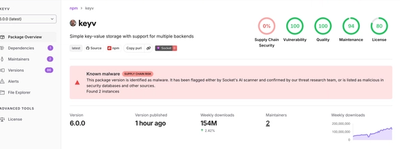
Popular npm packages keyv and cacheable compromised.

Security News
A misconfiguration gave three Anthropic models internet access, and one, believing it was in a simulation, shipped a credential-stealing package to PyPI.