

Company News
AWS Security Hub Adds Socket for Supply Chain Security
Socket is now in the AWS Security Hub Extended plan. Adopt it through AWS, apply committed spend, and block malicious open source packages.
By Feross Aboukhadijeh - Aug 04, 2026
@xxxoooxoxo/wiff
Advanced tools
Deterministic, resumable multi-agent workflows — a harness-agnostic MCP server that orchestrates Codex, Claude, Cursor, and Kimi agents from plain JavaScript, with journaled resume, git worktree isolation, and personas.
Deterministic, resumable multi-agent workflows for Codex,
Claude Code, Cursor, and Kimi, exposed as a harness-agnostic MCP server. Write plain JavaScript with
agent(), /goal stages, parallel(), and pipeline(); wiff runs the children on a pluggable backend
(Codex app-server threads, headless claude or kimi, or the Cursor SDK — chosen per agent
from the model name), journals every step, and resumes interrupted runs without re-paying for
completed work.
At a Codex stage that must keep going until a condition is genuinely met, prefix the agent prompt
with /goal:
phase("Verify and repair");
await agent("/goal Make the unit tests pass and verify the final run.", {
  key: "tests-green",
  sandbox: "workspace-write",
  timeoutMs: 30 * 60 * 1_000,
});
Wiff keeps that Codex thread at the current workflow stage while its goal is active. The workflow advances only when the worker marks the goal complete; blocked or limited goals fail explicitly.
Persistent preferences live in ~/.wiff/config.json, with optional project overrides at
<cwd>/.wiff/config.json. They can provide user instructions, default agent options, ordered
cross-backend fallbackModels, and matching rules that select models or turn phases into /goal
stages. Wiff injects applicable instructions alongside the task and includes the effective
preference decision in the resume-cache identity. See the
workflow API reference for the
schema and precedence rules.
Run the server (any MCP client):
npx @xxxoooxoxo/wiff                      # stdio MCP server: start / status / wait / cancel / models
npx -p @xxxoooxoxo/wiff wiff-viewer       # live web viewer on http://127.0.0.1:4979
Goal stages are marked directly in the workflow graph as queued, active, met, failed, or replayed.
Requires Node >= 22, git for isolation: "worktree", and the runtime of whichever backend
your agents use: Codex CLI >= 0.144.6 for gpt-*/o* models (the default), the claude CLI for
current claude-fable-5/claude-opus-5/claude-sonnet-5/claude-haiku-4-5 models and the
moving fable/opus/sonnet/haiku aliases, or CURSOR_API_KEY plus the bundled
@cursor/sdk for composer-* models, or the kimi CLI for kimi-code/* models. Set
WIFF_BACKEND to route unrecognized models to a specific backend, and WIFF_DEFAULT_MODEL
to change the default model. Agent calls default to medium reasoning effort and a 10-minute
execution timeout; time waiting for a concurrency slot is tracked separately. Wiff-launched
Codex children disable plugins, apps, and configured MCP servers only inside their app-server
process so normal interactive Codex configuration is unchanged.
Full documentation, the workflow script contract, and Codex/Claude Code plugin installs: https://github.com/xxxoooxoxo/wiff
FAQs
Deterministic, resumable multi-agent workflows — a harness-agnostic MCP server that orchestrates Codex, Claude, Cursor, and Kimi agents from plain JavaScript, with journaled resume, git worktree isolation, and personas.
We found that @xxxoooxoxo/wiff demonstrated a healthy version release cadence and project activity because the last version was released less than a year ago. It has 1 open source maintainer collaborating on the project.
Did you know?

Socket for GitHub automatically highlights issues in each pull request and monitors the health of all your open source dependencies. Discover the contents of your packages and block harmful activity before you install or update your dependencies.
Company News
Socket is now in the AWS Security Hub Extended plan. Adopt it through AWS, apply committed spend, and block malicious open source packages.
Research
/Security News
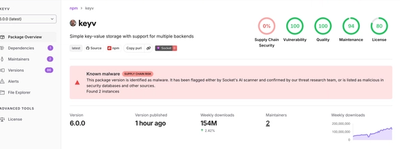
Popular npm packages keyv and cacheable compromised.

Security News
A misconfiguration gave three Anthropic models internet access, and one, believing it was in a simulation, shipped a credential-stealing package to PyPI.