

Company News
AWS Security Hub Adds Socket for Supply Chain Security
Socket is now in the AWS Security Hub Extended plan. Adopt it through AWS, apply committed spend, and block malicious open source packages.
By Feross Aboukhadijeh - Aug 04, 2026
@yault/aesp
Advanced tools
Agent Economic Sovereignty Protocol — defining how AI agents operate economically under human sovereignty
Defining how AI agents operate economically under human sovereignty.
AESP is a TypeScript SDK and MCP integration layer for agent payments under explicit human control. It is designed so that agents can execute economic actions while humans retain full economic sovereignty.
Core principles:
npm install @yault/aesp
Requires Node.js >= 18.
Add the following to your Claude Desktop config (claude_desktop_config.json):
{
  "mcpServers": {
    "yault": {
      "command": "npx",
      "args": ["-y", "@yault/aesp"],
      "env": {
        "YAULT_API_KEY": "sk-yault-..."
      }
    }
  }
}
claude mcp add yault -- npx -y @yault/aesp
Then set the environment variable YAULT_API_KEY in your shell or .claude/settings.json.
export YAULT_API_KEY="sk-yault-..."
yault-mcp                  # if installed globally
npx @yault/aesp            # via npx
Go to yault.xyz to create an account and obtain your API key (sk-yault-*). The key is tied to your vault — each user manages their own key. Agent developers do not need a key unless they are also vault users; it is the end-user who configures their own key in the MCP client.
import { PolicyEngine } from '@yault/aesp/policy';
import { getAllMCPTools } from '@yault/aesp/mcp';
import { NegotiationStateMachine } from '@yault/aesp/negotiation';

const engine = new PolicyEngine(storageAdapter);
await engine.load();

const tools = getAllMCPTools(); // 6 MCP tool definitions
AESP is organized into subpath exports so you can import only what you need:
| Subpath | Description |
|---|---|
@yault/aesp | Unified re-export of all modules |
@yault/aesp/types | Shared type definitions (AgentExecutionRequest, TransferPayload, ChainId, etc.) |
@yault/aesp/policy | Policy engine with 8-check evaluation, budget tracking, and policy change classification |
@yault/aesp/identity | Agent identity derivation, certificate creation, and hierarchy management |
@yault/aesp/negotiation | Offer/counter-offer state machine with session management |
@yault/aesp/commitment | EIP-712 structured commitment builder for dual-signed agreements |
@yault/aesp/review | Human-in-the-loop review queue with freeze/unfreeze controls |
@yault/aesp/mcp | MCP tool definitions, argument validation, and server router |
@yault/aesp/a2a | Agent-card builder for cross-agent discovery (A2A protocol) |
@yault/aesp/crypto | Cryptographic helpers: signing, encryption, hashing, ZK proof bridge |
@yault/aesp/privacy | Context tagging, ephemeral address pools, and consolidation scheduling |
The stdio server exposes 6 backend-connected tools:
| Tool | Method + Endpoint | Purpose |
|---|---|---|
yault_check_balance | GET /api/vault/balance/:address | Read a wallet vault balance |
yault_deposit | POST /api/vault/deposit | Deposit underlying into vault |
yault_redeem | POST /api/vault/redeem | Redeem vault shares |
yault_transfer | POST /api/vault/transfer | Transfer vault allocation (parent to sub-account) |
yault_check_authorization | GET /api/vault/agent-authorization | Read operator/allowance status |
yault_get_balances | GET /api/vault/balances/:address | Read multi-balance breakdown |
The MCP server is a thin API client. It expects a Yault backend providing:
GET /api/vault/balance/:addressGET /api/vault/balances/:addressGET /api/vault/agent-authorizationPOST /api/vault/deposit -- { address, amount }POST /api/vault/redeem -- { address, shares }POST /api/vault/transfer -- { from_address, to_address, amount, currency? }Authentication: Authorization: Bearer sk-yault-* via YAULT_API_KEY env variable.
AESP is built around "bounded autonomy":
For vulnerability reporting, see SECURITY.md.
| Package | Description |
|---|---|
@yault/elizaos-plugin-aesp | ElizaOS plugin wrapping AESP for agent frameworks |
Run tests:
npm test
Build TypeScript:
npm run build:ts
Build with WASM (requires acegf-wallet as a sibling repo, or set ACEGF_ROOT):
npm run build:wasm
npm run build:ts
See CONTRIBUTING.md for the full development guide.
This project is licensed under the Apache License 2.0. See LICENSE for the full text.
FAQs
Agent Economic Sovereignty Protocol — defining how AI agents operate economically under human sovereignty
The npm package @yault/aesp receives a total of 16 weekly downloads. As such, @yault/aesp popularity was classified as not popular.
We found that @yault/aesp demonstrated a healthy version release cadence and project activity because the last version was released less than a year ago. It has 1 open source maintainer collaborating on the project.
Did you know?

Socket for GitHub automatically highlights issues in each pull request and monitors the health of all your open source dependencies. Discover the contents of your packages and block harmful activity before you install or update your dependencies.
Company News
Socket is now in the AWS Security Hub Extended plan. Adopt it through AWS, apply committed spend, and block malicious open source packages.
Research
/Security News
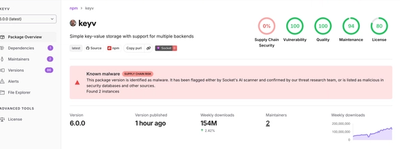
Popular npm packages keyv and cacheable compromised.

Security News
A misconfiguration gave three Anthropic models internet access, and one, believing it was in a simulation, shipped a credential-stealing package to PyPI.