

Company News
AWS Security Hub Adds Socket for Supply Chain Security
Socket is now in the AWS Security Hub Extended plan. Adopt it through AWS, apply committed spend, and block malicious open source packages.
By Feross Aboukhadijeh - Aug 04, 2026
afta-protocol
Advanced tools
Reference implementation of the Agent Fair-Trade Agreement (AFTA): an open standard for API publishers fair to AI agents. Code-enforced no-charge guarantees, Ed25519-signed receipts, transparent pricing, inference-only license.
Canonical home: afta.dev · Source repo: github.com/RipperMercs/afta · Governance: GOVERNANCE.md
Agent Fair-Trade Agreement. AFTA is the open standard for API trade between humans, businesses, and AI agents. As autonomous agents move trillions of micropayments per day across the internet of money, both sides of every paid call need the same thing: a clear, code-enforceable contract that says what was charged, what was delivered, and what either party can dispute. Loose terms break down at agent velocity.
This package is the reference implementation: zero runtime dependencies, runs on Node 20+, Bun, Cloudflare Workers, Deno, and modern browsers.
npm install afta-protocol
AFTA is bilateral by design. The same primitives (code-enforced no-charge guarantees, Ed25519-signed receipts, public freshness SLAs, on-chain settlement) protect agents and publishers in the same handshake.
When an agent calls a paid API that has adopted AFTA, the publisher commits, in code the agent can audit, to four no-charge guarantees:
credits_charged: 0.stale: true.Plus an Ed25519-signed receipt on every paid call, verifiable offline against the publisher's public JWK. No shared secret, no certificate authority, no server round-trip.
The same primitives that protect the agent also protect the business on the other side of the call:
/.well-known/agent-fair-trade.json, and any agent that recognizes the standard already knows how to transact, audit, and verify. No vendor-specific onboarding tax for either side.There is no certification body. Adoption is the certification. Self-publish a /.well-known/agent-fair-trade.json conforming to the schema and you are an AFTA adopter.
Standard manifesto: https://tensorfeed.ai/agent-fair-trade
JSON Schema: https://tensorfeed.ai/.well-known/agent-fair-trade-schema.json (also bundled at afta/schema/agent-fair-trade-schema.json)
npx afta-generate-key --publisher=example.com
Writes the public JWK to ./public/.well-known/example.com-receipt-key.json (commit it). Prints the private JWK to stdout once. Set it as RECEIPT_PRIVATE_KEY_JWK in your runtime secret store. Never commit the private JWK.
import {
  loadSigningKey,
  signReceipt,
  hashRequest,
  hashResponse,
  generateReceiptId,
  tokenShort,
  checkStaleness,
  resolveSLA,
} from "afta-protocol";

const FRESHNESS = {
  "/api/premium/news/search": { maxAgeSeconds: 30 * 60 },
};

const signingKey = await loadSigningKey(process.env.RECEIPT_PRIVATE_KEY_JWK);
if (!signingKey) throw new Error("AFTA: signing key unset");

// Inside your premium handler:
const result = await yourHandler(request);   // includes captured_at
const url = new URL(request.url);
const endpoint = url.pathname;

const staleness = checkStaleness(FRESHNESS, endpoint, result.captured_at);
const noChargeReason = staleness.applies && staleness.stale ? "stale_data" : null;

const core = {
  v: 1 as const,
  id: generateReceiptId(),
  endpoint,
  method: request.method,
  token_short: tokenShort(bearer),
  credits_charged: noChargeReason ? 0 : cost,
  credits_remaining: balanceAfter,
  request_hash: await hashRequest(request.method, url),
  response_hash: await hashResponse(result),
  captured_at: result.captured_at ?? null,
  server_time: new Date().toISOString(),
  no_charge_reason: noChargeReason,
  freshness_sla_seconds: resolveSLA(FRESHNESS, endpoint)?.maxAgeSeconds ?? null,
};

const receipt = await signReceipt({
  core,
  signingKey,
  verifyDoc: "https://example.com/agent-fair-trade#receipts",
});

return Response.json({ ...result, receipt });
import { buildManifest } from "afta-protocol";

const manifest = buildManifest({
  publisher: {
    name: "Example.com",
    url: "https://example.com",
    contact: "contact@example.com",
    manifesto_page: "https://example.com/agent-fair-trade",
  },
  self_description:
    "Example.com is agent fair-trade certified: open pricing, automatic no-charge on 5xx, breaker, schema fail, and stale data, Ed25519-signed receipts on every paid call, inference-only license.",
  freshness_slas: "https://example.com/api/meta",
  receipts: {
    public_key_url: "https://example.com/.well-known/example.com-receipt-key.json",
    verify_doc: "https://example.com/agent-fair-trade#receipts",
  },
  pricing: {
    listed_at: "https://example.com/api/payment/info",
    currency: "USDC",
    network: "eip155:8453",
    network_name: "Base mainnet",
  },
  data_license: { type: "inference-only" },
});

// Serve as /.well-known/agent-fair-trade.json
return new Response(JSON.stringify(manifest, null, 2), {
  headers: { "content-type": "application/json" },
});
import { verifyReceiptSignature } from "afta-protocol";

const publicJwk = await fetch(
  "https://example.com/.well-known/example.com-receipt-key.json",
).then((r) => r.json());

const valid = await verifyReceiptSignature(receipt, publicJwk);
| Export | Purpose |
|---|---|
canonicalJSON(value) | Deterministic JSON serialization. The serialization receipts are signed over. |
CANONICAL_FORM_ID | Constant: "afta-canonical-json-v1". |
hashRequest(method, url) | sha256 of METHOD path?canonicalQuery. |
hashResponse(result) | sha256 of canonical JSON of the response body. |
tokenShort(token) | Non-PII short reference of a bearer token. |
generateReceiptId() | rcpt_<16hex>. |
loadSigningKey(jwk) | Import a private JWK to a signing CryptoKey. |
signReceipt({core, signingKey, verifyDoc}) | Produce a SignedReceipt. |
verifyReceiptSignature(signed, publicJwk) | true iff the receipt verifies. |
resolveSLA(registry, path) | Look up freshness SLA for an endpoint (with prefix matching). |
checkStaleness(registry, endpoint, capturedAt) | Is this response stale relative to the SLA? |
describeSLAs(registry, reasons) | Public-facing array shape for /api/meta. |
buildManifest(config, options) | Build the /.well-known/agent-fair-trade.json document. |
Current AFTA adopters:
If you adopt AFTA, open a PR to add yourself to the list. There is no fee, no review process, no certification authority. Self-publish a conforming manifest, cite the code that enforces each guarantee, and you are in.
The first wave of agent-paid APIs is shipping right now, mostly under terms-of-service contracts written for human users. Both sides feel it. Agents have no way to verify a 500 didn't cost them a credit, no way to audit a publisher's freshness claims, no recourse when a publisher silently changes the rules. Publishers have no way to defend against bad-faith billing disputes, no way to prove a charge was legitimate after the fact, no way to ship paid endpoints without exposing themselves to ambiguous "your API double-billed me" complaints. Neither side can audit the other's behavior at the cryptographic level.
AFTA is what we built when we asked: what would it look like if the contract between an agent and a publisher were enforced in code instead of policy, with cryptographic attestation instead of "trust us"? Both sides gain something concrete. Agents get verifiable charges and bounded loss. Publishers get a public record that defends them when accused of mis-billing.
It is intentionally a small standard. It does not solve identity, attribution, anti-abuse, or liability. It solves the narrowest, most concrete piece: every paid call between an agent and a publisher should be verifiable by either party at any point in the future. Everything else can compose on top.
AFTA's governance is small and capture-resistant by design. See GOVERNANCE.md for the full document. Key principles:
MIT. The standard is open. The schema is open. This implementation is open. Use it, fork it, port it to other languages, ship it.
PRs welcome, especially:
afta-cloudflare-worker, afta-fastapi)The build trail is in the git log. AFTA was designed by Ripper in collaboration with Claude (Anthropic).
FAQs
Reference implementation of the Agent Fair-Trade Agreement (AFTA): an open standard for API publishers fair to AI agents. Code-enforced no-charge guarantees, Ed25519-signed receipts, transparent pricing, inference-only license.
We found that afta-protocol demonstrated a healthy version release cadence and project activity because the last version was released less than a year ago. It has 1 open source maintainer collaborating on the project.
Did you know?

Socket for GitHub automatically highlights issues in each pull request and monitors the health of all your open source dependencies. Discover the contents of your packages and block harmful activity before you install or update your dependencies.
Company News
Socket is now in the AWS Security Hub Extended plan. Adopt it through AWS, apply committed spend, and block malicious open source packages.
Research
/Security News
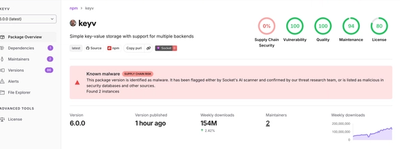
Popular npm packages keyv and cacheable compromised.

Security News
A misconfiguration gave three Anthropic models internet access, and one, believing it was in a simulation, shipped a credential-stealing package to PyPI.