
Research
/Security News
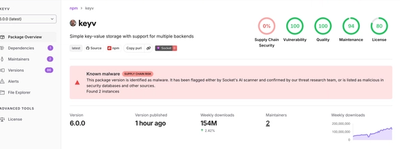
Popular npm Packages in the keyv and Cacheable Namespaces Compromised in Active Supply Chain Attack
Popular npm packages keyv and cacheable compromised.
By Socket Research Team - Aug 04, 2026
agent-traffic-classifier
Advanced tools
Classify web traffic into humans, bots, AI agents, and programmatic clients from access logs and HTTP header signals


Classify web server traffic into humans, bots, AI agents, and programmatic clients. Built for analyzing access logs and HTTP header signals to understand how AI agents interact with your site.
Status: Early development (0.x) This library is currently in early iteration and does not promise stability guarantees.
Given access log entries (and optionally HTTP header signals), the library:
npm install agent-traffic-classifier
The simplest usage: parse Apache access logs, classify, and aggregate.
import {
  parseLine,
  createClassifier,
  createFilter,
  reclassifyEntries,
  aggregate,
} from 'agent-traffic-classifier';
import type { LogEntry } from 'agent-traffic-classifier';

const classify = createClassifier();
const shouldSkip = createFilter();

// Parse log lines into entries
const lines = [
  '1.1.1.1 - - [04/Apr/2026:10:00:00 -0700] "GET /about/ HTTP/1.1" 200 5000 "https://google.com" "Mozilla/5.0 Chrome/120"',
  '2.2.2.2 - - [04/Apr/2026:10:00:01 -0700] "GET /about/ HTTP/1.1" 200 5000 "-" "GPTBot/1.0"',
  '3.3.3.3 - - [04/Apr/2026:10:00:02 -0700] "GET / HTTP/1.1" 200 3000 "-" "curl/7.68.0"',
];

const entries: LogEntry[] = lines.map((line) => parseLine(line)).filter((e) => e !== null);

// Classify (no signal data, so pass null for seeds)
const classified = reclassifyEntries(entries, null, classify);

// Aggregate into daily summaries
const docs = aggregate(classified, {
  domain: 'example.com',
  tzOffsetMinutes: -420, // PDT
  shouldSkip,
});

// docs[0].summary.byCategory => { human: {...}, 'ai-crawler': {...}, programmatic: {...} }
For deeper agent detection, capture HTTP headers from requests that exhibit agent-like behavior (content negotiation, llms.txt requests, etc.) and feed them as signal entries. Combined with IP intelligence, this lets the library identify agents that use standard browser user-agents and attribute unidentified traffic to suspected services.
import {
  parseLine,
  createClassifier,
  createFilter,
  createSignalClassifier,
  createCountryLookup,
  createCloudProviderLookup,
  buildSessionProfiles,
  buildAgentSeeds,
  reclassifyEntries,
  detectDuplicateRequestAgents,
  crossReferenceSignalIps,
  aggregate,
} from 'agent-traffic-classifier';
import type { LogEntry, SignalEntry } from 'agent-traffic-classifier';

const classify = createClassifier();
const shouldSkip = createFilter();

// Initialize IP intelligence (async, fetches public range data once)
const countryLookup = await createCountryLookup(['CN']); // Only fetch ranges for countries you need
const cloudLookup = await createCloudProviderLookup(); // Google, AWS, Cloudflare ranges

const { classifySignalEntry, getSignalSummary } = createSignalClassifier({
  ipLookup: (ip) => {
    const info: Record<string, string> = {};
    const country = countryLookup(ip);
    if (country) info.country = country;
    const provider = cloudLookup(ip);
    if (provider) info.cloudProvider = provider;
    return info;
  },
});

// Parse access log entries
const entries: LogEntry[] = logLines.map((line) => parseLine(line)).filter((e) => e !== null);

// Signal entries from your capture mechanism (middleware, edge function, etc.)
const signalEntries: SignalEntry[] = [
  {
    ip: '5.5.5.5',
    timestamp: 1743789604, // Unix epoch seconds
    domain: 'example.com',
    headers: { 'User-Agent': 'Claude-User/1.0' },
    trigger: 'content-negotiation',
  },
];

// Build agent seeds from signals and reclassify access log entries
const seeds = buildAgentSeeds(signalEntries, classifySignalEntry);
const domainSeeds = seeds.get('example.com') ?? null;
const classified = reclassifyEntries(entries, domainSeeds, classify);

// Build per-IP session profiles (static assets + self-site referrers)
// to suppress false-positive "Cursor (suspected)" during traffic spikes
const sessionProfiles = buildSessionProfiles(classified, 'example.com');

// Detect proxy-based agents (e.g., Cursor's duplicate-request pattern)
const withDuplicates = detectDuplicateRequestAgents(classified, { sessionProfiles });

// Upgrade programmatic clients that share IPs with known agent signals
const withCrossRef = crossReferenceSignalIps(
  withDuplicates,
  signalEntries,
  'example.com',
  classifySignalEntry,
);

// Aggregate with signal summary
const docs = aggregate(withCrossRef, {
  domain: 'example.com',
  tzOffsetMinutes: -420,
  shouldSkip,
  signalEntries,
  classifySignalEntry,
  getSignalSummary,
});
The library operates on format-agnostic LogEntry and SignalEntry interfaces. The Apache parser is a convenience adapter; you can construct entries from any source:
import type { LogEntry, SignalEntry } from 'agent-traffic-classifier';

// From nginx JSON logs, CDN exports, middleware, etc.
const entry: LogEntry = {
  ip: '1.2.3.4',
  timestamp: 1743789600, // Unix epoch seconds (UTC)
  method: 'GET',
  path: '/about/',
  status: 200,
  size: 5000,
  referrer: null,
  userAgent: 'Mozilla/5.0 ...',
};
Every request is classified into one of these categories:
| Category | Description |
|---|---|
human | Regular browser traffic |
agent | AI coding agents (Claude Code, Claude Agent, Cursor, Kiro, GitHub Copilot, Gemini CLI, MCP clients) |
ai-crawler | AI training data crawlers (GPTBot, ClaudeBot, etc.) |
ai-assistant | AI assistants fetching live content (ChatGPT-User, GoogleAgent-URLContext) |
ai-search | AI-powered search engines (PerplexityBot, OAI-SearchBot, Kagibot) |
search-crawler | Traditional search engines (Googlebot, Bingbot) |
seo-bot | SEO/marketing bots (AhrefsBot, SemrushBot) |
monitoring | Uptime monitors (UptimeRobot, Pingdom) |
social-preview | Link preview fetchers (Twitterbot, Slackbot, Mastodon, WhatsApp) |
feed-reader | Feed readers and news apps (FreshRSS, Feedly, HackerNews app) |
programmatic | HTTP clients (curl, axios, python-requests, httpx, trafilatura) |
other-bot | Bots detected by isbot but not in the curated list |
unknown | Empty or missing user-agent |
Classification priority: curated bot list > programmatic client heuristic > isbot fallback > human.
When HTTP header signals are available, the library applies a chain of heuristics to identify agents that use standard browser user-agents. The chain is ordered by specificity (first match wins):
Claude-User), Claude Agent (Claude-Agent), Gemini CLI (Google-Gemini-CLI), markdown.newBaggage headerX-Conversation-Id or X-Conversation-Request-Id are definitively agent headersSec-Ch-Ua (a header real Chrome always sends)content-negotiation, llms-txt) but no heuristic match are classified as "unidentified"All heuristics are exported individually so you can reorder, replace, or extend the chain.
The library includes adapters for IP-to-country and IP-to-cloud-provider lookups. These are optional, async-init, sync-lookup: you call the async factory once at startup, and it returns a synchronous lookup function.
import {
  createCountryLookup,
  createCloudProviderLookup,
  createIpLookup,
  buildCidrIndex,
} from 'agent-traffic-classifier';

// Country lookup from RIR delegation data (fetches from APNIC, RIPE, etc.)
const countryLookup = await createCountryLookup(['CN', 'RU']);

// Cloud provider lookup (fetches published ranges from Google, AWS, Cloudflare)
const cloudLookup = await createCloudProviderLookup();

// Combined convenience factory
const ipLookup = await createIpLookup({
  countries: ['CN'],
  cloudProviders: true,
});

// Or build your own CIDR index for custom ranges
const customIndex = buildCidrIndex([
  { cidr: '10.0.0.0/8', tag: 'internal' },
  { cidr: '172.16.0.0/12', tag: 'internal' },
]);
const tag = customIndex('10.1.2.3'); // => 'internal'
The IpLookup interface ((ip: string) => IpInfo) can be implemented with any data source. The built-in adapters are convenience layers; pass your own function if you have a different IP intelligence source.
Every module uses a factory function that accepts an options object. All options have sensible defaults. Each option replaces (not merges with) its default, so spread the default if you want to extend.
import { createClassifier, defaultBotDb } from 'agent-traffic-classifier';

const classify = createClassifier({
  // Prepend custom bots (checked first due to priority ordering)
  bots: [
    { pattern: 'MyBot', name: 'MyBot', company: 'Me', category: 'ai-crawler' },
    ...defaultBotDb.bots,
  ],
  // Add custom programmatic client patterns
  programmaticClients: ['my-http-lib', ...DEFAULT_PROGRAMMATIC],
});
The filter determines which requests are counted in aggregation. Requests matching skip patterns are excluded from all stats (category counts, top paths, referrers, status codes).
import { createFilter, DEFAULT_SKIP_SUBSTRINGS } from 'agent-traffic-classifier';

const shouldSkip = createFilter({
  // Extend default substrings with site-specific patterns
  skipSubstrings: [...DEFAULT_SKIP_SUBSTRINGS, '-staging-'],
  // Per-site paths (empty by default)
  siteSkipPaths: ['/old-section/'],
});
The default substrings cover common vulnerability scanner probes (wp-admin, phpinfo, .git/, .ssh/, .aws/, xmlrpc, _profiler, etc.) using substring matching, so they catch all prefix variants at once (e.g., /wp/wp-admin/, /blog/wp-admin/, /old/wp-admin/).
import {
  createSignalClassifier,
  DEFAULT_KNOWN_AGENTS,
  DEFAULT_HEURISTICS,
} from 'agent-traffic-classifier';

const { classifySignalEntry, getSignalSummary } = createSignalClassifier({
  // Add a new known agent UA pattern
  knownAgents: [{ pattern: 'MyAgent', name: 'My Agent', company: 'Me' }, ...DEFAULT_KNOWN_AGENTS],
  // Add a custom header-based heuristic
  heuristics: [
    (entry, ipInfo) => {
      if (entry.headers?.['X-My-Agent']) {
        return { isAgent: true, name: 'MyAgent', company: 'Me' };
      }
      return null;
    },
    ...DEFAULT_HEURISTICS,
  ],
  // Optional IP intelligence for country/cloud attribution
  ipLookup: (ip) => ({ country: 'US' }),
});
import { buildSessionProfiles, detectDuplicateRequestAgents } from 'agent-traffic-classifier';

// Build session profiles from the full (unfiltered) classified entries.
// This checks each IP for static asset requests and self-site referrers,
// which are strong indicators of real browser sessions.
const sessionProfiles = buildSessionProfiles(classified, 'example.com');

const result = detectDuplicateRequestAgents(classified, {
  windowSeconds: 120, // Signal seed matching window (default: 60)
  proxyWindowSeconds: 5, // Duplicate-request pairing window (default: 2)
  proxyAgent: {
    // Override the default Cursor identity
    name: 'Windsurf',
    company: 'Codeium',
    suspectedName: 'Windsurf (suspected)',
  },
  // Suppress false-positive "suspected" labels when both IPs in a
  // duplicate pair have browser-like sessions (static assets + self-referrers)
  sessionProfiles,
});
import { aggregate } from 'agent-traffic-classifier';

const docs = aggregate(classified, {
  domain: 'example.com',
  tzOffsetMinutes: -420,
  shouldSkip, // Entries matching this filter are excluded from all stats
  topPathsLimit: 100, // Max top paths per day (default: 50)
  topItemPathsLimit: 20, // Max top paths per bot/agent (default: 10)
  topReferrersLimit: 50, // Max referrers per day (default: 30)
  topPathsSkipCategories: ['seo-bot', 'other-bot'], // Categories excluded from top paths
  normalizePath: (raw) => ({
    // Custom path normalization
    path: raw.toLowerCase(),
    utmSource: null,
  }),
});
parseLine(line) -- Parse an Apache Combined Log Format line into a LogEntryreadLogFiles(dir) -- Read and parse .log and .log.gz files from a directoryparseApacheTs(raw) -- Convert an Apache timestamp string to Unix epoch secondsparseApacheTzOffset(raw) -- Extract timezone offset in minutes from an Apache timestampparseSignalLog(dir) -- Parse JSONL signal log files from a directory into SignalEntry[]createClassifier(options?) -- Returns (userAgent: string) => ClassifyResultcreateFilter(options?) -- Returns (entry: LogEntry) => boolean (true = skip)createSignalClassifier(options?) -- Returns { classifySignalEntry, getSignalSummary }buildSessionProfiles(entries, domain) -- Build per-IP session profiles (static assets, self-site referrers) for false-positive suppressionbuildAgentSeeds(signalEntries, classifySignalEntry) -- Build agent seeds grouped by domainreclassifyEntries(entries, domainSeeds, classifyFn, options?) -- Reclassify access log entries using signal seedsdetectDuplicateRequestAgents(entries, options?) -- Detect proxy-based agents via duplicate-request heuristiccrossReferenceSignalIps(entries, signalEntries, domain, classifySignalEntry) -- Upgrade programmatic entries to agent when their IP appears in signal datacreateIpLookup(options?) -- Combined country + cloud provider lookup factorycreateCountryLookup(countries) -- Country lookup from RIR delegation datacreateCloudProviderLookup(options?) -- Cloud provider lookup from published rangesbuildCidrIndex(entries) -- Build a CIDR lookup index from custom rangesparseIpv4(ip), parseCidr(cidr), matchesCidr(ip, cidr) -- Low-level IPv4 utilitiesaggregate(entries, options) -- Aggregate classified entries into DaySummary[]normalizePath(rawPath) -- Normalize URL paths (trailing slashes, utm_source extraction)extractDateKey(epochSeconds, tzOffsetMinutes) -- Convert epoch + offset to YYYY-MM-DD date stringAll defaults are exported so you can extend them:
import {
  // Bot database
  defaultBotDb,
  // Programmatic clients
  DEFAULT_PROGRAMMATIC,
  DEFAULT_EXACT_PROGRAMMATIC,
  // Agent detection
  DEFAULT_KNOWN_AGENTS,
  DEFAULT_DEV_TOOLS,
  DEFAULT_AGENT_TRIGGERS,
  DEFAULT_HEURISTICS,
  SUSPECTED_AGENTS,
  DEFAULT_ACCEPT_TAXONOMY,
  // Individual heuristics
  sentryBaggageHeuristic,
  cursorHeuristic,
  chrome122Heuristic,
  conversationTrackingHeuristic,
  markdownMimeHeuristic,
  acceptTaxonomyHeuristic,
  missingBrowserHeadersHeuristic,
  // Skip patterns
  DEFAULT_SKIP_EXTENSIONS,
  DEFAULT_SKIP_PATHS,
  DEFAULT_SKIP_PREFIXES,
  DEFAULT_SKIP_SUBSTRINGS,
  // Session config
  DEFAULT_WINDOW_SECONDS,
  DEFAULT_PROXY_WINDOW_SECONDS,
  CURSOR_PROXY_AGENT,
  // Aggregation
  DEFAULT_TOP_PATHS_SKIP_CATEGORIES,
  DEFAULT_TOP_ITEM_PATHS_LIMIT,
  // Category constants
  CATEGORY_HUMAN,
  CATEGORY_AGENT,
  CATEGORY_FEED_READER,
  CATEGORY_PROGRAMMATIC,
  CATEGORY_OTHER_BOT,
  CATEGORY_UNKNOWN,
  AI_CATEGORY_PREFIX,
  UNIDENTIFIED_AGENT,
} from 'agent-traffic-classifier';
MIT
FAQs
Classify web traffic into humans, bots, AI agents, and programmatic clients from access logs and HTTP header signals
We found that agent-traffic-classifier demonstrated a healthy version release cadence and project activity because the last version was released less than a year ago. It has 1 open source maintainer collaborating on the project.
Did you know?

Socket for GitHub automatically highlights issues in each pull request and monitors the health of all your open source dependencies. Discover the contents of your packages and block harmful activity before you install or update your dependencies.
Research
/Security News
Popular npm packages keyv and cacheable compromised.

Security News
A misconfiguration gave three Anthropic models internet access, and one, believing it was in a simulation, shipped a credential-stealing package to PyPI.

Security News
/Company News
Socket has joined the new Composer and Packagist sponsorship program as a launch sponsor, supporting the team that keeps PHP's package ecosystem secure.