


Research
/Security News
Popular npm Packages in the keyv and Cacheable Namespaces Compromised in Active Supply Chain Attack
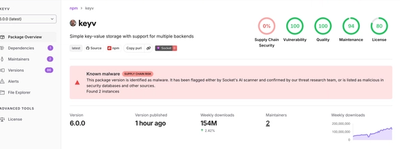
Popular npm packages keyv and cacheable compromised.
By Socket Research Team - Aug 04, 2026
agentic-os-mcp
Advanced tools
MCP server serving the agentic-os governance, SDLC, and QE methodology. Read-only.




Read-only MCP server for the agentic-os methodology: governance (agentic-os), the SDLC pipeline (agentic-sdlc), and Quality Engineering blueprints (agentic-qe).
agentic-os puts guardrails on AI coding agents — what files they may touch, when they must stop and ask a human, and how their work gets independently reviewed before anything is committed. On top of that, agentic-sdlc is an optional pipeline that carries a ticket from idea → spec → plan → tested code → review-ready pull request, and agentic-qe is a catalog of Quality-Engineering blueprints. There are role setups for developers, QA, architects, DevOps, business analysts, and project/portfolio managers.
This MCP server hands that whole methodology — the docs, a per-role install plan, the QE catalog, and an install auditor — to any MCP-capable assistant, not just the Claude Code / Cursor plugins. So you can explore agentic-os, plan an install, or audit an existing one from wherever your assistant runs.
It serves knowledge, not actions. Every tool is read-only — the server never writes to your repository. It gives your assistant the documents and the plan; your assistant performs any file writes, so you review each one. To actually run the governed pipeline or scaffold files into a repo, install the plugins (see the main README).
Claude Code:
claude mcp add agentic-os -- npx -y agentic-os-mcp
Codex:
codex mcp add agentic-os -- npx -y agentic-os-mcp
VS Code — one-click:
or from the command line:
code --add-mcp '{"name":"agentic-os","command":"npx","args":["-y","agentic-os-mcp"]}'
Cursor — one-click:
or add to .cursor/mcp.json directly, same as Claude Desktop's
claude_desktop_config.json:
{ "mcpServers": { "agentic-os": { "command": "npx", "args": ["-y", "agentic-os-mcp"] } } }
You don't call these tools yourself — your assistant does, when you ask in plain language. A typical exchange:
You: "Search the agentic-os methodology for how to run a code review."
Assistant: calls
search_methodology→ gets rankedagentic-os://URIs → callsget_documenton the top hit → summarizes thecode-reviewskill for you.
Start with search_methodology (find the right document) and get_document
(read it). The other five tools list the presets, phases, and blueprints, turn a
role into an install plan, or audit an existing install — see the examples below.
Real things to ask your assistant once the server is connected. Each role is a
preset; list_presets shows all ten with their human-in-the-loop mode.
| Role | Ask your assistant | Tools it triggers | What you get |
|---|---|---|---|
| Developer | "Walk me through the agentic-sdlc pipeline, then plan a developer install." | list_sdlc_phases, plan_install | the 13-phase spec → plan → TDD → review → PR map, plus an ordered file manifest (stack-aware generator agents, blind + security review, QA gates) |
| QA | "What QE blueprints do you have for the execution stage?" | list_qe_blueprints | the QE catalog (28 blueprints across 6 STLC stages) — e.g. coverage-analysis, flaky-debugging — to scaffold a test framework from |
| Architect | "How does the blind pre-commit review gate work?" | search_methodology → get_document | the governance doc itself — the instruction-quality rubric, review gates, and patterns |
| DevOps | "What does the devops role set up, and how does MR-watch fix CI?" | list_presets, get_document | the devops preset (git hooks, PR pipeline gate) and the mr-watch skill that monitors merge requests and auto-fixes CI until they merge |
| BA / PO | "How do I turn a ticket into requirements with agentic-sdlc?" | search_methodology, get_document | the requirements-intake / product-owner method — a story with acceptance criteria and an early complexity read (no code) |
| PM / delivery | "What's the PR-gate and status workflow for a delivery manager?" | list_presets, get_document | the pm-delivery preset — ticket/MR adapters, a PR pipeline gate, mr-watch, and status conventions |
| Portfolio | "What cross-project oversight does the portfolio role give?" | list_presets, get_document | run status, repo/knowledge-health audits, and durable cross-session memory — read/report-only, no git footprint |
| Security | "What does the security preset enforce when I threat-model a feature?" | list_presets, get_document | the threat-modeler contract + threat-modeling guide — DFD-first STRIDE with per-element constraints, severities proposed — owner confirmation pending, writes only docs/security/ |
| Data | "What are the standards for designing a pipeline with quality checks?" | list_presets, get_document | the pipeline-designer contract + data-pipeline-design guide — counted row-math equations, force-tested DQ checks, lineage, recommend-only queries |
| Design | "What must an agent-ready design handoff contain?" | list_presets, get_document | the experience-designer contract + experience-design guide — emotion-annotated journeys, decision-closing workshops, verbatim negative ACs, the context+spec pair |
plan_install turns any of these roles into an ordered file manifest; you (or
your assistant, with your review) apply it. To run the pipeline or scaffold the
files for real, install the plugins — see the main README.
| Tool | Purpose |
|---|---|
search_methodology | Find the right document. Start here. |
get_document | Fetch one document by its agentic-os:// URI. |
list_presets | List the agentic-os role presets with HITL default, orchestration mode, and SDLC skills. |
list_qe_blueprints | List the agentic-qe Quality Engineering blueprints, filterable by STLC stage. |
list_sdlc_phases | List the agentic-sdlc pipeline phase map with its judgment gates. |
plan_install | Compose one or more role presets into an ordered file manifest (a plan; you perform the writes). |
run_doctor | Audit an agentic-os install in a target repo you name. |
The tool surface is deliberately capped at 8 tools. Agent tool-selection accuracy degrades sharply as the number of available tools grows — research shows the performance cliff occurs around 30–40 tools, and real deployments (e.g., GitHub's MCP server) report measurable gains (2–5 points on SWE-Lancer and SWEbench-Verified, plus ~400ms lower latency) after cutting from ~40 tools to 13. The current surface exposes seven tools, one short of the cap.
run_doctor's split verdictrun_doctor audits .agentic/agentic-os/install.json and the files it
journals in a target repo you name, through a reader (mcp/src/target.ts)
gated by root containment rather than the bundle's build-time index — see
SECURITY.md for exactly how that gate works and the one
accepted risk it documents. It verdicts what it can inspect natively as
plain file reads, and returns everything else as host_must_run: exact
commands for three checks that require executing Python (hook
compile+import, canned-event dry-runs, HITL smoke) — the server never runs
them itself.
Because of that split, verdict: "incomplete" is the expected,
correct result of a server-side-only run, not a sign that something went
wrong. verdict is "passed" only when every native check passed and
host_must_run is empty (i.e., your host actually ran the returned
commands and folded their results back in); it is "incomplete" whenever
host_must_run still has entries, and "failed" only when a native check
itself found a real problem. A reader who sees "incomplete" on its own
should read it as "native checks passed; three checks are still owed to
the host," not as a failure. host_must_run is never empty on a single
server-side call, so this server alone never returns "passed".
A host that automatically runs host_must_run's commands writes to the
target repo, even though the server itself never does. Two of the three
command sets do: dry_runs creates .agentic/agents/__agentic_doctor_probe__.md
(a one-line dummy contract, to exercise instruction_gate.py's
never-graded case) and deletes it in the next command, unconditionally;
hitl_smoke creates a temporary working directory outside the target repo
(via mktemp -d) holding synthetic transcript files, removed automatically
on exit by a shell trap. Both are the doctor's real, documented
procedure — nothing here is left behind — but it means the "read-only"
claim above is a property of this server's own code, not of what happens
if a host executes what run_doctor hands back. See each host_must_run
entry's why field for the exact commands.
31 agentic-os://skills/<plugin>/<skill> resources, one per SKILL.md
across the three plugins, plus a resource template,
agentic-os://file/{+path}, that serves any other file shipped by a plugin
that is tracked in content-index.json — not just markdown, JSON, or text:
template sources (.md.tmpl/.json.tmpl/.py.tmpl), plain hook scripts
(.py/.sh and six extensionless git hooks), and a long tail of one-off
files (sdlc.html, scaffold.ps1, run-hook.cmd, .ts/.mts sources,
.shellcheckrc, *.md.template repo-guide templates) are all servable too
(e.g. agentic-os://file/agentic-sdlc/agents/guide-sync.md). Index
membership is the entire access-control model — see mcp/src/content.ts.
The template is the primary integration point for clients that want to reach
content beyond the curated skill list.
Two families of shorter canonical aliases resolve to the same content:
agentic-os://presets/{role} for a role preset and
agentic-os://qe/blueprints/{stage}/{id} for a QE blueprint. list_presets
and list_qe_blueprints return these aliases as each item's uri, and
search_methodology returns the blueprint alias for a blueprint hit — it
searches markdown documents only, so a preset (JSON) can never be a
search_methodology result in the first place. Both alias forms, and the
plain file/ form, always resolve via get_document or a direct resource
read.
Ready-made entry points your assistant can offer by name:
| Prompt | What it does |
|---|---|
agentic-init | Interview to set up the governance guardrails in your repo |
agentic-doctor | Verify an existing agentic-os install is healthy |
agentic-upgrade | Upgrade the installed templates to a newer version |
sdlc-start | Run the governed SDLC pipeline on a task, stopping at human gates |
sdlc-task | Lightweight SDLC flow for a small (XS/S/M) task |
qe-blueprint-scaffold | Scaffold a fill-in-ready QE agent framework from a blueprint |
See CHANGELOG.md.
Maintainer-only. See RELEASE.md for the one-time setup and per-release runbook.
Node >= 20.
npm install
npm run build   # build:content (indexes plugins/ + copies dist/content) + build:ts
npm test        # vitest — requires the build above, since the content layer reads dist/content
npx -y agentic-os-mcp is the supported install path; the Dockerfile
at the repository root exists for MCP directories that introspect a server by
building and running it in a sandbox. It is equivalent, not an alternative to
recommend.
Build from the repository root, never from mcp/ — the content build reads
plugins/**, the root LICENSE/NOTICE, and git ls-files:
docker build -t agentic-os-mcp .
The server speaks JSON-RPC over stdio, so -i is required and -t must not be
used (a TTY corrupts the stream):
docker run --rm -i agentic-os-mcp
FAQs
MCP server serving the agentic-os governance, SDLC, and QE methodology. Read-only.
We found that agentic-os-mcp demonstrated a healthy version release cadence and project activity because the last version was released less than a year ago. It has 1 open source maintainer collaborating on the project.
Did you know?

Socket for GitHub automatically highlights issues in each pull request and monitors the health of all your open source dependencies. Discover the contents of your packages and block harmful activity before you install or update your dependencies.
Research
/Security News
Popular npm packages keyv and cacheable compromised.

Security News
A misconfiguration gave three Anthropic models internet access, and one, believing it was in a simulation, shipped a credential-stealing package to PyPI.

Security News
/Company News
Socket has joined the new Composer and Packagist sponsorship program as a launch sponsor, supporting the team that keeps PHP's package ecosystem secure.