

Product
PHP and Composer Support Is Now in Beta
Socket’s PHP and Composer support is now in Beta for all customers, with PHP reachability analysis generally available.
By Trevor Norris, Benjamin Barslev - Aug 21, 2026
agentstack-mcp
Advanced tools
AgentStack MCP — one deterministic reasoning stack for AI agents: simulate (ScenarioSim) + decide (DecisionMatrix) + compute (PrecisionCalc) with cross-domain composite tools. Runs over stdio (npx) or as a remote server.
One deterministic reasoning stack for AI agents — behind a single Model Context Protocol (MCP) endpoint and one API key:
simulate (ScenarioSim) → decide (DecisionMatrix) → compute (PrecisionCalc)
plus cross-domain composite tools that chain the three. Every number runs
through decimal.js at 40-digit precision
(never floats), so identical inputs always produce byte-identical output.
The server is stateless — no database, no sessions.
AgentStack bundles three standalone MCP servers so an agent installs one server, uses one key, and can run reasoning that spans all three domains. It imports the same engines directly (no HTTP proxying) — zero added latency, no cascading failure.
https://agentstack-mcp.pages.dev/mcp
{ "mcpServers": { "agentstack": {
    "type": "http", "url": "https://agentstack-mcp.pages.dev/mcp" } } }
Free tier: no key, 20 calls/day per IP. Paid plans (Starter $19/mo · 8,000/day,
Pro $59/mo · 80,000/day) return an API key sent as X-API-Key. One key covers
all three products and the composites — about half the cost of subscribing to them
separately. Landing page: https://agentstack-mcp.pages.dev.
| namespace | engine | tools |
|---|---|---|
sim_* | ScenarioSim — what-if / scenario simulation | sim_run, sim_sensitivity, sim_break_even, sim_compare, sim_list_templates |
decide_* | DecisionMatrix — multi-criteria decision analysis | decide, decide_score, decide_sensitivity, decide_compare_two, decide_list_methods |
calc_* | PrecisionCalc — exact finance/business math | calc_metric, calc_list_metrics, calc_currency_convert, calc_business_days, calc_compound_growth, calc_npv, calc_irr, calc_loan_amortization, calc_depreciation |
| meta | — | list_capabilities, health_check |
Note on two deliberately-namespaced collisions:
sim_sensitivityvaries scenario inputs;decide_sensitivityvaries criteria weights. They are different operations — the prefix disambiguates them for the agent.
Deterministic end-to-end; each chains engines that no single server bundles:
| Tool | Pipeline | What it does |
|---|---|---|
plan_to_valuation | simulate → compute | Project a scenario, take a per-period cash-flow line (cashflow_metric), and value it: NPV at a discount rate, IRR, undiscounted total. initial_investment becomes the period-0 outflow (needed for IRR). |
evaluate_options_with_scenarios | simulate → decide | Project each option as its own scenario, then rank the options against weighted criteria drawn from the scenario outcomes (key_results). |
stress_test_decision | simulate × decide | Stress one scenario assumption across every option and report how often the baseline winner survives (robustness) and where it flips. |
Composite responses report the pipeline they ran and carry each stage's
structured output, so an agent can drill into any step.
Append ?profile= to the endpoint to load only a subset:
| profile | tools |
|---|---|
all (default) | every tool (24) |
finance | calc_* + plan_to_valuation + meta |
decision | decide_* + evaluate_options_with_scenarios + stress_test_decision + meta |
simulation | sim_* + all composites + meta |
{ "mcpServers": { "agentstack": {
    "url": "https://agentstack-mcp.pages.dev/mcp?profile=finance" } } }
Namespaced tools return the exact envelope of their underlying product. Composite
tools add composite, pipeline, per-stage blocks, methodology, notes, and a
plain-language explanation. Errors are always structured data:
{ "status": "error", "error": { "type": "unknown_metric", "message": "...", "hint": "..." } }
Example — plan_to_valuation (trimmed):
{
  "status": "success",
  "composite": "plan_to_valuation",
  "pipeline": ["scenariosim.run_scenario", "precisioncalc.net_present_value", "precisioncalc.internal_rate_of_return"],
  "scenario": { "template": "saas_growth", "horizon": 12, "key_results": { "ending_mrr": 26982.1 } },
  "cashflow_metric": "mrr",
  "cashflows": [-150000, 14040, 15600, "..."],
  "valuation": { "discount_rate": 0.01, "npv": 11157.386023, "irr": 0.02504, "value_creating": true },
  "explanation": "Projecting 'saas_growth' over 12 month(s) and valuing the 'mrr' stream at 1%/period gives an NPV of ..."
}
agentstack-mcp/
├── worker-src/
│   ├── index.mjs           # Cloudflare Pages Function: MCP transport, namespacing, profiles, billing
│   ├── composites.mjs      # the 3 cross-domain tools (simulate -> decide -> compute)
│   ├── billing.mjs         # Stripe + KV: one key / one quota for the whole stack
│   └── engines/            # vendored, unmodified product engines (100% deterministic)
│       ├── scenariosim.mjs
│       ├── decisionmatrix.mjs
│       └── precisioncalc.mjs
├── server.mjs              # local stdio MCP server (same engines + composites; AGENTSTACK_PROFILE env)
├── site/                   # landing page + mcp.json + llms.txt + _worker.js (built)
├── tests/composites.test.mjs
├── examples/agent_example.mjs
├── scripts/sync-engines.sh # re-vendor engines from the sibling repos
├── package.json · wrangler.toml · server.json · smithery.yaml · Dockerfile · LICENSE
└── README.md
Why vendor the engines? So this repo is self-contained and reproducible. The
engines are the same deterministic modules that power the three standalone
servers; npm run sync-engines re-copies them from the sibling repos when an
upstream change lands.
git clone <your-fork> agentstack-mcp && cd agentstack-mcp
npm install
npm test                      # composite-logic tests (no network)
npm run dev                   # -> http://127.0.0.1:8788/mcp
node examples/agent_example.mjs            # hosted demo
node examples/agent_example.mjs http://127.0.0.1:8788
node server.mjs               # dependency-light stdio server (AGENTSTACK_PROFILE=finance to subset)
Quick manual call:
curl -s http://127.0.0.1:8788/mcp \
  -H 'content-type: application/json' -H 'accept: application/json, text/event-stream' \
  -d '{"jsonrpc":"2.0","id":1,"method":"tools/call","params":{"name":"list_capabilities","arguments":{}}}'
Run the server locally over stdio with a single command — nothing to deploy:
npx -y agentstack-mcp
Claude Desktop / any stdio MCP client (claude_desktop_config.json):
{ "mcpServers": { "agentstack": { "command": "npx", "args": ["-y", "agentstack-mcp"] } } }
This is the same deterministic engine as the hosted server, running on your machine.
~/.cursor/mcp.json{ "mcpServers": { "agentstack": { "url": "https://agentstack-mcp.pages.dev/mcp" } } }
claude_desktop_config.json (via mcp-remote){ "mcpServers": { "agentstack": { "command": "npx", "args": ["-y", "mcp-remote", "https://agentstack-mcp.pages.dev/mcp"] } } }
.vscode/mcp.json{ "servers": { "agentstack": { "type": "http", "url": "https://agentstack-mcp.pages.dev/mcp" } } }
~/.codeium/windsurf/mcp_config.json{ "mcpServers": { "agentstack": { "serverUrl": "https://agentstack-mcp.pages.dev/mcp" } } }
Add "headers": { "X-API-Key": "ssak_live_..." } once you have a key.
Rank growth strategies on their projected outcomes:
{ "name": "evaluate_options_with_scenarios", "arguments": {
  "template": "saas_growth", "horizon": 12,
  "options": [
    { "name": "Aggressive", "inputs": { "new_customers_per_period": 60, "churn_rate": 0.05 } },
    { "name": "Lean",       "inputs": { "new_customers_per_period": 20, "churn_rate": 0.02 } }
  ],
  "criteria": [
    { "metric": "ending_mrr", "weight": 3, "direction": "benefit" },
    { "metric": "total_churned_customers", "weight": 1, "direction": "cost" }
  ]
} }
Value a plan's MRR stream:
{ "name": "plan_to_valuation", "arguments": {
  "template": "saas_growth", "horizon": 12,
  "inputs": { "new_customers_per_period": 60, "churn_rate": 0.05, "arpu": 60 },
  "cashflow_metric": "mrr", "rate": 0.01, "initial_investment": 150000
} }
Stress-test the decision:
{ "name": "stress_test_decision", "arguments": {
  "template": "saas_growth", "horizon": 12,
  "options": [ { "name": "Aggressive", "inputs": { "churn_rate": 0.05 } },
               { "name": "Lean", "inputs": { "churn_rate": 0.02 } } ],
  "criteria": [ { "metric": "ending_mrr", "weight": 3 } ],
  "stress": { "variable": "churn_rate", "variation": 0.5, "steps": 5 }
} }
npm install
npx wrangler login
npm run deploy      # esbuild -> site/_worker.js, then wrangler pages deploy
Runs fully free / private with no bindings or secrets (fails open on the free
tier). For billing: bind a KV namespace AGENTSTACK_KV, set PRICE_STARTER /
PRICE_PRO in [vars], and add Stripe secrets:
wrangler pages secret put STRIPE_SECRET_KEY    --project-name agentstack-mcp
wrangler pages secret put STRIPE_WEBHOOK_SECRET --project-name agentstack-mcp
Routes: /mcp (Streamable HTTP), /checkout, /success, /portal, /webhook, /metrics.
Enforced in worker-src/billing.mjs: identify() reads X-API-Key /
Authorization: Bearer and falls back to per-IP free tier; consumeQuota() is a
KV daily counter (the single gating point). One key / one quota spans the whole
stack. Marked NOTE (auth) / NOTE (rate limiting) seams show where to swap in
JWT/mTLS or a token-bucket. None of it touches the deterministic math.
AgentStack is additive, not a replacement. The three products keep running on their own for single-domain use:
MIT — see LICENSE.
FAQs
AgentStack MCP — one deterministic reasoning stack for AI agents: simulate (ScenarioSim) + decide (DecisionMatrix) + compute (PrecisionCalc) with cross-domain composite tools. Runs over stdio (npx) or as a remote server.
We found that agentstack-mcp demonstrated a healthy version release cadence and project activity because the last version was released less than a year ago. It has 1 open source maintainer collaborating on the project.
Product
Socket’s PHP and Composer support is now in Beta for all customers, with PHP reachability analysis generally available.
Product
Socket is bringing experimental protection to Firefox, scanning 97,000+ extensions in Mozilla's official directory for malware and risky updates.
Research
/Security News
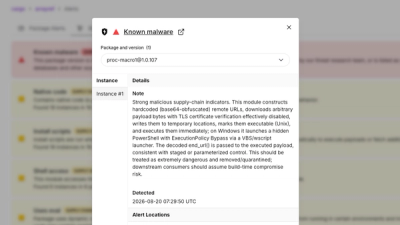
Three compromised Rust crates pulled in a malicious dependency that downloaded and executed cross-platform malware during Cargo builds.