

Company News
AWS Security Hub Adds Socket for Supply Chain Security
Socket is now in the AWS Security Hub Extended plan. Adopt it through AWS, apply committed spend, and block malicious open source packages.
By Feross Aboukhadijeh - Aug 04, 2026
argus-decision-mcp
Advanced tools
Argus judgment-record MCP — preserve a user-authorized statement, its return condition, and later answers without scoring the person.
Argus preserves consequential judgments, the assumptions behind them, and what reality later did. It does not score people or give verdicts.
Part of Argus · web app at argus.voyage · MIT licensed.
You talk normally. Argus offers to keep one thing, and comes back later.
2026-08-19
you We're going with Postgres over DynamoDB — the join patterns kill us otherwise.
┌ Save this as a prediction? (your host renders the form)
│ "Postgres handles our join patterns without a read-replica through Q4"
│ check by 2026-10-01
└ accept as written · edit the wording or the date · decline
… six weeks later, in a different conversation …
2026-10-01
argus One check is due — you saved this on 2026-08-19:
"Postgres handles our join patterns without a read-replica through Q4"
What actually happened?
you We added a read replica in September. Analytics queries, not joins.
Recorded. The original sentence stays exactly as you wrote it, your
answer is appended next to it, and nothing is scored.
Nothing is saved without you accepting it, and Argus never fills in the outcome for you.
Requirements: Node.js 18 or newer — Node 20 LTS is the tested version
(node --version; get it from nodejs.org). No API key and
no account: records are local files from the first call.
Pick your host. Every path below installs the same server.
The plugin wires this server for you and adds the decision commands on top:
/plugin marketplace add commet/Argus
/plugin install argus@argus
Restart Claude Code, then /argus:settings doctor confirms the wiring.
Want the server alone, without the commands? Add it directly:
claude mcp add argus -- npx -y argus-decision-mcp          # this project only
claude mcp add -s user argus -- npx -y argus-decision-mcp  # every project
claude mcp add defaults to the current project — use -s user if you want
Argus everywhere.
Settings → Developer → Edit Config opens the file directly. It lives at:
~/Library/Application Support/Claude/claude_desktop_config.json%APPDATA%\Claude\claude_desktop_config.jsonAdd Argus to it, then quit Claude Desktop completely and reopen it (a window close is not enough):
{
  "mcpServers": {
    "argus-decision": {
      "command": "npx",
      "args": ["-y", "argus-decision-mcp"],
      "env": {
        "ARGUS_DIR": "/absolute/path/to/where/records/should/live/.argus"
      }
    }
  }
}
ARGUS_DIR is optional here too — a desktop app has no "current project", so
records go to your personal home ledger (~/.argus) by default rather than
scattering. Set it when you want them somewhere specific. On Windows, escape the
backslashes ("C:\\Users\\you\\decisions\\.argus").
npx -y argus-decision-mcp prints one
privacy notice and then waits for a client — that is success, not a hang
(Ctrl-C to stop it). Any other output is the real error.npx failing while it works in your terminal usually means npm is not
installed globally. Check that %APPDATA%\npm exists; if not, run
npm install -g npm.${APPDATA}, add
"APPDATA": "C:\\Users\\you\\AppData\\Roaming\\" to the env block above.%APPDATA%\Claude\logs\mcp*.log (macOS: ~/Library/Logs/Claude).codex mcp add argus-decision -- npx -y argus-decision-mcp
codex mcp list # argus-decision should be listed and enabled
Restart Codex afterwards. A conversation opened before mcp add does not gain
newly registered tools — quit and reopen the app, or start a new CLI session.
Argus confirms a prediction with a one-tap form before saving it. Codex renders
that form under its default approval policy. If yours is never, or
approval_policy.granular.mcp_elicitations = false, Codex returns a protocol
decline without ever showing the form. MCP supplies no marker that separates
that policy response from a fast intentional decline, so Argus has to respect it
as a decline. Enable MCP elicitations and retry if you want the form.
An AI-drafted premise has a chat fallback: when the confirm window cannot
reach you, the draft comes back in the response, and once you approve it in
conversation the assistant records it by calling again with
chat_confirmed: true. Provenance stays ai_surfaced either way.
{
  "mcpServers": {
    "argus-decision": {
      "command": "npx",
      "args": ["-y", "argus-decision-mcp"],
      "env": {
        "ARGUS_DIR": "/absolute/path/to/your/project/.argus"
      }
    }
  }
}
Install once; there is nothing to update by hand. Leave the version off, as
above — npx re-resolves a bare package name on every launch, so each session
starts the current build.
Do not write a range like @^2. A range is satisfied by whatever already
sits in the npx cache, so it never consults the registry again and the wire can
stay frozen on an old build for weeks while everything looks healthy. Measured
2026-07-29, same spec string both times, cache holding an older version the
range still allowed:
| spec | launched |
|---|---|
argus-decision-mcp | the current release |
argus-decision-mcp@^2.0.0 | the stale cached build |
An exact pin is correct but freezes there until someone edits it. argus_check_in
reports the version actually running (data.server_version) if you ever need to
confirm which build answered.
On your disk from the first call — nothing to set up.
ARGUS_DIR is optional. The default follows one rule — project evidence
decides where the ledger lives:
.argus
folder → <that-project>/.argus (per-project isolation, unchanged)~/.argus), so records accumulate across conversations instead
of fragmenting into per-conversation orphansA per-call absolute argus_dir overrides everything; ARGUS_DIR overrides
the rule.
Argus never scans other projects. Existing home-level ledgers are not migrated
or merged silently; point ARGUS_DIR at one explicitly if you need to inspect
it.
Off until you turn it on. Nothing leaves the machine before you approve it in a browser:
npx argus-decision-mcp connect       # one browser approval, credential stored locally
npx argus-decision-mcp disconnect    # revoke it here
Add --headless on a machine with no browser to get a device-code flow. For CI,
set ARGUS_TOKEN to a sync token from the web app's settings page instead of
running connect. With no credential, sync is a silent no-op — the local record
is unaffected.
The records are plain append-only files under .argus/. They are yours:
copy that folder to back it up, delete it to remove it. Uninstalling the
server never touches it.
For the durable home that survives moves and worktrees, the CLI also has
archive-export, archive-restore, and local-purge. Each one requires
explicit arguments — --repository-id, an absolute --archive-dir, and a
verbatim --confirm-repository before anything is deleted. That is deliberate:
erasing judgment records should never be a one-word command. Run one without
arguments and it names the argument it wants.
The complete callable surface is six tools:
| Tool | Purpose |
|---|---|
argus_capture | Capture a decision and its user-owned context. |
argus_predict | Record one falsifiable claim and its check date. |
argus_check_in | Read records that need attention now. |
argus_resolve | Append an outcome the user explicitly stated. |
argus_patterns | Read decisions, receipts, timelines, and patterns. |
argus_settings | Read or update language, reminders, and explicit sync. |
Names from pre-2.0 releases are not callable aliases. A cached call to one of
them returns UNKNOWN_TOOL, so hosts cannot accidentally keep using obsolete
contracts.
ARGUS_TELEMETRY=1.npm install
npm run typecheck
npm test
npm run build
npm pack --dry-run
The published package contains one bundled runtime entrypoint. Internal implementation and experimental modules are not shipped as separate callable or importable files.
See SECURITY.md for reporting and trust-boundary details.
FAQs
Argus judgment-record MCP — preserve a user-authorized statement, its return condition, and later answers without scoring the person.
The npm package argus-decision-mcp receives a total of 3,361 weekly downloads. As such, argus-decision-mcp popularity was classified as popular.
We found that argus-decision-mcp demonstrated a healthy version release cadence and project activity because the last version was released less than a year ago. It has 1 open source maintainer collaborating on the project.
Did you know?

Socket for GitHub automatically highlights issues in each pull request and monitors the health of all your open source dependencies. Discover the contents of your packages and block harmful activity before you install or update your dependencies.
Company News
Socket is now in the AWS Security Hub Extended plan. Adopt it through AWS, apply committed spend, and block malicious open source packages.
Research
/Security News
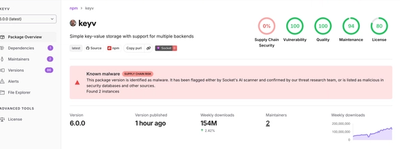
Popular npm packages keyv and cacheable compromised.

Security News
A misconfiguration gave three Anthropic models internet access, and one, believing it was in a simulation, shipped a credential-stealing package to PyPI.