
Security News
The Code You Didn't Write Is Still Yours to Defend
AI agents are pulling packages into environments no scanner is watching, creating exposure before security teams can see it.
By Brad Arkin - Jun 23, 2026
authentique
Advanced tools
Framework-agnostic authentication stack with adapters for MySQL, Supabase, Mongodb and Sqlite and social providers
Framework-Agnostic User Authentication Package – Semantq Native
A lightweight, framework-agnostic authentication system supporting:
npm install authentique
Run interactive setup:
npm run setup
You’ll be prompted for:
Example:
? Choose your database: MySQL
? Select email provider: Resend
? Include built-in auth UI? Yes

✅ Configuration complete!
Ensure your .env file contains required variables:
# === Core ===
BRAND_NAME=ExampleBrand
BRAND_SUPPORT_EMAIL=support@example.com
NODE_ENV=development
PORT=3000
BASE_URL=http://localhost:3000
UI_BASE_URL=http://localhost:3001

# === Database ===
# ===== MySQL/MariaDB =====
DB_ADAPTER=mysql
DB_MYSQL_HOST=localhost
DB_MYSQL_PORT=3306
DB_MYSQL_USER=root
DB_MYSQL_PASSWORD=mypassword
DB_MYSQL_NAME=auth
DB_MYSQL_POOL_LIMIT=10

# === Auth ===
JWT_SECRET=your_long_jwt_secret_here
JWT_ACCESS_EXPIRY=15m

# === Email ===
EMAIL_DRIVER=resend  # resend|mailgun|smtp
EMAIL_FROM=noreply@emailer.approveddomain.com
EMAIL_FROM_NAME=ExampleBrand

# --- Resend ---
RESEND_API_KEY=re_xxx

# --- Mailgun ---
# MAILGUN_API_KEY=key-xxx
# MAILGUN_DOMAIN=mg.yourdomain.com

# --- SMTP ---
# SMTP_HOST=smtp.example.com
# SMTP_PORT=587
# SMTP_USER=user
# SMTP_PASS=pass

# --- Supabase ---
# SUPABASE_URL=https://xxx.supabase.co
# SUPABASE_KEY=anon_key

# --- SQLite ---
# SQLITE_PATH=./data/db.sqlite

# --- MongoDB ---
# MONGO_URI=mongodb://user:pass@host:27017/dbname
Confirm generated config files:
ls config/
# Should show:
# authentique.config.js
# databases.js
# env-loader.js
Authentique uses a simple migration system to manage your database schema over time. Migrations are organized by adapter in:
src/adapters/databases/<adapter>/migrations/
For example for MySQL:
src/adapters/databases/mysql/migrations/
Each migration file must export an up(pool) function to apply changes, and optionally a down(pool) function to rollback.
Authentique provides starter migration files for supported databases to help you quickly set up the necessary tables for authentication functionality.
These starter migrations are located under:
authentique/lib/migration_repos/
mysql/ — SQL migrations for MySQL/MariaDBsupabase/ — SQL migration files for Supabase (PostgreSQL)After installing Authentique, you can optionally copy these migrations into your project’s own migration directories to initialize your database schema.
Source:
authentique/lib/migration_repos/mysql/
Destination:
authentique/src/adapters/mysql/migrations/
Example:
cp authentique/lib/migration_repos/mysql/* authentique/src/adapters/mysql/migrations/
Source:
authentique/lib/migration_repos/supabase/
Destination:
supabase/migrations/ (inside your Supabase CLI project directory)
Example:
cp authentique/lib/migration_repos/supabase/* supabase/migrations/
Do not mix MySQL migrations with Supabase/PostgreSQL projects. The file formats, naming conventions, and SQL dialect differ between MySQL and Supabase.
.sql files with MySQL-specific syntax.Ensure you copy the correct migration files into the appropriate project directories.
You’re free to modify, extend, or replace these starter migrations to suit your project’s needs. These are provided as a baseline for setting up the required authentication-related tables such as:
userssessionsoauth_tokens (for OAuth strategies)To run all pending migrations:
npm run migrate
This will:
migrations table (and create it if missing).js migration files in the adapter’s migrations/ directorymigrations tablemigrations tableTo rollback the latest migration:
npm run migrate:rollback
To rollback a specific number of recent migrations:
npm run migrate:rollback <number>
Examples:
Rollback the last 1 migration:
npm run migrate:rollback
Rollback the last 3 migrations:
npm run migrate:rollback 3
Rollback all applied migrations:
npm run migrate:rollback 999
Note: Only migrations with a down(pool) function can be rolled back. Migrations without one will be skipped with a warning.
// src/adapters/databases/mysql/migrations/0001-create-users.js

export async function up(pool) {
  await pool.query(`
    CREATE TABLE users (
      id INT PRIMARY KEY AUTO_INCREMENT,
      email VARCHAR(255) UNIQUE NOT NULL
    )
  `);
}

export async function down(pool) {
  await pool.query(`DROP TABLE IF EXISTS users`);
}
Applied migrations are tracked in a migrations table:
SELECT * FROM migrations;
Each entry records the migration filename and when it was run.
| Command | Description | Example |
|---|---|---|
npm run init | Runs the interactive configuration wizard to set up project config. | npm run init |
npm run migrate | Runs all pending database migrations not yet recorded in the migrations log. | npm run migrate |
npm run migrate:rollback | Rolls back the latest applied migration (1 step). | npm run migrate:rollback |
npm run migrate:rollback <N> | Rolls back the specified number of latest applied migrations. | npm run migrate:rollback 2 |
npm run migrate:rollback 999 | Rolls back all applied migrations (safe upper limit). | npm run migrate:rollback 999 |
npm run migrate:refresh | Rolls back all migrations and re-applies them from scratch. | npm run migrate:refresh |
npm run setup | Runs init, migrates the database, and starts both API and UI servers concurrently. | npm run setup |
Migrations are stored per adapter:
src/adapters/databases/<adapter>/migrations/
Authentique UI is a fully optional, lightweight user interface layer that ships alongside the Authentique authentication package. It provides a clean, modular, and extensible frontend to support full authentication workflows out of the box — without requiring a JavaScript framework.
Note: All you need to do to set up Authentique UI is to update the variables in the config.js file — that’s it.
Perfect — here’s your clean, updated feature-based directory structure section for the README, reflecting your exact latest layout, with OLDindex.html removed and project/ replaced with ui/ as requested:
Authentique UI follows a feature-based directory structure for clarity and scalability:
ui/
├── auth/
│   ├── confirm.html
│   ├── email-confirmation.html
│   ├── forgot-password.html
│   ├── index.html
│   ├── login.html
│   ├── reset-password.html
│   ├── signup.html
│   ├── verify-email.html
│   ├── css/
│   └── js/
│       ├── config.js               # UI runtime config (API endpoints & environment)
│       ├── login.js                # Login form logic
│       ├── signup.js               # Signup form logic
│       ├── forgot-password.js      # Forgot password form logic
│       └── reset-password.js       # Password reset form logic
├── dashboard/
│   ├── account.html
│   ├── css/
│   ├── index.html
│   └── js/
├── node_modules/
├── package-lock.json
├── package.json
├── server/
│   ├── middleware/
│   ├── routes/
│   └── test.js
└── ui-server.js                    # Express UI server with API proxy routes
Authentique UI includes:
User signup With support for multiple database adapters as configured in your Authentique backend setup:
Email-based account confirmation New users must confirm their email address before login is permitted.
Secure email and password login Authentication is JWT-based and secured via HttpOnly cookies. These tokens are never accessible from frontend JavaScript and are confined to backend-managed cookies.
Email-based password recovery Users can request a password reset via email, with secure token-based confirmation.
Automatic redirection to a prebuilt authentication dashboard template Upon login, users are automatically redirected to a prebuilt authentication dashboard template. This dashboard serves as a flexible foundation that you can easily customize to fit your application's unique requirements. By running database migrations with Authentique backends and extending the Authentique UI, you can quickly build a full-stack CRUD application with minimal effort. The solution is framework-agnostic but optimized for the Semantq JS framework, giving you maximum flexibility and speed in development.
Authentique UI makes all authentication API calls via frontend proxy routes, preventing the frontend from making direct cross-origin requests to the authentication backend. JWT tokens are stored in HttpOnly cookies set by the backend — these cookies are:
All Authentique UI scripts that communicate with the backend load a configuration object from:
authentiqueui/auth/js/config.js
This defines the environment and base backend API URLs dynamically based on the current host, or allows for manual environment selection.
config.js Structure/**
* AppConfig
*
* Application runtime configuration for Authentique UI.
*
* ENV can either be set dynamically based on the window location
* or manually for testing/dev purposes by assigning a fixed value:
*
* Example:
* ENV: 'development'
* ENV: 'production'
*
* BASE_URLS can be customized to point to your backend's dev or production
* environment as needed.
*/
const AppConfig = {
// Automatically detect the environment, or set manually for testing
ENV: (typeof window !== 'undefined' && window.location.hostname.includes('localhost'))
? 'development'
: 'production',
// Define your backend API base URLs for different environments
BASE_URLS: {
development: 'http://localhost:3000',
production: 'https://api.botaniqsa.com'
},
/**
* Dynamically returns the base API URL for the current environment
*/
get BASE_URL() {
return this.BASE_URLS[this.ENV] || this.BASE_URLS.development;
}
};
export default AppConfig;
Each Authentique UI module that requires access to backend API endpoints imports AppConfig from the config file. So you don't need to do this - it s already taken care of - all you need to do is update the variaables in the config.js file.
Example:
import AppConfig from './config.js';
API paths are then constructed using AppConfig.BASE_URL like this:
const PATHS = {
  FORGOT_PASSWORD_API: `${AppConfig.BASE_URL}/api/forgot-password`, // Assuming backend is on 3000
  LOGIN_PAGE: '/login' // Assuming your login page is at /login
};
This ensures your frontend modules automatically target the correct API environment without needing to hardcode endpoint URLs.
The config file must be located at:
authentiqueui/auth/js/config.js
No staging environment is included by default. The provided environments are:
development (for localhost testing)production (for live deployment)If necessary, you can extend the BASE_URLS object for additional environments as required for your own project.
Sure — here’s a clean, refined, and clear markdown section for your README that avoids re-showing the full config code while explaining the dashboard config neatly:
The optional built-in UI ui-server.js provided with Authentique requires a correctly configured API endpoint to communicate with the backend authentication service.
By default, the UI is served from within the authentique/ directory and reads the target backend API URL from the main .env file in the project root:
import fetch from 'node-fetch';
import 'dotenv/config';

const API_BASE_URL = process.env.API_BASE_URL;
if (!API_BASE_URL) {
  console.error('❌ Missing API_BASE_URL in environment!');
  process.exit(1);
}
authentique/ui/ui-server.js) reads the API_BASE_URL environment variable at runtime..env file has a valid API_BASE_URL defined if you're using the provided UI.authentique/ directory or deploy the frontend separately from the backend..env:API_BASE_URL=http://localhost:3000
If you integrate Authentique into a custom project structure:
API_BASE_URL retrieval logic in your custom UI server or configuration files to match your project’s conventions.Key principle:
The UI server must have a way to resolve and use the correct backend API endpoint at runtime for Authentique to function properly.
The default URL for the Authentique dashboard is set via the DASHBOARD variable in the config.js file:
DASHBOARD: '/dashboard/index.html',
You can customize this path to point to your preferred dashboard location if needed. The config.js file also manages environment-specific settings and API base URLs, making it simple to configure your application for both development and production environments.
Note: If you change the dashboard directory, you’ll also need to update the authentique/ui/server/routes/dashboard.routes.js file to reflect the new directory:
export default function (app, serveDirectory) {
  serveDirectory('dashboard', '/dashboard', true); // any logged-in user
}
This function tells the UI server to serve all routes and files within the specified directory without needing to define individual routes for each file — ensuring seamless access for authenticated users.
FAQs
Framework-agnostic authentication stack with adapters for MySQL, Supabase, Mongodb and Sqlite and social providers
We found that authentique demonstrated a healthy version release cadence and project activity because the last version was released less than a year ago. It has 1 open source maintainer collaborating on the project.
Did you know?

Socket for GitHub automatically highlights issues in each pull request and monitors the health of all your open source dependencies. Discover the contents of your packages and block harmful activity before you install or update your dependencies.
Security News
AI agents are pulling packages into environments no scanner is watching, creating exposure before security teams can see it.

Security News
GitHub Actions checkout now blocks risky pull_request_target checkouts by default to help prevent pwn request supply chain attacks.
Product
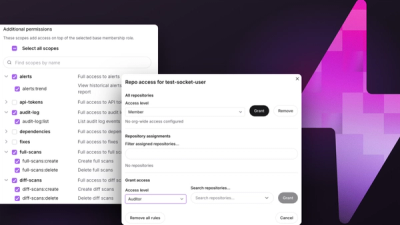
Socket now supports Custom Roles and Repository Access Permissions so organizations can control who can access specific repositories and actions.