

Research
/Security News
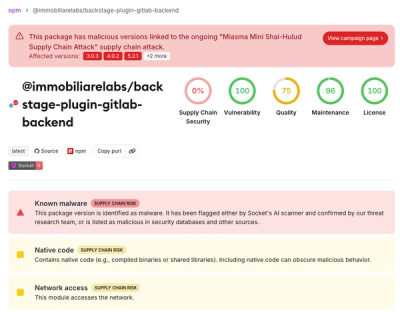
Miasma Mini Shai-Hulud Hits ImmobiliareLabs npm Packages
Miasma Mini Shai-Hulud hits @immobiliarelabs Backstage plugins, targeting GitLab and LDAP auth packages on npm.
By Socket Research Team - Jun 26, 2026
AI coding agent orchestration at scale. Karpathy optimization loops, multi-agent pipelines, DAG dependencies, autoscaling workers. Claude, Codex, Gemini.
One goal in. Finished work out. No human in the loop.
beat orchestrate "Migrate the payment module to a standalone microservice with its own database, API, and test suite"
Autobeat gives you four composable primitives -delegation, eval loops, persistence, and resource management -and lets you wire them together however you want. Loops inside loops. Pipelines inside orchestrators. Agents spawning agents. The framework doesn't prescribe your workflow. It gives you the building blocks and gets out of the way.
The orchestrator mode is where it all comes together: a meta-agent that uses Autobeat's own tools recursively to break down goals, spawn workers, handle failures, and iterate until everything passes. Fully autonomous. Nothing else works like this.
The orchestrator is a meta-agent -a coding agent whose tools are Autobeat's own primitives. Each iteration, it:
The orchestrator runs as a loop. Workers it spawns can themselves be loops. Loops all the way down.
Every other orchestration framework builds infrastructure the agent could do itself -worktree management, CI parsing, PR automation, inter-agent messaging. Every line of that code becomes technical debt as models improve.
Autobeat provides four primitives that agents can't do for themselves:
Everything else -worktrees, CI, PRs, code review, testing, deployment -is the agent's job. As models get smarter, the framework automatically gets more powerful without changing a line of code.
Add to your project's .mcp.json:
{
  "mcpServers": {
    "autobeat": {
      "command": "npx",
      "args": ["-y", "autobeat", "mcp", "start"]
    }
  }
}
Restart your MCP client to connect. Autobeat works with Claude Code, Codex, Gemini, Ollama, and any MCP-compatible agent.
claude, codex, or gemini)# Initialize — detects installed agents, sets defaults, installs agent skills
beat init
# Orchestrate -fire and forget
beat orchestrate "Add real-time collaborative editing to the document editor"
# Or run a single task in the foreground
beat run "Fix the failing test in parser.test.ts" -f
The flagship. One command, autonomous execution.
# Detached (default) -runs in the background
beat orchestrate "Set up a GraphQL API with subscriptions, pagination, and integration tests"

# Foreground -blocks and shows progress, Ctrl+C cancels
beat orchestrate "Migrate the database schema" --foreground

# Interactive -foreground TTY session with live output
beat orchestrate -i "Build the auth system"

# With options
beat orchestrate "Redesign the dashboard" \
  --agent claude \
  --max-workers 5 \
  --max-iterations 50 \
  --max-depth 3 \
  --system-prompt "Use functional patterns, no classes"
Scaffold a custom orchestrator with state file, exit condition, and system prompt:
beat orchestrate init "Migrate payments to microservice"
beat orchestrate status <id>     # Plan, steps, iteration count
beat orchestrate list             # All orchestrations
beat orchestrate cancel <id>     # Stop gracefully
The Karpathy loop for coding agents. Run a task, evaluate the result, iterate until optimal.
Retry strategy -run until a condition passes:
beat loop "Fix the failing tests" --until "npm test"
Optimize strategy -score output, seek the best:
beat loop "Optimize the bundle size" \
  --eval "node measure-bundle.js" \
  --direction minimize \
  --max-iterations 10
Agent eval -let an AI judge the result instead of a shell command:
beat loop "Fix the failing tests" --eval-mode agent --strategy retry
beat loop "Optimize the algorithm" --eval-mode agent --strategy optimize --maximize \
  --eval-prompt "Score the solution on correctness and efficiency (0-100)"
Pipeline loops -repeat a multi-step workflow:
beat loop "Implement and verify the feature" \
  --pipeline \
  --step "Implement the changes" \
  --step "Run the test suite" \
  --step "Fix any failures" \
  --until "npm test"
Each iteration starts with fresh context by default. The loop tracks the best result, reverts failures, and stops when the exit condition is met or safety limits are hit.
Spawn background coding agents with dependency ordering:
# Fire and forget
beat run "npm run build" --priority P1
# → task-abc123

# Chain with dependencies
beat run "npm test" --deps task-abc123
beat run "npm run deploy" --deps task-def456
# Execution: build → test → deploy
Session continuation passes output context through the chain:
const build = await DelegateTask({ prompt: "npm run build" });
const test = await DelegateTask({
  prompt: "npm test",
  dependsOn: [build.taskId],
  continueFrom: build.taskId  // receives build's checkpoint context
});
Chain steps across different agents. Schedule them on cron.
# Sequential pipeline
beat pipeline "Design the API schema" \
  --step "Implement the endpoints" \
  --step "Write integration tests" \
  --step "Review for security issues"

# Scheduled pipeline -runs every day at 2am
beat schedule create "Run nightly checks" \
  --cron "0 2 * * *" \
  --pipeline \
  --step "Run the full test suite" \
  --step "Check for security vulnerabilities" \
  --step "Generate coverage report"
Each step can use a different agent, working directory, and priority.
# Cron schedule
beat schedule create "Backup the database" --cron "0 2 * * *" --timezone "America/New_York"

# One-time schedule
beat schedule create "Deploy to production" --at "2026-04-01T08:00:00Z"

# Manage
beat schedule list
beat schedule pause <id>
beat schedule resume <id>
beat schedule cancel <id>
Four agent runtimes are supported: Claude, Codex, Gemini, and Ollama (local LLMs). Each agent can be configured with an API key, base URL, default model, proxy, and runtime.
beat agents list                    # Show available agents
beat agents check                   # Auth status for all agents
By default, agents use CLI login-based auth (e.g., claude login). To use your own API key instead:
beat agents config set claude apiKey "sk-ant-your-key"
beat agents config set codex apiKey "sk-your-openai-key"
beat agents config set gemini apiKey "your-gemini-key"
Auth resolution order: environment variable > stored config > CLI login.
| Agent | Env var (highest priority) |
|---|---|
| claude | ANTHROPIC_API_KEY |
| codex | OPENAI_API_KEY |
| gemini | GEMINI_API_KEY |
Set a default model per agent, or override per task:
# Default model for all Claude tasks
beat agents config set claude model "claude-sonnet-4-5-20250514"

# Override per task
beat run "Fix the tests" --agent claude --model "claude-sonnet-4-5-20250514"
beat orchestrate "Refactor auth" --agent claude --model "claude-sonnet-4-5-20250514"
Resolution order: per-task --model > agent config model > CLI default.
Route requests through a proxy, gateway, or local endpoint:
beat agents config set claude baseUrl "https://my-proxy.example.com/v1"
beat agents config set codex baseUrl "http://localhost:8080/v1"
Or via environment variables (takes precedence over config):
| Agent | Env var |
|---|---|
| claude | ANTHROPIC_BASE_URL |
| codex | OPENAI_BASE_URL |
| gemini | GEMINI_BASE_URL |
Note: Claude's login-based auth does not work with a custom baseUrl — you must also set an apiKey. Autobeat warns if baseUrl is set without one.
Run Claude-targeting agents on any OpenAI-compatible backend (OpenRouter, Together, vLLM, etc.). The proxy translates Anthropic Messages API to OpenAI Chat Completions format transparently.
beat agents config set claude proxy openai
beat agents config set claude baseUrl "https://openrouter.ai/api/v1"
beat agents config set claude apiKey "sk-or-your-key"
Wrap agent spawns with ollama launch for local LLM execution. The runtime manages the Ollama process lifecycle alongside the agent.
beat agents config set gemini runtime ollama
beat agents config set gemini model "llama3:8b"
Proxy and runtime are mutually exclusive — setting one clears the other.
Most local inference servers (Ollama, llama.cpp, vLLM, LM Studio) expose an OpenAI-compatible API. Point the codex agent at your local server:
beat agents config set codex baseUrl "http://localhost:11434/v1"
beat agents config set codex apiKey "any-string"
beat agents config set codex model "llama3"

beat run --agent codex "Refactor the utils module"
beat agents config show              # Show all agent configs
beat agents config show claude       # Show config for one agent
beat agents config reset claude      # Clear all stored config for an agent
Config is stored in ~/.autobeat/config.json.
| Tool | What It Does |
|---|---|
| CreateOrchestrator | Autonomous goal execution with worker management |
| OrchestratorStatus | Orchestration plan, steps, and iteration state |
| ListOrchestrators | List orchestrations with status filter |
| CancelOrchestrator | Cancel an orchestration and its workers |
| InitCustomOrchestrator | Scaffold a custom orchestrator (state file, exit condition, system prompt) |
| DelegateTask | Spawn a background coding agent |
| TaskStatus | Real-time task status |
| TaskLogs | Execution logs |
| CancelTask | Cancel with cleanup |
| RetryTask | Retry a task |
| ResumeTask | Resume from checkpoint |
| CreateLoop | Iterative eval loop (retry or optimize) |
| LoopStatus | Loop details and iteration history |
| ListLoops | List loops with status filter |
| CancelLoop | Cancel a loop |
| PauseLoop / ResumeLoop | Pause and resume loops |
| ScheduleLoop | Schedule a recurring loop |
| CreatePipeline | Sequential multi-step pipeline |
| PipelineStatus | Pipeline details and step progress |
| ListPipelines | List pipelines with status filter |
| CancelPipeline | Cancel a pipeline and its in-flight tasks |
| ScheduleTask | Cron or one-time task schedule |
| SchedulePipeline | Scheduled pipeline |
| ListSchedules / ScheduleStatus | Schedule management |
| PauseSchedule / ResumeSchedule | Schedule lifecycle |
| CancelSchedule | Cancel schedule and optionally in-flight tasks |
| ListAgents | List agents with auth status and config |
| ConfigureAgent | Check, set, or reset agent config (apiKey, baseUrl, model, proxy, runtime) |
beat orchestrate <goal> [options]     Autonomous orchestration (detached)
beat orchestrate <goal> -f            Foreground orchestration
beat orchestrate -i <goal>            Interactive TTY session
beat orchestrate init <goal>          Scaffold custom orchestrator
beat orchestrate status <id>          Orchestration details
beat orchestrate list                 List orchestrations
beat orchestrate cancel <id>          Cancel orchestration

beat run <prompt> [options]           Single task (detached or -f foreground)
beat list                             List tasks
beat status [id]                      Task status
beat logs <id>                        Task logs
beat cancel <id>                      Cancel task
beat retry <id>                       Retry task
beat resume <id>                      Resume from checkpoint

beat loop <prompt> --until <cmd>      Retry loop
beat loop <prompt> --eval <cmd>       Optimize loop
beat loop list                        List loops
beat loop status <id>                 Loop details
beat loop pause <id>                  Pause loop
beat loop resume <id>                 Resume loop
beat loop cancel <id>                 Cancel loop

beat schedule create <prompt>         Create schedule
beat schedule list                    List schedules
beat schedule status <id>             Schedule details
beat schedule pause/resume/cancel     Schedule lifecycle

beat pipeline <prompt> --step ...     Create pipeline

beat agents list                      List available agents
beat agents check                     Auth status for all agents
beat agents config show [agent]       Show agent config
beat agents config set <agent> <key> <value>  Set agent config
beat agents config reset <agent>      Clear agent config

beat dashboard                        Interactive terminal dashboard
beat init                             Interactive setup
beat config show|set|reset|path       Configuration
beat help                             Help
Configuration priority: environment variables > config file > defaults.
beat config show                    # Show resolved config
beat config set timeout 300000      # Set a value
beat config reset timeout           # Revert to default
| Variable | Default | Description |
|---|---|---|
TASK_TIMEOUT | 1800000 (30min) | Task timeout in ms |
MAX_OUTPUT_BUFFER | 10485760 (10MB) | Output buffer size |
CPU_CORES_RESERVED | 2 | CPU cores reserved for system |
MEMORY_RESERVE | 2684354560 (2.5GB) | Memory reserve in bytes |
LOG_LEVEL | info | Logging verbosity |
Event-driven system with autoscaling workers and SQLite persistence. Components communicate through a central EventBus with specialized handlers.
Task Lifecycle: Queued → Running → Completed / Failed / Cancelled
Four agent runtimes: Claude, Codex, Gemini, and Ollama (local LLMs). API translation proxy enables cross-platform agent execution. Per-task agent selection. Crash recovery restores all in-flight work on restart.
See Architecture Documentation for details.
npm run dev          # Development mode with auto-reload
npm run build        # Build TypeScript
npm run test:core    # Core tests (~3s)
npm run test:all     # Full suite (3,600+ tests)
See FEATURES.md for the complete feature list and ROADMAP.md for what's next.
MIT
FAQs
AI coding agent orchestration at scale. Karpathy optimization loops, multi-agent pipelines, DAG dependencies, autoscaling workers. Claude, Codex, Gemini.
We found that autobeat demonstrated a healthy version release cadence and project activity because the last version was released less than a year ago. It has 1 open source maintainer collaborating on the project.
Did you know?

Socket for GitHub automatically highlights issues in each pull request and monitors the health of all your open source dependencies. Discover the contents of your packages and block harmful activity before you install or update your dependencies.
Research
/Security News
Miasma Mini Shai-Hulud hits @immobiliarelabs Backstage plugins, targeting GitLab and LDAP auth packages on npm.

Security News
Rolldown paused Rust React Compiler integration after a 5MB binary size increase raised concerns about shipping React-specific code to all Vite users.

Security News
/Research
Mini Shai-Hulud expands into the Go ecosystem after hitting LeoPlatform npm packages and targeting GitHub Actions workflows.