
Research
/Security News
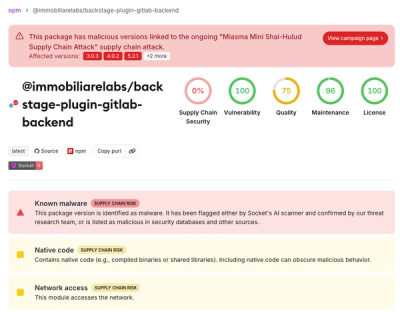
Miasma Mini Shai-Hulud Hits ImmobiliareLabs npm Packages
Miasma Mini Shai-Hulud hits @immobiliarelabs Backstage plugins, targeting GitLab and LDAP auth packages on npm.
By Socket Research Team - Jun 26, 2026
bare-broadcast-channel
Advanced tools
Multi-producer, multi-consumer inter-thread broadcast messaging for JavaScript
Multi-producer, multi-consumer inter-thread broadcast messaging for JavaScript. Unlike https://github.com/holepunchto/bare-channel, which is single-producer / single-consumer over a fixed port pair, bare-broadcast-channel allows any number of ports (up to BroadcastChannel.MAX_PORTS) to connect to the same channel. Each write is broadcast to every other connected port, and a port never receives messages it wrote itself.
npm i bare-broadcast-channel
const BroadcastChannel = require('bare-broadcast-channel')
const { Thread } = Bare

const channel = new BroadcastChannel()

const consumer = (label) =>
  new Thread(__filename, { data: { handle: channel.handle, label } }, async ({ handle, label }) => {
    const BroadcastChannel = require('bare-broadcast-channel')
    const port = BroadcastChannel.from(handle).connect()
    console.log(label, 'got', await port.read())
    await port.close()
  })

const a = consumer('a')
const b = consumer('b')

const port = channel.connect()

while (port.peers < 2) await new Promise((r) => setTimeout(r, 10))

await port.write('hello')
await port.close()

a.join()
b.join()
const channel = new BroadcastChannel([options])Create a new broadcast channel. The channel is backed by a SharedArrayBuffer exposed as channel.handle that can be passed to other threads to share the channel across them.
Options include:
options = {
  handle,
  interfaces: []
}
If handle is provided, the channel is restored from that existing SharedArrayBuffer rather than allocating a fresh one. interfaces is a list of serializable constructors used by https://github.com/holepunchto/bare-structured-clone when encoding values.
BroadcastChannel.MAX_PORTSMaximum number of ports that may connect to a single channel over its lifetime.
const channel = BroadcastChannel.from(handle[, options])Restore a channel from its SharedArrayBuffer handle. options accepts the same fields as the constructor, except for handle.
channel.handleThe SharedArrayBuffer backing the channel. Pass this to other threads to share the channel.
channel.interfacesThe serializable interfaces registered on the channel.
const port = channel.connect()Connect a new port to the channel. Throws if MAX_PORTS has been reached. Port slots are not reused, so the cap applies to the total number of connections over the channel's lifetime, not the number of concurrently connected ports.
A Port is an EventEmitter and is both iterable (for ... of) and async iterable (for await ... of).
port.peersThe current number of connected peer ports, excluding port itself.
const flushed = await port.write(value)Broadcast value to every currently connected peer. Resolves to true once value has been pushed to every peer's queue, or false if port is closed. If any peer's queue is full, the write waits for it to drain before resolving.
value is cloned for each peer using https://github.com/holepunchto/bare-structured-clone. Transferring ownership of a value is not supported; a broadcast delivers to many peers, so there is no single recipient to take ownership, and the same serialization is decoded independently by each peer.
const flushed = port.writeSync(value)Synchronous version of port.write().
const value = await port.read()Read the next message broadcast to port. Resolves to null once port is closed via port.close(), or once every peer has left after at least one has been observed - so a read loop terminates naturally when the other side disconnects rather than waiting forever. Any messages still queued are delivered before null.
const value = port.readSync()Synchronous version of port.read(), with the same end-of-stream semantics: returns null once port is closed, or once every peer has left after at least one has been observed.
await port.close()Close port, releasing it from the channel. After close, subsequent reads resolve to null and subsequent writes resolve to false.
port.ref()Reference port, keeping the event loop alive while it is open.
port.unref()Unreference port, letting the event loop exit if port is the only thing keeping it alive.
const stream = port.createReadStream([options])A Readable stream wrapping port.read(). options is passed through to https://github.com/holepunchto/bare-stream.
const stream = port.createWriteStream([options])A Writable stream wrapping port.write() and port.close(). options is passed through to https://github.com/holepunchto/bare-stream.
const stream = port.createStream([options])A Duplex stream wrapping read, write, and close. options is passed through to https://github.com/holepunchto/bare-stream.
event: 'peers'Emitted when the number of connected peer ports changes. The listener receives the new peer count.
event: 'close'Emitted once port has fully closed.
Apache-2.0
FAQs
Multi-producer, multi-consumer inter-thread broadcast messaging for JavaScript
The npm package bare-broadcast-channel receives a total of 824 weekly downloads. As such, bare-broadcast-channel popularity was classified as not popular.
We found that bare-broadcast-channel demonstrated a healthy version release cadence and project activity because the last version was released less than a year ago. It has 1 open source maintainer collaborating on the project.
Did you know?

Socket for GitHub automatically highlights issues in each pull request and monitors the health of all your open source dependencies. Discover the contents of your packages and block harmful activity before you install or update your dependencies.
Research
/Security News
Miasma Mini Shai-Hulud hits @immobiliarelabs Backstage plugins, targeting GitLab and LDAP auth packages on npm.
Security News
Rolldown paused Rust React Compiler integration after a 5MB binary size increase raised concerns about shipping React-specific code to all Vite users.
Security News
/Research
Mini Shai-Hulud expands into the Go ecosystem after hitting LeoPlatform npm packages and targeting GitHub Actions workflows.