
Research
/Security News
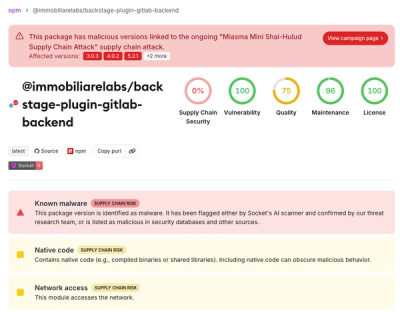
Miasma Mini Shai-Hulud Hits ImmobiliareLabs npm Packages
Miasma Mini Shai-Hulud hits @immobiliarelabs Backstage plugins, targeting GitLab and LDAP auth packages on npm.
By Socket Research Team - Jun 26, 2026
bare-type-stripper
Advanced tools
Heuristic lexer for stripping TypeScript type syntax to produce plain JavaScript
Heuristic lexer for stripping TypeScript type syntax to produce plain JavaScript. Stripped regions are replaced with spaces so source positions and line numbers are preserved.
const strip = require('bare-type-stripper')
strip(`
const x: number = 1
function f<T>(xs: T[]): T { return xs[0] }
`).toString()
// '
// const x = 1
// function f (xs ) { return xs[0] }
// '
const output = strip(source[, encoding][, options])Strip TypeScript-only syntax from source and return plain JavaScript as a Buffer. Stripped regions are replaced with spaces (newlines preserved) so the output has the same byte length as the input, keeping stack traces and source positions aligned.
source may be a string or a Buffer. When a string, encoding selects the character encoding (defaults to 'utf8').
Throws a SyntaxError when the source contains non-erasable TypeScript syntax (see below).
Options are reserved.
const ranges = strip.lex(source[, encoding][, options])Return the raw [start, end, flags?] ranges that strip() would erase, without applying them. The optional third element is a bitmap of flags from strip.constants that controls how a single byte in the range is rewritten (instead of being blanked to a space).
strip.lex('const x: number = 1')
// [ [ 7, 16 ] ]
strip.constants| Constant | Description |
|---|---|
SEMI | The first byte of the range becomes ; instead of a space. Used on whole-statement strips (type, interface, declare, import type, export type/interface) and on the first stripped modifier of a class member to keep ASI from folding the preceding statement or field into what follows. |
PAREN | The first byte of the range becomes ) instead of a space. Used together with a wider strip range to relocate an arrow function's closing ) down to the line where => lives, when the (now stripped) return-type annotation spanned newlines. |
ERROR | The range marks non-erasable TypeScript syntax that cannot be stripped to valid JavaScript. strip() throws a SyntaxError when a lexed range carries this flag; lex() returns the range so callers can implement their own handling. |
| Construct | Example |
|---|---|
| Type annotations | const x: number = 1 |
| Type aliases | type Foo = number |
| Interfaces | interface Foo { x: number } |
| Type-only imports/exports | import type { Foo } from 'mod' |
| Generics at declarations | function f<T>(x: T): T |
| Generics at call sites | foo<number>() |
| Generic arrow functions | <T>(x: T) => x |
| Type assertions | x as Foo, x satisfies Foo |
| Non-null assertion | obj!.foo |
| Optional parameter marker | function f(x?: T) |
| Definite assignment | let x!: number |
| Class member modifiers | public, private, readonly, etc. |
implements clauses | class C implements I |
declare statements | declare const x: number |
| Overload signatures | function f(x: string): void |
| Abstract members | abstract foo(): void |
Constructs with runtime semantics that a purely lexical stripper cannot reproduce are marked with the ERROR flag, and strip() throws a SyntaxError when it meets one:
enum / const enum declarations - they emit a runtime object.namespace / module declarations with bodies - they emit runtime code.constructor(public x: number) implies a this.x = x assignment that stripping the modifier would silently lose.<Foo>expr) - indistinguishable from JSX, which is not supported.The stripper targets plain .ts sources; JSX (.tsx) is not supported and is reported as non-erasable syntax.
Apache-2.0
FAQs
Heuristic lexer for stripping TypeScript type syntax to produce plain JavaScript
We found that bare-type-stripper demonstrated a healthy version release cadence and project activity because the last version was released less than a year ago. It has 1 open source maintainer collaborating on the project.
Did you know?

Socket for GitHub automatically highlights issues in each pull request and monitors the health of all your open source dependencies. Discover the contents of your packages and block harmful activity before you install or update your dependencies.
Research
/Security News
Miasma Mini Shai-Hulud hits @immobiliarelabs Backstage plugins, targeting GitLab and LDAP auth packages on npm.

Security News
Rolldown paused Rust React Compiler integration after a 5MB binary size increase raised concerns about shipping React-specific code to all Vite users.

Security News
/Research
Mini Shai-Hulud expands into the Go ecosystem after hitting LeoPlatform npm packages and targeting GitHub Actions workflows.