

Company News
AWS Security Hub Adds Socket for Supply Chain Security
Socket is now in the AWS Security Hub Extended plan. Adopt it through AWS, apply committed spend, and block malicious open source packages.
By Feross Aboukhadijeh - Aug 04, 2026
BATON — hand off AI work with a signed verification receipt (independent E2E-proven), over MCP
Hand off AI work — with a receipt.
An AI did the work. How does the next person — or the next AI — know it actually works, not just that the build passed? BATON seals a unit of AI work into a portable capsule, and an independent verifier replays it and issues a server-signed Verification Receipt. The receiver trusts observed evidence, not a claim.
Never trust an agent handoff without a receipt.
BATON is a standard MCP (Model Context Protocol) server — any MCP-capable tool (Claude Code, Codex CLI, Gemini CLI, Cursor …) connects with one URL. The producer and the verifier can be different models, machines, and people.
Running Claude + Codex + Gemini together (swarms, rooms, agent messaging) is a crowded space. BATON isn't that. The one thing almost nobody does: bind the handoff artifact to independent execution evidence as a single, forgeable-proof trust unit. That's the receipt.
Claude did the work
↓ baton_pass → sealed capsule (BTN-H-…)
Codex / a teammate receives it
↓ baton_verify → replay in a clean env, observe the real flow
↓
🕸️ VERIFIED — signed receipt: who verified · what was observed · in what env · with what artifacts
↓
trust (or reject)
The real buyer isn't "me switching Claude→Codex" (just re-read the repo). It's outsourcer→in-house, leaver→joiner, KO team→US team — where "an AI made this, does it really work?" is a question worth paying to answer.
baton_verify doesn't return a ✅ sticker. It returns a signed record:
{
  "kind": "baton.verification-receipt/v1",
  "capsule": "BTN-H-…",              // the handoff this verifies
  "verifier": "receiver-spider",    // WHO verified — independent of the producer
  "environment": { "os": "ubuntu-24.04", "node": "24.2" },
  "observed": [{ "claim": "payment succeeds", "observed": true,
                 "detail": "POST /pay 200 + order row +1" }],
  "artifacts": ["playwright.trace.zip", "network.har"],
  "verdict": "verified",
  "signature": "…hmac-sha256…"       // server-signed → tamper the verdict, break the sig
}
Flip verdict to "verified" without re-signing and the badge is refused. A passing build never earns verified on its own — only observed E2E does (this is what catches a silent upsert that returns 200 but writes nothing).
| Group | Tools | What it does |
|---|---|---|
| Handoff | baton_pass baton_receive baton_diff baton_revoke | Seal a work capsule into a code (BTN-H-…), hand it over, diff versions. Body encrypted with a code-derived key — the server never sees plaintext |
| Verify | baton_verify baton_verify_plan + spider_* ×6 | Independent verifier replays and issues the signed receipt. No observation, no 🕸️ |
| Relay (supporting) | baton_create_room baton_join baton_send baton_inbox baton_who baton_leave | Live sessions from different people/models talk in an invite-code room (BTN-R-…) |
ciphertext + code_hash. Without the code, even the operator can't read the plaintext — the proof of "we can't lock you in."BATON_RECEIPT_SECRET); no client can forge verified.verified requires observed side effects, never static analysis alone.npm install
npm test # 15/15 E2E groups pass
node src/server.js # stdio (local / any CLI)
BATON_HTTP=1 PORT=8080 node src/server.js # remote Streamable HTTP
claude mcp add --transport http baton https://baton-mcp-production.up.railway.app/mcp
Billing/gating is off by default (dogfooding phase). Set BATON_BILLING=on to re-enable quotas/seats. See USAGE.md for the full guide.
MVP uses SQLite (better-sqlite3) — self-host single binary. The hosted service drops a Postgres adapter into the narrow interface in src/store.js.
MIT
FAQs
BATON — hand off AI work with a signed verification receipt (independent E2E-proven), over MCP
We found that baton-mcp demonstrated a healthy version release cadence and project activity because the last version was released less than a year ago. It has 1 open source maintainer collaborating on the project.
Did you know?

Socket for GitHub automatically highlights issues in each pull request and monitors the health of all your open source dependencies. Discover the contents of your packages and block harmful activity before you install or update your dependencies.
Company News
Socket is now in the AWS Security Hub Extended plan. Adopt it through AWS, apply committed spend, and block malicious open source packages.
Research
/Security News
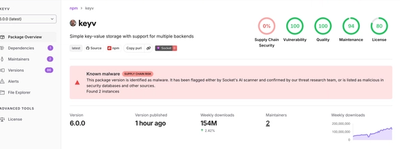
Popular npm packages keyv and cacheable compromised.

Security News
A misconfiguration gave three Anthropic models internet access, and one, believing it was in a simulation, shipped a credential-stealing package to PyPI.