
Research
/Security News
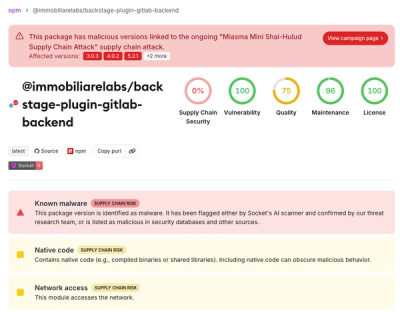
Miasma Mini Shai-Hulud Hits ImmobiliareLabs npm Packages
Miasma Mini Shai-Hulud hits @immobiliarelabs Backstage plugins, targeting GitLab and LDAP auth packages on npm.
By Socket Research Team - Jun 26, 2026
Create encrypted Hypercore push notifications for the sender core -> blind-peering -> blind-peer -> push forwarder -> FCM -> receiver core flow.
This package turns Hypercore proofs into compact notification payloads for the blind-peer delivery path. In the deployed flow, the sender core does not hand craft the push payload itself. Instead, the application asks blind-peering to send a notification. blind-peering builds the BlindPeerRequest message and sends it to the selected blind peer over the blind-peer-muxer Protomux channel. The blind peer generates the encrypted payload from its replicated Hypercore state, then sends a forward-push request to a push forwarder, which delivers the payload over FCM to the receiver core.
High level:
sender core
  -> blindPeering.sendNotification(...)
blind-peering
  -> BlindPeerRequest over blind-peer-muxer
blind-peer
  -> createNotification(...)
  -> { discoveryKey, payload }
  -> forward-push request
push forwarder
  -> FCM
receiver core
  -> decode(...)            // optional transport decoding
  -> readNotification(store, roomKey, payload)
  -> verified proof / newer-state signal
If the latest block would make the notification too large for common push payload limits, blind-push falls back to a compact proof without inline block data. The receiver can still verify that newer data exists and fetch the missing block over Hypercore replication.
const notification = await blindPush.createNotification(core, [options])Create an encrypted notification payload from a Hypercore block proof.
In the deployed flow, core is typically the blind-peer's replicated view of the sender core, not the sender's local process.
options include:
roomKey: optional room key used to encrypt the notification. Defaults to core.key.roomDiscoveryKey: optional discovery key to expose in the returned payload. Defaults to crypto.discoveryKey(roomKey).index: optional block index to prove. Defaults to core.length - 1.timeout: optional timeout passed to core.get(...). Defaults to 10000.extra: optional metadata embedded in the encrypted proof payload.Resolves to:
notification.discoveryKey: discovery key for the room.notification.payload: encrypted proof bytes suitable for forwarding in a push payload.If the encrypted payload exceeds the internal size budget, the returned notification omits inline block data and carries a compact proof instead.
The embedded version and extra fields live inside the encrypted proof payload and are exposed after decryption via readNotification(...).
const result = await blindPush.readNotification(store, roomKey, payload)Decrypt and verify a notification payload against a local Hypercore store.
store: a Hypercore store instance, for example core.state.storage.store.roomKey: the room key used to decrypt the notification payload.payload: encrypted proof bytes returned by createNotification.Resolves to the verified result from hypercore/lib/fully-remote-proof, or null if the proof targets a core that does not exist in the provided store.
Common fields on the resolved result include:
key: the sender core key.discoveryKey: the sender core discovery key.length: the proved core length.newer: true when the receiver is behind the proved length.block: the proved block when it was embedded in the notification, otherwise null.const raw = blindPush.encode(notification)Encode a { discoveryKey, payload } notification object using the package's PushPayload compact encoding.
const notification = blindPush.decode(raw)Decode a PushPayload buffer back into { discoveryKey, payload }.
const BlindPushError = require('blind-push/errors')Exports the package error type.
BlindPushError.PAYLOAD_TOO_LARGE()Returned by createNotification(...) when the compact proof still exceeds the internal push payload size budget, typically because extra is too large.
const encodings = require('blind-push/encodings')Exports the generated compact encodings used by the package:
encodings.PushPayload: { discoveryKey, payload }, the encrypted push payload delivered to the receiver.encodings.BlindPeerRequest: notification message encoding used by blind-peering and blind-peer-muxer with { block: { key, index }, destination: { key, discoveryKey }, appId?, extra? }.encodings.ForwardPushRequest: blind-peer -> push forwarder request encoding with { payload, appId? }.FAQs
P2P Push notification gateway that work with blind-peer
The npm package blind-push receives a total of 3,706 weekly downloads. As such, blind-push popularity was classified as popular.
We found that blind-push demonstrated a healthy version release cadence and project activity because the last version was released less than a year ago. It has 1 open source maintainer collaborating on the project.
Did you know?

Socket for GitHub automatically highlights issues in each pull request and monitors the health of all your open source dependencies. Discover the contents of your packages and block harmful activity before you install or update your dependencies.
Research
/Security News
Miasma Mini Shai-Hulud hits @immobiliarelabs Backstage plugins, targeting GitLab and LDAP auth packages on npm.
Security News
Rolldown paused Rust React Compiler integration after a 5MB binary size increase raised concerns about shipping React-specific code to all Vite users.
Security News
/Research
Mini Shai-Hulud expands into the Go ecosystem after hitting LeoPlatform npm packages and targeting GitHub Actions workflows.