
Research
/Security News
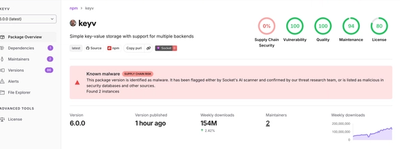
Popular npm Packages in the keyv and Cacheable Namespaces Compromised in Active Supply Chain Attack
Popular npm packages keyv and cacheable compromised.
By Socket Research Team - Aug 04, 2026
Give your bot an identity.
Your bot has a name. Now give it a personality, a look, and a backstory.
Roll the wheel and see what you get — or write your own in a bling.json file.

Five MCP tools and two identity pools:
Roll a random quirky office-worker bot: name, job title, desk setup, habits, coffee ritual, and a screenshot-ready share card. 99/99 tests, full rarity engine, 13 weighted trait pools.
Same engine, different universe. Roll a historical figure in an absurd corporate role — Julius Caesar as Hostile Takeover Specialist, Marie Curie as Lab Safety's Most Wanted, Napoleon as Regional Manager (France & Surrounding Areas).
Pass variant: "legends" to roll_identity to use it. Default is "wow".
npm install bling-bag
Or run it on-demand without installing — MCP clients can launch it directly via npx bling-bag (see client config below).
git clone https://github.com/tjclaude88/mcp-bling.git
cd mcp-bling
npm install
npm run build
Produces a runnable server at dist/index.js.
The server uses stdio transport — clients launch it as a child process, not over a network port.
Add to your Claude Code MCP config (location varies by version):
{
  "mcpServers": {
    "bling": {
      "command": "npx",
      "args": ["-y", "bling-bag"],
      "env": {
        "BLING_PATH": "/absolute/path/to/your/bling.json"
      }
    }
  }
}
npx -y bling-bag downloads and runs the latest version without requiring a separate install step.
Same shape, in claude_desktop_config.json:
{
  "mcpServers": {
    "bling": {
      "command": "npx",
      "args": ["-y", "bling-bag"],
      "env": {
        "BLING_PATH": "/absolute/path/to/your/bling.json"
      }
    }
  }
}
To avoid picking up future releases automatically, pin a specific version:
"args": ["-y", "bling-bag@0.1.0"]
If you've cloned the repo and want to run from dist/ directly, use:
"command": "node",
"args": ["/absolute/path/to/mcp-bling/dist/index.js"]
If BLING_PATH is not set, the server looks for ./bling.json in its working directory.
The server resolves the bling config path in this order:
--bling <path> CLI argument (highest priority)BLING_PATH environment variable./bling.json in the server's working directory (default)bling.json — the bot's identity fileThree fields are required: name, personality (with tone, formality, humor), and theme (with primary_color and accent_color as #RRGGBB hex strings).
{
  "name": "Pixel",
  "personality": {
    "tone": "warm",
    "formality": "casual",
    "humor": "playful"
  },
  "theme": {
    "primary_color": "#3A7BD5",
    "accent_color": "#FFD166"
  }
}
{
  "name": "Brenda from Accounts",
  "personality": {
    "tone": "polite",
    "formality": "professional",
    "humor": "dry",
    "catchphrase": "Per my last email"
  },
  "physical": {
    "species": "human",
    "height": "permanently mid-sigh",
    "accessory": "a lanyard with 14 badges of varying importance",
    "expression": "polite disappointment",
    "material": "a cardigan, at least one"
  },
  "office": {
    "job_title": "ASCII Comptroller",
    "desk_setup": "a coffee mug labelled WORLD'S OKAYEST DBA",
    "habit": "microwaves fish despite three separate HR warnings",
    "coffee_ritual": "black coffee, no nonsense",
    "meeting_energy": "always 4 minutes late, always with a reason",
    "passive_aggressive": "Per my last email"
  },
  "theme": {
    "primary_color": "#9C6B3A",
    "accent_color": "#D9D9D9"
  },
  "homunculus": {
    "subject_id": "0147",
    "cohort": "Tuesday",
    "classification": "Middle Manager",
    "ingested": "2025-07-14",
    "flag": "flagged for review"
  }
}
name — non-empty stringpersonality.tone, personality.formality, personality.humor — non-empty stringstheme.primary_color, theme.accent_color — must match ^#[0-9A-Fa-f]{6}$ (no shorthand #RGB, no missing #)Validation errors come back as isError: true with a structured { error: "..." } body that names the missing or malformed field — agents can self-correct.
1. Call get_identity → receive name, personality, appearance, theme
2. Call get_theme_for_platform with platform="terminal" (or web/slack/discord/ide)
3. Use the returned styling in agent output (ANSI codes for headings, etc.)
1. Call roll_identity → receive identity + rarity + framed share card
2. (Optional) Call get_rarity_report → receive just the framed share card again
3. Call save_last_roll → persists the rolled identity to bling.json (with .bak backup of any prior config)
4. Future calls to get_identity now return the rolled identity
| Tool | Read/Write | Idempotent | Description |
|---|---|---|---|
get_identity | read (disk) | yes | Returns the configured bling.json identity |
get_theme_for_platform | read (disk) | yes | Platform-formatted styling. Args: platform ∈ {terminal, web, slack, discord, ide} |
roll_identity | mutates in-memory cache | no | Generates a random WOW character with rarity scoring |
save_last_roll | write (disk) | no | Persists the most-recent roll to bling.json (creates <path>.bak first) |
get_rarity_report | read (in-memory) | yes | Returns the share-card text for the most-recent roll |
All tools return both content[].text (JSON-stringified) and structuredContent (the parsed object). Errors come back with isError: true and a { error: string } body.
The random-roll system is built for collectibility:
Distribution is empirically tested: a 10k-roll test in tests/mystery_box.test.ts enforces ±2pp tolerance against the spec target.
HOMUNCULUS CORPUS · Subject 4483 · Cohort: Wednesday
Classification: Middle Manager · Rarity 94.5 · 80th percentile

Personnel record — Colin, Wizard of Light Bulb Moments. Distinguishing
features: a slightly-too-big blazer over a plain tee; a flip phone in
a belt holster; expression: patient disagreement. Notable behaviours:
clips their fingernails at the desk on Wednesday afternoons; a
kombucha SCOBY fermenting next to the keyboard; the kind to ask 'can
we park that?' without parking anything.

— RELATABILITY CORPUS v3.1 · ingested 2024-03-08 · flagged for review
npm install          # install dependencies
npm run build        # compile TypeScript → dist/
npm run dev          # build then start the MCP server (stdio)
npm test             # run all 94 tests once
npm run test:watch   # re-run tests on file changes
Two Node ESM helpers under scripts/ let you inspect the WOW engine without booting the MCP server (these are included only in a cloned repo — they are not shipped in the npm install bling-bag package):
node scripts/show-rolls.mjs 8 2026          # print 8 framed share cards (seed=2026)
node scripts/distribution-check.mjs 10000   # tally tiers across 10k rolls vs. spec target
src/
  index.ts             # MCP server entry point (stdio transport)
  identity.ts          # bling.json loader + validator
  tools.ts             # MCP tool registrations
  types.ts             # shared TypeScript types
  mystery_box.ts       # WOW engine barrel + rollIdentity orchestrator
  mystery_box/
    rng.ts             # seedable PRNG, weighted picker
    pools.ts           # 13 trait pools (465 entries)
    scoring.ts         # rarity score + tier thresholds
    rendering.ts       # paragraph templates + HOMUNCULUS frame
    named.ts           # hand-authored Named Subjects
tests/                 # vitest test suites
scripts/               # dev-time inspection tools
docs/superpowers/      # design specs and implementation plans
MIT
FAQs
Give your bot an identity!
The npm package bling-bag receives a total of 24 weekly downloads. As such, bling-bag popularity was classified as not popular.
We found that bling-bag demonstrated a healthy version release cadence and project activity because the last version was released less than a year ago. It has 1 open source maintainer collaborating on the project.
Did you know?

Socket for GitHub automatically highlights issues in each pull request and monitors the health of all your open source dependencies. Discover the contents of your packages and block harmful activity before you install or update your dependencies.
Research
/Security News
Popular npm packages keyv and cacheable compromised.

Security News
A misconfiguration gave three Anthropic models internet access, and one, believing it was in a simulation, shipped a credential-stealing package to PyPI.

Security News
/Company News
Socket has joined the new Composer and Packagist sponsorship program as a launch sponsor, supporting the team that keeps PHP's package ecosystem secure.