
Research
/Security News
Popular npm Packages in the keyv and Cacheable Namespaces Compromised in Active Supply Chain Attack
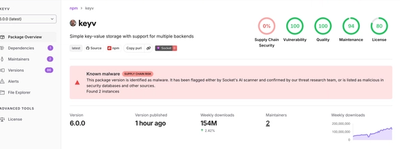
Popular npm packages keyv and cacheable compromised.
By Socket Research Team - Aug 04, 2026

Local-first, tamper-evident audit trails for AI conversations, tool calls, code changes, and secrets — with deterministic compliance review across SOC 2, ISO 27001, EU AI Act, and NIST AI RMF.
AI tools show when you sent a message. Chron logs when the AI responded too — and keeps a permanent, queryable, tamper-evident record of the AI work happening across your tools.
Works with Claude Desktop, Claude Code, Cursor, Windsurf, Codex, and any MCP-compatible AI tool.
AI tools produce no audit trail by default. You cannot answer:
Chron fixes that. Every exchange is logged with a precise local datetime (including timezone offset) to a SQLite file you own. It can hash-chain every event, sign sessions with Ed25519, detect secrets/PII, run deterministic compliance review across four frameworks, and stream metadata-only events to your SIEM. No cloud, no vendor lock-in, no message content leaving your machine.
Chron stores a local audit trail of:
Chron's SIEM integrations send only metadata: session starts, role-only message events, and masked secret detections. Message content and raw secret values stay local.
Need runtime policy enforcement for AI agents? CLAIIM adds agent identity, approval workflows, and ALLOW/DENY gates on top of Chron proof. Try the public preview: https://claiim.io/preview
MCP server (for Claude Desktop, Claude Code, Cursor, Windsurf):
Add to your AI tool's MCP config:
{
"mcpServers": {
"chron": {
"command": "npx",
"args": ["-y", "chron-mcp"]
}
}
}
CLI (for chron history, chron connect, chron export, etc.):
npm install -g chron-mcp
npx chron-mcpstarts the MCP server only — it does not put thechronCLI command in your PATH. You need a global install for the CLI.
First run creates ~/.chron/chron.db automatically. No database setup, no env vars, no migrations.
Check your setup:
chron doctor
For CI or automation:
chron doctor --json
After npm install -g chron-mcp, the chron command is available globally:
Usage: chron <command> [options]

Commands:
  history         List sessions or show full log for a session
  report          Aggregate audit stats across sessions
  export          Export a session as markdown
  secrets         List detected secrets across sessions
  settings        View current configuration
  connect         Connect to a SIEM or AI tool (codex, crowdstrike, sentinel, splunk)
  summary         Structured summary of a session (timeline, mutations, secrets)
  sign            Sign a session with its Ed25519 key — produces a .chron.sig file
  verify          Verify a session's hash chain and Ed25519 signature
  prune           Delete sessions older than a retention cutoff
  doctor          Check your Chron setup — Node version, DB, MCP configs, SIEM
  import          Import conversations from external AI tools into Chron
  review          Review AI sessions against compliance control criteria
  update          Update chron to the latest version

Options (history):
  --limit=<n>       Max sessions to show (default: 20)
  --search=<query>  Full-text search across all sessions (FTS5: phrases, boolean, prefix*)
  --ref=<value>     Filter by external_ref prefix (e.g. --ref=jira:ENG-123)
  <id-prefix>       Show full log for the session with this ID prefix

Options (report):
  --since=<range>   Filter by date: 7d, 30d, or YYYY-MM-DD (default: all time)
  --format=soc2     Generate SOC 2 HTML evidence package
  --output=<file>   Output file for --format=soc2

Options (export):
  <id-prefix>       Markdown export for a single session
  --signed          Tamper-evident bundle (JSONL + manifest + Ed25519 sig)
  --session=<id>    Filter bundle to a single session
  --since=<range>   Filter bundle by date: 7d, 30d, or YYYY-MM-DD
  --output=<file>   Output path (default: bundle.chron.tar.gz)

Options (verify):
  <id-prefix>       Verify a session's hash chain + Ed25519 signature
  --bundle=<file>   Verify a signed bundle offline (no DB needed)

Options (prune):
  --older-than=<n>d  Cutoff in days (falls back to retention_days in config)
  --dry-run          Show what would be deleted without deleting
  --confirm          Required flag to actually delete

Options (doctor):
  --json             Machine-readable JSON output

Options (import):
  chatgpt <file>     Import from ChatGPT export (.zip or conversations.json)

Options (review):
  --framework=<name>  Framework to review against: soc2, iso27001, euaiact, nist-ai-rmf
  --since=<range>     Limit to sessions since: 7d, 30d, or YYYY-MM-DD
  --all               Include accepted, dismissed, and resolved findings
  --output=<file>     Write HTML report to file (printable to PDF from browser)
  accept <id>         Mark a finding as accepted; supports --note=<text>
  dismiss <id>        Mark a finding as dismissed; supports --note=<text>
  resolve <id>        Mark a finding as resolved; supports --note=<text>
chron review scans your session history and flags findings against a compliance framework. No model inference. No API calls. Pure deterministic pattern matching on structured events Chron already captured.
chron review --framework=soc2
chron review --framework=iso27001
chron review --framework=euaiact
chron review --framework=nist-ai-rmf
Add --since=30d to scope to recent sessions, and --output=report.html to generate a printable HTML evidence report.
Four frameworks supported:
| Framework | Rules | Controls covered |
|---|---|---|
| SOC 2 | 5 | CC6.1, CC6.6, CC6.7, CC7.2, CC8.1 |
| ISO 27001:2022 | 6 | A.8.2, A.8.3, A.8.12, A.8.20, A.8.24, A.8.31 |
| EU AI Act | 6 | Art. 9, Art. 10, Art. 12, Art. 13, Art. 14 |
| NIST AI RMF 1.0 | 7 | GOVERN, MAP, MEASURE, MANAGE |
Finding workflow:
Every finding has a stable SHA-256 ID. Act on findings as you review:
chron review accept <id> --note="approved by security team, PR #512"
chron review dismiss <id> --note="test fixture, not production code"
chron review resolve <id> --note="credential rotated, no commit exposure"
chron review --framework=soc2 --all   # show accepted/dismissed/resolved too
Reviewed findings do not reappear as noise on the next run. New findings — from sessions since your last review — surface cleanly.
Important: Chron covers the subset of controls evaluable from AI coding session evidence. A full framework assessment requires policy documentation, board records, and auditor judgement that session logs cannot replace. Each HTML report includes a framework-specific disclaimer on the cover page.
chron doctorchron doctor validates the pieces that make Chron useful in real life:
npx chron-mcp --version/health~/.chron/config.jsonWarnings for optional integrations do not fail the command. Real failures exit with code 1.
Every exchange is recorded with precise local timestamps — user message when received, assistant response when sent:
[user: 2026-05-08 14:32:11 +02:00 | assistant: 2026-05-08 14:32:43 +02:00]

The main risks of deploying this contract are...
The gap between user and assistant timestamps is real generation time. Both are stored in your local SQLite DB with full timezone offset.
Edit ~/Library/Application Support/Claude/claude_desktop_config.json (macOS) or %APPDATA%\Claude\claude_desktop_config.json (Windows):
{
  "mcpServers": {
    "chron": {
      "command": "npx",
      "args": ["-y", "chron-mcp"]
    }
  }
}
claude mcp add chron -- npx -y chron-mcp
Then add the skill hook to ~/.claude/settings.json:
{
  "hooks": {
    "SessionStart": [
      {
        "hooks": [
          {
            "type": "command",
            "command": "cat ~/.chron/chron.skill.md"
          }
        ]
      }
    ]
  }
}
Edit ~/.cursor/mcp.json:
{
  "mcpServers": {
    "chron": {
      "command": "npx",
      "args": ["-y", "chron-mcp"]
    }
  }
}
Edit ~/.codeium/windsurf/mcp_config.json:
{
  "mcpServers": {
    "chron": {
      "command": "npx",
      "args": ["-y", "chron-mcp"]
    }
  }
}
Chron ships with skills/chron.skill.md — a plain-text instruction file that tells the AI how to use the MCP tools automatically. Load it into your AI tool once. After that, the AI:
[user: YYYY-MM-DD HH:MM:SS ±HH:MM | assistant: YYYY-MM-DD HH:MM:SS ±HH:MM] at the top of every response| Tool | Description |
|---|---|
init_session | Initialize or resume a session — returns session_id, message count, and recent messages in one call |
start_session | Create a new named audit session (legacy — prefer init_session) |
log_message | Record a single message with the current local datetime |
log_tool_call | Record an AI tool invocation as an audit event |
log_tool_result | Record tool output and link it to a tool call |
log_code_change | Record a file edit with operation and unified diff |
log_exchange | Log a user/assistant pair atomically (for batch imports) |
list_sessions | List all sessions ordered by most recently active |
get_session_history | Retrieve the full timestamped log for a session |
verify_session | Verify the tamper-evident hash chain — detects any post-log edits |
scan_prompt | Scan text for secrets (API keys, credentials) before logging — returns masked detections |
rehydrate_response | Restore redacted placeholders in an assistant response back to their original values |
delete_session | Delete a session and cascade its messages/secrets |
summarize_session | Return a timeline summary with latency, mutations, secrets, and prod references |
Every new audit event is linked to the previous one via a SHA-256 chain:
content_hash = SHA256(session_id | role | content | created_at | prev_hash | event_type)
verify_session walks the chain and returns:
valid: true — no messages were modified after loggingvalid: false, first_break: <id> — exact row ID of the first tampered messageThis turns your local log into a verifiable audit artifact. Any edit to a stored message — content, timestamp, or role — breaks the chain and is detected immediately.
Chron also generates an Ed25519 keypair per new session when possible. The private key stays under ~/.chron/keys. Use:
chron sign <session-id-prefix>
chron verify <session-id-prefix>
For portable evidence:
chron export --signed --session=<session-id-prefix> --output=evidence.chron.tar.gz
chron verify --bundle=evidence.chron.tar.gz
chron verify also reports NTP clock attestation metadata for sessions created with clock-check support.
Chron can detect and mask:
Use:
chron secrets
chron secrets <session-id-prefix>
MCP tools can also call scan_prompt before sending content to an AI tool. Redaction uses $CHRON_* placeholders and rehydrate_response can restore values from the returned token map.
chron history
chron summary <session-id-prefix>
chron report --since=30d
chron report --format=soc2 --output=soc2-report.html
chron export <session-id-prefix>
chron export --signed --since=30d --output=bundle.chron.tar.gz
chron prune --older-than=90d --dry-run
The SOC 2 report and signed bundles are designed for audit review, legal hold, and incident reconstruction without sending conversation content to Chron infrastructure.
Stream AI session telemetry directly from developer machines into your CrowdStrike LogScale repository. No relay service — events go straight to your own LogScale instance.
What gets sent: session starts, message counts (role only), and masked credential detections. Message content never leaves the machine.
1. Create a LogScale repository and ingest token
In Falcon console → Log Management → Repositories → New repository (name it ChronAIEvents).
Then Settings → API Tokens → Add token → select Ingest permission → copy the token.
Your ingest URL follows this pattern:
https://<your-cluster>.humio.com/api/v1/ingest/humio-structured
2. Install the CLI and run the onboarding wizard
npm install -g chron-mcp
chron connect crowdstrike
# Paste your ingest URL and token when prompted
# The wizard sends a test event and confirms before saving
3. Add env vars to your MCP client config
The wizard prints the exact block to paste. For Claude Code, add to the chron entry in ~/.claude.json:
{
  "mcpServers": {
    "chron": {
      "command": "npx",
      "args": ["-y", "chron-mcp"],
      "env": {
        "CHRON_LOGSCALE_URL": "https://<your-cluster>.humio.com/api/v1/ingest/humio-structured",
        "CHRON_LOGSCALE_TOKEN": "<your-ingest-token>"
      }
    }
  }
}
Restart your AI tool to pick up the new env vars.
4. Import the pre-built dashboard
In Falcon → Log Management → Dashboards → Import:
node_modules/chron-mcp/dashboards/logscale/chron-ai-activity.yaml
Full guide with SOC alert setup: dashboards/logscale/README.md
| Env var | Description |
|---|---|
CHRON_LOGSCALE_URL | LogScale ingest endpoint |
CHRON_LOGSCALE_TOKEN | LogScale ingest token |
Both must be set for events to flow. If unset, the integration is silently disabled.
Stream AI session telemetry into Splunk via HTTP Event Collector (HEC). Works with Splunk Enterprise, Splunk Cloud, and a local Docker instance.
What gets sent: session starts, message counts (role only), and masked credential detections. Message content never leaves the machine.
Option A — Local Docker (fastest, no account needed)
# Start a local Splunk instance (Apple Silicon: --platform linux/amd64 is required)
docker run -d --name splunk-chron \
  --platform linux/amd64 \
  -p 8000:8000 -p 8088:8088 \
  -e SPLUNK_START_ARGS=--accept-license \
  -e SPLUNK_GENERAL_TERMS=--accept-sgt-current-at-splunk-com \
  -e SPLUNK_PASSWORD=Admin1234! \
  -e SPLUNK_HEC_TOKEN=chron-test-token \
  splunk/splunk:latest

# Wait ~2 minutes, then watch until ready:
docker logs -f splunk-chron 2>&1 | grep -i "Ansible playbook complete"
Option B — Splunk Enterprise or Cloud
Settings → Data Inputs → HTTP Event Collector → New Token → name it chron-ingest → source type chron:event → copy the token.
2. Install the CLI and run the onboarding wizard
npm install -g chron-mcp
chron connect splunk
# For local Docker: URL = https://localhost:8088, Token = chron-test-token
# TLS verification is skipped automatically for localhost (self-signed cert)
3. Add env vars to your MCP client config
The wizard prints the exact block to paste. For Claude Code, add to ~/.claude.json:
{
  "mcpServers": {
    "chron": {
      "command": "npx",
      "args": ["-y", "chron-mcp"],
      "env": {
        "CHRON_SPLUNK_URL": "https://localhost:8088",
        "CHRON_SPLUNK_TOKEN": "chron-test-token",
        "CHRON_SPLUNK_INSECURE": "1"
      }
    }
  }
}
Remove
CHRON_SPLUNK_INSECUREfor production Splunk instances with valid TLS certificates.
Restart your AI tool to pick up the new env vars.
4. Search in Splunk
Open http://localhost:8000 → Search & Reporting → run:
sourcetype="chron:event"
Events appear in real time as you have AI conversations.
Full guide with dashboard templates and alert setup: dashboards/splunk/README.md
| Env var | Description |
|---|---|
CHRON_SPLUNK_URL | Splunk HEC base URL, e.g. https://localhost:8088 or https://your-host:8088 |
CHRON_SPLUNK_TOKEN | HEC ingest token |
CHRON_SPLUNK_INSECURE | Set to 1 to skip TLS verification (local Docker with self-signed cert) |
CHRON_SPLUNK_URL and CHRON_SPLUNK_TOKEN must both be set for events to flow.
Stream AI session telemetry into your Microsoft Sentinel workspace via the Azure Monitor Logs Ingestion API. Events go directly from developer machines to your own Log Analytics workspace — no relay service.
What gets sent: session starts, message counts (role only), and masked credential detections. Message content never leaves the machine.
1. Register an Azure App
Azure Portal → Azure Active Directory → App registrations → New registration → name it chron-ingest.
Note the Application (client) ID and Directory (tenant) ID.
Go to Certificates & secrets → New client secret → copy the value immediately.
2. Create a custom table in Log Analytics
Open your Log Analytics workspace → Tables → Create → New custom log (DCR-based) → name it ChronEvents_CL.
Add these columns (in addition to the auto-added TimeGenerated):
| Column | Type |
|---|---|
EventType | string |
SessionIdPrefix | string |
AiTool | string |
OS | string |
ChronVersion | string |
Computer | string |
Role | string |
DetectionType | string |
MaskedValue | string |
The wizard creates a Data Collection Endpoint (DCE) and Data Collection Rule (DCR) — note both.
3. Grant the App ingest permission
Open the DCR → Access control (IAM) → Add role assignment → Role: Monitoring Metrics Publisher → Member: the chron-ingest app.
4. Get the DCR Immutable ID
Open the DCR → Overview → JSON view → copy the immutableId field (starts with dcr-).
5. Install the CLI and run the onboarding wizard
npm install -g chron-mcp
chron connect sentinel
# Enter tenant ID, client ID, client secret, DCE URL, DCR immutable ID, and stream name
# The wizard authenticates with Azure AD and sends a test event before saving
6. Add env vars to your MCP client config
The wizard prints the exact block to paste. For Claude Code, add to ~/.claude.json:
{
  "mcpServers": {
    "chron": {
      "command": "npx",
      "args": ["-y", "chron-mcp"],
      "env": {
        "CHRON_SENTINEL_TENANT_ID": "<your-tenant-id>",
        "CHRON_SENTINEL_CLIENT_ID": "<your-client-id>",
        "CHRON_SENTINEL_CLIENT_SECRET": "<your-client-secret>",
        "CHRON_SENTINEL_DCE": "https://<your-dce>.ingest.monitor.azure.com",
        "CHRON_SENTINEL_DCR_ID": "dcr-<your-immutable-id>",
        "CHRON_SENTINEL_STREAM": "Custom-ChronEvents_CL"
      }
    }
  }
}
Restart your AI tool to pick up the new env vars.
7. Query in Sentinel
Sentinel → Logs → paste any query from dashboards/sentinel/:
ChronEvents_CL
| where TimeGenerated > ago(24h)
| summarize count() by EventType, AiTool
Full guide with KQL queries and alert rule setup: dashboards/sentinel/README.md
| Env var | Description |
|---|---|
CHRON_SENTINEL_TENANT_ID | Azure AD tenant ID |
CHRON_SENTINEL_CLIENT_ID | App Registration client ID |
CHRON_SENTINEL_CLIENT_SECRET | App Registration client secret |
CHRON_SENTINEL_DCE | Data Collection Endpoint URL |
CHRON_SENTINEL_DCR_ID | DCR Immutable ID (starts with dcr-) |
CHRON_SENTINEL_STREAM | Stream name, e.g. Custom-ChronEvents_CL |
All six must be set for events to flow. Token refresh is automatic (1-hour Azure AD tokens, refreshed 60s before expiry).
| Env var | Default | Description |
|---|---|---|
CHRON_DB_PATH | ~/.chron/chron.db | Path to SQLite database file |
CHRON_TRANSPORT | stdio | Set to http to enable HTTP+SSE mode |
CHRON_API_KEY | (none) | Bearer token for HTTP mode |
PORT | 3001 | Port for HTTP mode |
CHRON_LOGSCALE_URL | (none) | LogScale ingest endpoint (enables CrowdStrike integration) |
CHRON_LOGSCALE_TOKEN | (none) | LogScale ingest token |
CHRON_SENTINEL_TENANT_ID | (none) | Azure AD tenant ID (enables Sentinel integration) |
CHRON_SENTINEL_CLIENT_ID | (none) | App Registration client ID |
CHRON_SENTINEL_CLIENT_SECRET | (none) | App Registration client secret |
CHRON_SENTINEL_DCE | (none) | Data Collection Endpoint URL |
CHRON_SENTINEL_DCR_ID | (none) | DCR Immutable ID |
CHRON_SENTINEL_STREAM | (none) | Stream name (e.g. Custom-ChronEvents_CL) |
CHRON_SPLUNK_URL | (none) | Splunk HEC base URL (enables Splunk integration) |
CHRON_SPLUNK_TOKEN | (none) | Splunk HEC ingest token |
CHRON_SPLUNK_INSECURE | (none) | Set to 1 to skip TLS verification for local Splunk/self-signed certs |
CHRON_RELAY_URL | (none) | Generic relay endpoint (any SIEM or webhook) |
CHRON_RELAY_TOKEN | (none) | Bearer token for generic relay |
For teams or remote use, run Chron as an HTTP server:
CHRON_TRANSPORT=http CHRON_API_KEY=your-key PORT=3001 npx chron-mcp
Point your MCP config at the URL:
{
  "mcpServers": {
    "chron": {
      "url": "https://your-server/sse",
      "headers": {
        "Authorization": "Bearer your-key"
      }
    }
  }
}
Bring your existing ChatGPT history into Chron's tamper-evident audit trail.
# From a ChatGPT data export ZIP
chron import chatgpt ~/Downloads/chatgpt-export.zip

# Or from an extracted conversations.json
chron import chatgpt ~/Downloads/conversations.json
How to get your ChatGPT export: ChatGPT → Settings → Data Controls → Export data → wait for email → download the ZIP.
What gets imported:
ai_tool=chatgptexternal_ref=chatgpt:<conversation_id> on every session (visible in chron history)Re-running is safe — already-imported conversations are skipped by external_ref match.
After import, sessions appear in chron history and chron verify works on them the same as any natively-logged session.
Your audit log lives at ~/.chron/chron.db — a single SQLite file on your machine. Query it directly with any SQLite tool:
sqlite3 ~/.chron/chron.db \
  "SELECT s.title, m.role, m.content, m.created_at
   FROM messages m JOIN sessions s ON s.id = m.session_id
   ORDER BY m.created_at"
No cloud, no telemetry, no data leaving your machine. Change the location with CHRON_DB_PATH.
Copyright (c) 2026 Nivaya. All rights reserved.
Source code is public for transparency only. Cloning, forking, modification, and redistribution are not permitted without explicit written permission. See LICENSE for full terms.
FAQs
Audit-grade timestamped logs for every AI conversation
The npm package chron-mcp receives a total of 410 weekly downloads. As such, chron-mcp popularity was classified as not popular.
We found that chron-mcp demonstrated a healthy version release cadence and project activity because the last version was released less than a year ago. It has 1 open source maintainer collaborating on the project.
Did you know?

Socket for GitHub automatically highlights issues in each pull request and monitors the health of all your open source dependencies. Discover the contents of your packages and block harmful activity before you install or update your dependencies.
Research
/Security News
Popular npm packages keyv and cacheable compromised.

Security News
A misconfiguration gave three Anthropic models internet access, and one, believing it was in a simulation, shipped a credential-stealing package to PyPI.

Security News
/Company News
Socket has joined the new Composer and Packagist sponsorship program as a launch sponsor, supporting the team that keeps PHP's package ecosystem secure.