

Company News
AWS Security Hub Adds Socket for Supply Chain Security
Socket is now in the AWS Security Hub Extended plan. Adopt it through AWS, apply committed spend, and block malicious open source packages.
By Feross Aboukhadijeh - Aug 04, 2026
CLI tool that analyzes TypeScript/JavaScript and Python codebases to generate knowledge graphs, system design analysis, and security assessments
A CLI tool and library that analyzes TypeScript/JavaScript and Python codebases to generate knowledge graphs, system design analysis, and security assessments.
--language to overrideANTHROPIC_API_KEY environment variable (only if using LLM enrichment)# Install dependencies
npm install
# Build the project
npm run build
# Install globally (makes 'cmiw' available everywhere)
npm link
To uninstall the global command later: npm unlink -g cmiw
CMIW provides granular subcommands designed for both human users and coding agents:
cmiw analyze <path>       Full analysis pipeline (components + graph + security + architecture)
cmiw components <path>    Extract components only -> JSON array
cmiw graph <path>         Build knowledge graph -> JSON object
cmiw security <path>      Security analysis only -> JSON object
cmiw schema <type>        Output JSON Schema for a type (no project needed)
# Full analysis (terminal output, no LLM)
cmiw analyze ./my-project --skip-llm

# JSON output to file
cmiw analyze ./my-project --skip-llm --format json -o report.json

# SARIF output for CI/CD integration
cmiw analyze ./my-project --skip-llm --format sarif -o results.sarif

# Markdown report
cmiw analyze ./my-project --format markdown -o report.md

# Analyze a remote git repository
cmiw analyze https://github.com/user/repo --skip-llm

# With LLM enrichment (requires ANTHROPIC_API_KEY)
cmiw analyze ./my-project

# Extract only components (always JSON)
cmiw components ./my-project --quiet

# Build knowledge graph only
cmiw graph ./my-project --quiet

# Security scan with exit code (0=clean, 2=findings)
cmiw security ./my-project --quiet

# Discover output shapes before calling subcommands
cmiw schema components
cmiw schema graph
cmiw schema security
cmiw schema report
Shared options (available on analyze, components, graph, security):
| Option | Description | Default |
|---|---|---|
<path> | Project directory (or git URL for analyze) | required |
--tsconfig <path> | Path to tsconfig.json | Auto-detected |
--language <lang> | Language: typescript, python, auto | auto |
-v, --verbose | Enable debug logging | false |
-q, --quiet | Suppress progress output (auto-enabled when piped) | false |
Analyze-specific options:
| Option | Description | Default |
|---|---|---|
-o, --output <path> | Write output to file instead of stdout | stdout |
-f, --format <format> | Output format: terminal, json, sarif, markdown | terminal |
--skip-llm | Skip Claude AI enrichment | false |
Security options (available on analyze and security):
| Option | Description | Default |
|---|---|---|
--config <path> | Path to .cmiwrc.json config file | Auto-detected |
--min-severity <level> | Minimum severity: critical, high, medium, low, info | all |
--disable-rules <ids> | Comma-separated rule IDs to disable | none |
| Code | Meaning | Commands |
|---|---|---|
| 0 | Success (or no security findings above threshold) | all |
| 1 | Error (invalid path, parse failure, runtime error) | all |
| 2 | Security findings found above severity threshold | analyze, security |
Exit code 2 lets CI/CD pipelines and agents gate on security without parsing JSON.
For the full agent integration guide with detailed examples, patterns, and error handling, see docs/agent-integration.md.
CMIW is designed to be a first-class tool for coding agents (Claude Code, Cursor, custom MCP agents). The granular subcommands output structured JSON that agents can parse and act on directly.
jq), spinners are automatically suppressed. No --quiet flag needed.components, graph, and security subcommands always output JSON. No --format flag needed.cmiw schema <type> to discover the output shape before calling the actual subcommand. No documentation lookup needed.cmiw security exits with code 2 if findings exist, enabling simple if checks without JSON parsing.Get component names:
cmiw components ./project | jq '.[].name'
Check if project has security issues:
cmiw security ./project --quiet
# $? == 0 -> clean, $? == 2 -> has findings
Get security findings with severity filter:
cmiw security ./project --min-severity high | jq '.findings[] | {title, severity, filePath, startLine}'
Build graph and extract circular dependencies:
cmiw graph ./project | jq '.circularDependencies'
Discover output shape before calling:
# Learn what fields CmiwComponent has
cmiw schema components | jq '.items.properties | keys'

# Then extract components
cmiw components ./project | jq '.[0]'
Full analysis as JSON (auto-quiets in pipe):
cmiw analyze ./project --skip-llm --format json | jq '.security.grade'
CMIW includes ready-to-use Claude Code skills for interactive agent workflows:
/cmiw-security -- Scan a project, present findings, offer to fix them, re-scan to verify/cmiw-diagram -- Generate a Mermaid system design diagram from codebase analysisInstall them by copying from docs/skills/ to ~/.claude/skills/. See docs/agent-integration.md for full details and instructions for writing your own skills.
All analysis functions are available for programmatic use:
import {
  loadProject,
  extractComponents,
  buildRelationships,
  buildGraph,
  analyzeSecurityPosture,
  assembleReport,
  formatJson,
  formatSarif,
  formatMarkdown,
  formatTerminal,
} from 'cmiw-cli';

const project = loadProject({ targetPath: './my-project' });
const components = extractComponents(project);
const relationships = buildRelationships(project, components);
const graph = buildGraph(components, relationships);
const security = analyzeSecurityPosture(project);

const report = assembleReport({
  analyzedPath: './my-project',
  components,
  relationships,
  graph,
  architecture: { layers: [], patterns: [], decisions: [], summary: 'Static only' },
  security,
  startTime: Date.now(),
  llmEnriched: false,
});

console.log(formatJson(report));
The analyze command runs 8 phases in sequence:
CmiwReport and formats the output| Rule ID | Name | Severity | CWE | OWASP | What It Detects |
|---|---|---|---|---|---|
| cmiw-sec-001 | Unsanitized Input | High | CWE-79 | A03:2021 | req.body/req.query flowing directly into innerHTML, .query(), etc. |
| cmiw-sec-002 | SQL Injection | Critical | CWE-89 | A03:2021 | Template literals or string concatenation building SQL queries |
| cmiw-sec-003 | Missing Authentication | High | CWE-306 | A07:2021 | Express/Fastify route handlers without auth middleware |
| cmiw-sec-004 | Hardcoded Secrets | Critical | CWE-798 | A07:2021 | API keys, passwords, tokens assigned as string literals |
| cmiw-sec-005 | Unsafe Eval | Critical/High | CWE-95 | A03:2021 | eval(), Function(), innerHTML assignment, document.write() |
| cmiw-sec-006 | Command Injection | Critical | CWE-78 | A03:2021 | Dynamic input passed to exec(), execSync(), spawn() |
| cmiw-sec-007 | Path Traversal | High | CWE-22 | A01:2021 | User input used in readFile(), writeFile(), and other fs operations |
| Rule ID | Name | Severity | CWE | OWASP | What It Detects |
|---|---|---|---|---|---|
| cmiw-py-001 | SQL Injection | High | CWE-89 | A03:2021 | f-strings or .format() in cursor.execute(), db.execute() |
| cmiw-py-002 | Command Injection | Critical | CWE-78 | A03:2021 | User input in os.system(), subprocess, eval(), exec() |
| cmiw-py-003 | Path Traversal | High | CWE-22 | A01:2021 | User input in open(), os.path.join() without validation |
| cmiw-py-004 | Hardcoded Secrets | Medium | CWE-798 | A07:2021 | Passwords, API keys, tokens as string literals |
| cmiw-py-005 | Unsafe Deserialization | Critical | CWE-502 | A08:2021 | pickle.loads(), yaml.load() without SafeLoader |
| cmiw-py-006 | Missing Auth | Medium | CWE-862 | A01:2021 | Flask/Django routes without @login_required |
Supported Python frameworks: Flask, Django, FastAPI
Each finding deducts from a base score of 100:
Grades: A (90-100), B (80-89), C (70-79), D (60-69), F (<60)
Security rules use intra-procedural data-flow (taint) analysis to trace whether user input sources actually reach dangerous sinks. This reduces false positives from flagging constant strings or config values that happen to appear near SQL/exec/fs calls.
How it works:
const name = req.body.name) are marked as taintedconst x = name), destructuring (const { id } = req.params), and property access (body.email)Limitations:
Create a .cmiwrc.json file in your project root to configure security rules. CMIW searches the target directory and its parents for this file.
Full config example:
{
  "security": {
    "minSeverity": "medium",
    "customSources": ["ctx.request.body", "event.data"],
    "customSinks": {
      "sql": ["prisma.$queryRaw", "knex.raw"],
      "command": ["shelljs.exec"]
    },
    "customRouterNames": ["api", "v1"],
    "trustedMiddleware": ["rateLimiter", "helmet"],
    "falsePositivePatterns": ["DEMO_KEY", "test_token"],
    "rules": {
      "cmiw-sec-003": { "enabled": false },
      "cmiw-sec-004": { "severity": "medium" }
    }
  }
}
Config options:
| Option | Type | Description |
|---|---|---|
minSeverity | string | Filter out findings below this level (critical, high, medium, low, info) |
customSources | string[] | Additional taint source patterns (e.g., ctx.request.body for Koa, event.data for Lambda) |
customSinks.sql | string[] | Additional method names treated as SQL sinks (e.g., prisma.$queryRaw) |
customSinks.command | string[] | Additional method names treated as command execution sinks |
customRouterNames | string[] | Additional object names recognized as HTTP routers for missing-auth checks |
trustedMiddleware | string[] | Additional middleware names that count as authentication (for missing-auth rule) |
falsePositivePatterns | string[] | Additional strings that indicate a secret value is a placeholder (for hardcoded-secrets rule) |
rules.<id>.enabled | boolean | Disable a specific rule by ID |
rules.<id>.severity | string | Override the severity of all findings from a rule |
CLI overrides always win over file config. For example, --min-severity critical --disable-rules cmiw-sec-003 overrides any .cmiwrc.json settings.
Framework examples:
Express (default -- works out of the box):
{}
Koa:
{
  "security": {
    "customSources": ["ctx.request.body", "ctx.query", "ctx.params"],
    "customRouterNames": ["koaRouter"]
  }
}
Fastify:
{
  "security": {
    "customSources": ["request.body", "request.query", "request.params"],
    "customRouterNames": ["fastify"]
  }
}
Next.js API routes:
{
  "security": {
    "customSources": ["req.body", "req.query"],
    "rules": {
      "cmiw-sec-003": { "enabled": false }
    }
  }
}
AWS Lambda:
{
  "security": {
    "customSources": ["event.body", "event.queryStringParameters", "event.pathParameters"],
    "rules": {
      "cmiw-sec-003": { "enabled": false }
    }
  }
}
Colored output with severity-based highlighting. Critical/high findings in red, medium in yellow, low in blue. Includes summary metrics, architecture overview, security findings with file locations, and graph statistics.
Complete CmiwReport object with all metadata, components, relationships, graph, architecture, and security data. Pretty-printed with 2-space indentation.
Industry-standard Static Analysis Results Interchange Format. Integrates with GitHub Code Scanning, VS Code SARIF Viewer, and other security tools. Maps findings to SARIF results with rule definitions and severity levels.
Human-readable document with tables and lists. Suitable for documentation, pull request descriptions, or sharing with non-technical stakeholders.
When --skip-llm is not set and ANTHROPIC_API_KEY is configured, CMIW sends structured analysis summaries to Claude for two enrichments:
The LLM receives component/relationship summaries and graph statistics, not raw source code. If the API call fails, the report explicitly states the failure reason rather than silently falling back.
| Type | Description |
|---|---|
file | Source files (.ts, .tsx, .js, .jsx, .py) |
class | Class declarations with methods, properties, decorators |
function | Top-level function declarations with parameters and return types |
interface | TypeScript interfaces with property definitions |
type-alias | TypeScript type alias declarations |
enum | Enum declarations |
decorator | Python decorators extracted as first-class components |
| Type | Description |
|---|---|
imports | File-level import statements with named specifiers |
extends | Class inheritance |
implements | Interface implementation |
calls | Function/method call expressions resolved to declarations |
uses-type | Type references across files |
contains | Parent-child containment |
depends-on | General dependency |
src/
  cli/
    index.ts                    # Commander.js program setup + subcommand registration
    quiet-spinner.ts            # Spinner/quiet utility for pipe detection
    commands/
      analyze.ts                # Full analysis pipeline orchestration
      components.ts             # Extract components -> JSON
      graph.ts                  # Build knowledge graph -> JSON
      security.ts               # Security analysis -> JSON (exit code 2)
      schema.ts                 # Output JSON Schema for types
  analyzers/
    typescript/
      index.ts                  # TypeScriptAnalyzer (wraps ts-morph)
    python/
      index.ts                  # PythonAnalyzer (tree-sitter WASM)
      component-extractor.ts    # Python class/function extraction
      relationship-builder.ts   # Python import/call resolution
      security-rules.ts         # 6 Python-specific security rules
      taint-analysis.ts         # Python taint tracking
  core/
    project-loader.ts           # ts-morph Project initialization
    component-extractor.ts      # AST walking, component extraction
    relationship-builder.ts     # Import/call/hierarchy resolution
    graph-builder.ts            # Knowledge graph construction
    security-analyzer.ts        # Security rule orchestration, scoring
    report-assembler.ts         # Final report assembly
    config-loader.ts            # .cmiwrc.json finder, parser, merger
    language-analyzer.ts        # LanguageAnalyzer interface + factory
    language-detector.ts        # Auto-detect language from file extensions
  security/
    data-flow.ts                # Intra-procedural taint tracking
    rules/
      index.ts                  # Rule interface, registry, runner
      unsanitized-input.ts      # cmiw-sec-001
      sql-injection.ts          # cmiw-sec-002
      missing-auth.ts           # cmiw-sec-003
      hardcoded-secrets.ts      # cmiw-sec-004
      unsafe-eval.ts            # cmiw-sec-005
      command-injection.ts      # cmiw-sec-006
      path-traversal.ts         # cmiw-sec-007
  llm/
    client.ts                   # Anthropic SDK wrapper
    prompts.ts                  # Prompt templates for Claude
    enrichment.ts               # LLM enrichment orchestrator
  output/
    json-formatter.ts           # JSON output
    sarif-formatter.ts          # SARIF 2.1.0 output
    markdown-formatter.ts       # Markdown output
    terminal-formatter.ts       # Chalk-colored terminal output
  types/
    components.ts               # Component/relationship types and enums
    graph.ts                    # Graph node/edge/cluster types
    security.ts                 # Finding/rule/posture types
    architecture.ts             # Layer/pattern/decision types
    report.ts                   # CmiwReport top-level schema
    config.ts                   # CLI configuration types
    index.ts                    # Re-exports
  utils/
    logger.ts                   # Structured logging (debug/info/warn/error)
    id-generator.ts             # Deterministic component/relationship IDs
    errors.ts                   # CmiwError, ProjectLoadError, AnalysisError, LlmError
    git.ts                      # Git clone wrapper (simple-git)
  index.ts                      # Library API exports
bin/
  cmiw.js                       # CLI entry point (shebang wrapper)
tests/
  fixtures/
    simple-project/             # Known TS project for positive tests
    security-vulnerable/        # Intentionally vulnerable TS code for security tests
    python-project/             # Clean Python project for positive tests
    python-vulnerable/          # Intentionally vulnerable Python code for security tests
  unit/
    core/                       # Component extractor, relationship builder, graph builder
    security/                   # Security rule tests
    llm/                        # Prompt construction tests
    output/                     # Formatter tests
    utils/                      # ID generator tests
  integration/
    analyze-command.test.ts     # Full pipeline tests
    subcommands.test.ts         # Subcommand tests (components, graph, security, schema)
# Install dependencies
npm install

# Type check
npm run typecheck

# Run tests
npm test

# Run tests in watch mode
npm run test:watch

# Build for distribution
npm run build
Copy .env.example to .env and set your API key:
cp .env.example .env
# Edit .env and set ANTHROPIC_API_KEY
| Package | Purpose | Origin |
|---|---|---|
| ts-morph | TypeScript AST parsing | Canada |
| commander | CLI framework | Canada |
| @anthropic-ai/sdk | Claude API client | US |
| chalk | Terminal colors | Thailand |
| ora | Terminal spinners | Thailand |
| simple-git | Git operations | UK |
| node-sarif-builder | SARIF output | France |
| web-tree-sitter | WASM tree-sitter bindings | US (GitHub/Zed team) |
| tree-sitter-wasms | Prebuilt language grammars | US |
# Install globally
npm install -g cmiw-cli

# Or use with npx (no install)
npx cmiw-cli analyze ./my-project --skip-llm
npx cmiw-cli components ./my-project
npx cmiw-cli security ./my-project
FAQs
CLI tool that analyzes TypeScript/JavaScript and Python codebases to generate knowledge graphs, system design analysis, and security assessments
We found that cmiw-cli demonstrated a healthy version release cadence and project activity because the last version was released less than a year ago. It has 1 open source maintainer collaborating on the project.
Did you know?

Socket for GitHub automatically highlights issues in each pull request and monitors the health of all your open source dependencies. Discover the contents of your packages and block harmful activity before you install or update your dependencies.
Company News
Socket is now in the AWS Security Hub Extended plan. Adopt it through AWS, apply committed spend, and block malicious open source packages.
Research
/Security News
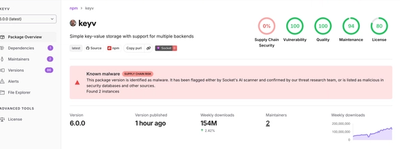
Popular npm packages keyv and cacheable compromised.

Security News
A misconfiguration gave three Anthropic models internet access, and one, believing it was in a simulation, shipped a credential-stealing package to PyPI.