

Security News
Federal Audit Finds NIST Wasted Funds With No Plan to Clear NVD Backlog
Federal audit finds NIST lacked a plan to clear the NVD backlog, wasted funds on duplicate work, and delayed use of CISA data.
By Sarah Gooding - Jun 03, 2026
confused-ai
Advanced tools
Fast TypeScript AI agent framework — per-request agents, 30+ model providers, 100+ integrations, 20+ vector DBs, 10+ databases, sessions, memory, knowledge, tracing, evals, HITL, teams, and workflows.

confused-ai is a TypeScript agent framework built around one stable install story: start with a single package, ship one useful agent, then layer tools, retrieval, sessions, serving, orchestration, and production controls without changing frameworks midway through the project.
import { agent, tool } from 'confused-ai';
import { z } from 'zod/v3';

const getQuote = tool({
	name: 'get_quote',
	description: 'Return a stock quote for a ticker symbol.',
	parameters: z.object({ symbol: z.string() }),
	execute: async ({ symbol }) => ({ symbol, price: 927.5, changePct: 1.4 }),
});

const financeAgent = agent({
	name: 'finance-agent',
	model: 'gpt-4o-mini',
	instructions: 'Use the tool to answer market questions in one concise sentence.',
	tools: [getQuote],
});

const result = await financeAgent.run("What's NVDA trading at today?");
console.log(result.text);
The intended feel is simple: plain TypeScript, one explicit capability at a time, and a direct path from small prototype to production-ready runtime.
Use confused-ai when you want to build one of these shapes from the same public API surface:
The design goal is not to force every feature on day one. The design goal is to let the first useful version stay small while keeping a direct path to a larger system.
| Primitive | Use it when |
|---|---|
| Agent | one model-backed worker can handle the task |
| Team | specialists should coordinate or delegate work |
| Workflow | the execution path should be staged, deterministic, or branching |
These three shapes cover most systems in the framework. The difference is not branding. The difference is how control flows through the application.
The cleanest adoption path is:
That order matters because it keeps the model behavior understandable before infrastructure complexity gets involved.
The public install story is intentionally simple.
| Import path | Use it for |
|---|---|
confused-ai | core agent authoring, composition, and common entry points |
confused-ai/session | session stores and continuity |
confused-ai/serve | HTTP runtime |
confused-ai/tool | MCP and broader tool infrastructure |
confused-ai/orchestration | teams, supervisors, roles, and tasks |
confused-ai/reasoning | explicit reasoning steps and events |
confused-ai/scheduler | scheduled jobs and run history |
confused-ai/observe | traces, metrics, and evaluation workflows |
confused-ai/adapters | infrastructure adapters and bindings |
confused-ai/guard | runtime control primitives such as circuit breakers |
Avoid internal @confused-ai/* package imports in application code and public documentation. Those paths describe the monorepo layout, not the intended consumer API.
The framework stays understandable if you think in layers:
Each layer is optional. Most real projects only need a subset.
| Capability | What it gives you |
|---|---|
| Tools | explicit boundaries for live data and side effects |
| Sessions | continuity across turns |
| Memory | retained facts and selective recall |
| Knowledge | retrieval-backed answers from indexed content |
| Storage | durable state around the agent |
| Serve | HTTP runtime for real applications |
| Orchestration | teams, supervisors, roles, and routing |
| Reasoning | explicit reasoning loops when the task needs them |
| Scheduler | time-based execution for reports, digests, and automation |
| Observe | traces, metrics, and evaluation workflows |
| Guardrails and HITL | validation, approvals, and policy-driven runtime control |
If you are new to the repo, follow this order:
docs/guide/introduction.md for the mental model and product story.docs/guide/getting-started.md for the first implementation path.docs/examples/index.md for runnable examples by difficulty.docs/guide/ pages for capability-specific guidance.docs/api/ pages for a compact public API map.The first milestone should be boring on purpose:
Once that path is correct, the rest of the framework becomes a set of focused additions rather than a wall of concepts to learn up front.
FAQs
Fast TypeScript AI agent framework — per-request agents, 30+ model providers, 100+ integrations, 20+ vector DBs, 10+ databases, sessions, memory, knowledge, tracing, evals, HITL, teams, and workflows.
We found that confused-ai demonstrated a healthy version release cadence and project activity because the last version was released less than a year ago. It has 1 open source maintainer collaborating on the project.
Did you know?

Socket for GitHub automatically highlights issues in each pull request and monitors the health of all your open source dependencies. Discover the contents of your packages and block harmful activity before you install or update your dependencies.
Security News
Federal audit finds NIST lacked a plan to clear the NVD backlog, wasted funds on duplicate work, and delayed use of CISA data.
Research
/Security News
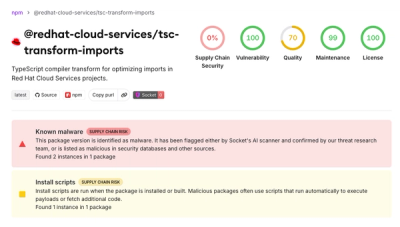
A mini Shai-Hulud campaign compromised Red Hat Cloud Services npm packages to steal developer and CI/CD secrets during installation.

Research
/Security News
The North Korean malware loader hides in a Packagist-listed package and its GitHub branch to fetch and execute remote code in a likely Contagious Interview-style lure.