

Company News
AWS Security Hub Adds Socket for Supply Chain Security
Socket is now in the AWS Security Hub Extended plan. Adopt it through AWS, apply committed spend, and block malicious open source packages.
By Feross Aboukhadijeh - Aug 04, 2026
CPFS Runner as an MCP server — deterministic AI coding guardrails via a compiled WASM core.
The same CPFS Runner guardrail engine (compiled Rust → WASM core) that powers the VS Code / Cursor extension, exposed as an MCP server. No editor required — works in any MCP client: Claude Desktop, Claude Code, Cursor, Windsurf, Zed, Continue, Cline, Roo, GitHub Copilot.
The engine is shared, not forked. Customer installs load the compiled WASM core and closed node-safe modules from bundled
cpfs-mcp/runtime/(synced from the extension build). Monorepo dogfood can fall back to siblingcpfs-runner/dist. One implementation, two hosts — no product TypeScript in the npm tarball.
One subscription unlocks both the CPFS Runner extension (Cursor/VS Code) and the cpfs-mcp server (any MCP client). Use whichever surface fits the task — no double billing. But only one runtime may be active in a given workspace at any time. If the extension is enabled in a workspace, the MCP server refuses to start (and tells you to disable the extension first); if the MCP server is running in a workspace, the extension refuses to enable (and tells you to stop the MCP server first). This is per-workspace, so the MCP server in a different workspace (e.g., Claude Desktop elsewhere) does not conflict with the extension here. Stale locks from a crashed runtime are auto-cleaned.
cpfs_check_heuristics) — the §13 detector that flags numeric
thresholds, path literals, semantic regex, and workaround comments. Same findings the
extension shows.cpfs_start_feature, cpfs_get_feature_log) — name a feature,
set TARGET FILES, define success criteria, write the log under logs/development_history/.cpfs_refresh_ai_context) — regenerates the active rule
(FEATURE / TARGET FILES / DO NOT REPEAT / REAL TEST BEFORE PASS / NO FALSE COMPLETION /
checksum) and writes it to every AI client's auto-read rules file, so the AI sees
fresh context on every turn — without editor hooks:
.cursor/rules/cpfs-active.mdc (Cursor — alwaysApply: true)AGENTS.md (Claude Code, Zed, generic)CLAUDE.md (Claude Code).clinerules (Cline) · .roorules (Roo) · .windsurfrules (Windsurf).github/copilot-instructions.md (Copilot) · CONVENTIONS.md (Aider)cpfs_end_attempt_success) — the only way to mark a task done. Refuses
if (a) free-tier is exhausted, (b) VERIFY BY is not agreed, or (c) there is no real-test
evidence. The AI cannot bypass this — it's a server-side tool call, not chat text.cpfs_enter_license) — verified offline by the WASM core (ed25519).cpfs_status) — native core version, free-tier cap/usage, active feature.cpfs_check_scope) — are the files the AI touched inside TARGET FILES? The in-conversation check; the git pre-commit hook is the hard backstop.cpfs_set_telemetry) — opt in/out, default OFF, reversible. Anonymous startup ping only (feature count, core version, free-tier usage) — never source, paths, or prompts.The MCP server runs an embedded localhost HTTP server serving the real CPFS cockpit
(renderCockpit from the closed runtime) — the same surface the extension shows, fed with
live data from your feature logs. Open it in any browser:
http://127.0.0.1:8765          # cockpit (live feature, target files, decision actions)
http://127.0.0.1:8765/heuristic  # §13 heuristic report across the workspace
Set CPFS_DASHBOARD_PORT=0 to disable.
Since MCP has no editor to block edits in, scope + §13 enforcement runs at commit time:
node src/install.js # writes .git/hooks/pre-commit + prints client configs
The hook blocks a commit if staged files are outside the active feature's TARGET FILES,
or if staged added lines trip a §13 heuristic signal. Override with
CPFS_SCOPE_ALLOW=1 / CPFS_HEURISTIC_ALLOW=1 (e.g. git commit --no-verify bypasses entirely).
Full step-by-step guide: see
docs/INSTALL.md— covers every supported MCP client (Claude Desktop, Cursor, Windsurf, Zed, Cline, Roo, Continue, Copilot), verification, first task, and troubleshooting.
cd cpfs-mcp
npm install
npm run sync-runtime       # (monorepo) refresh runtime/ from cpfs-runner/dist
npm test                   # smoke + MCP + pack self-containment
# or: npm pack && npm install -g ./cpfs-mcp-*.tgz
Published / packed installs already include runtime/ (WASM + closed JS). You do not
need a sibling cpfs-runner checkout.
WASM is mandatory. If required native files are missing or the install is corrupt, the MCP server exits immediately and tells the user to reinstall or contact the manufacturer. It does not continue in a degraded mode.
Add cpfs-mcp as an MCP server. Set CPFS_WORKSPACE to the project root you want CPFS
to supervise.
claude_desktop_config.json){
"mcpServers": {
"cpfs": {
"command": "node",
"args": ["/absolute/path/to/factai/cpfs-mcp/src/index.js"],
"env": { "CPFS_WORKSPACE": "/absolute/path/to/your/project" }
}
}
}
.cursor/mcp.json){
"mcpServers": {
"cpfs": {
"command": "node",
"args": ["/absolute/path/to/factai/cpfs-mcp/src/index.js"],
"env": { "CPFS_WORKSPACE": "${workspaceFolder}" }
}
}
}
Same command/args/env shape — each client's MCP config file accepts the same server
entry. See your client's "MCP servers" docs for the file location.
| Extension (Cursor) | MCP server |
|---|---|
| Editor hook refreshes rule before each message | File watcher keeps rules files fresh; client's own rules engine attaches them |
| Chat-claim guard inspects AI reply text | Server-side gate on cpfs_end_attempt_success — the only path to "done" |
| Webview dashboard | Embedded localhost HTTP server serving renderCockpit + Formal Feature + legacy-crossings pages |
| Diff-tab scope alerts | Git pre-commit hook — editor-agnostic backstop |
| Formal Feature webview (Type 3) | Dashboard /formal-feature criteria editor page (Phase 4) |
| Legacy crossings (LSP via IDE) | cpfs_analyze_legacy_crossings drives standalone language servers over LSP (Phase 5) |
The transport changes; the effect is preserved. See
../marketing/cpfs-runner/MCP_SERVER_FEATURE_MAP.md
for the full feature-by-feature analysis.
v0.2 — extension feature parity (this commit):
renderCockpit + heuristic report) — interactive: Pass/Fail/Refresh buttons POST to /api/action and mutate the log via the same gated opsCPFS_TELEMETRY_URL set)logs/verify/ with exit_code + sha256Lifecycle & gating (v0.1): cpfs_status, cpfs_check_heuristics, cpfs_check_scope,
cpfs_start_feature, cpfs_get_feature_log, cpfs_refresh_ai_context, cpfs_agree_verify,
cpfs_record_evidence, cpfs_end_attempt_success (gated), cpfs_continue_feature,
cpfs_fail_attempt, cpfs_add_do_not_repeat, cpfs_enter_license, cpfs_set_telemetry.
Phase 1 — thin wrappers: cpfs_enable_workspace, cpfs_install_mandatory_rule,
cpfs_dismiss_pending_scope_edits, cpfs_dev_set_free_counter, cpfs_remove_license,
cpfs_show_license_status, cpfs_refresh_license, cpfs_set_reference_images_dir,
cpfs_open_reference_images_dir, cpfs_toggle_lint_enabled, cpfs_set_lint_command,
cpfs_toggle_checkpoint_enabled, cpfs_toggle_checkpoint_auto_restore,
cpfs_open_dashboard, cpfs_toggle_cpfs, cpfs_owner_pass.
Phase 2 — core enforcement: cpfs_validate_attempt, cpfs_run_all_checks,
cpfs_restore_attempt_checkpoint, cpfs_export_report, cpfs_manage_active_zones,
cpfs_add_file_to_zone, cpfs_remove_file_from_zone, cpfs_lint_file,
cpfs_set_test_command, cpfs_accept_outcomes.
Phase 3 — onboarding suite: cpfs_generate_onboarding, cpfs_verify_onboarding,
cpfs_approve_onboarding, cpfs_reaudit_onboarding, cpfs_attach_onboarding,
cpfs_mark_onboarding_ai_audit, cpfs_open_onboarding.
Phase 4 — formal features (Type 3): cpfs_start_formal_feature,
cpfs_upgrade_to_type3, cpfs_edit_criteria.
Phase 5 — legacy crossings (C-LSP): cpfs_analyze_legacy_crossings — drives
standalone language servers (pyright, typescript-language-server, gopls,
rust-analyzer, clangd) over LSP to resolve non-CPFS callers of a changed symbol;
auto-installs npm-based servers, surfaces a one-line install hint for toolchain-based
servers, and falls back to symbol-existence-only ("basic blast-radius detection")
when no server is available.
http://127.0.0.1:8765/                       # cockpit (live feature, target files, decisions)
http://127.0.0.1:8765/heuristic              # §13 heuristic report across the workspace
http://127.0.0.1:8765/formal-feature          # Formal Feature (Type 3) criteria editor (Phase 4)
http://127.0.0.1:8765/legacy-crossings?slug=  # blast-radius report + coverage-task creation (Phase 5)
Run the tests: npm test (artifacts auto-saved to logs/verify/)
Remaining (user testing only): load cpfs-mcp into a real AI client (Claude Desktop / Cursor / etc.) via the config in node src/install.js and run a live task. The protocol, gates, dashboard, hook, and extension-parity tools are all proven; the last mile is a real client session.
FAQs
CPFS Runner as an MCP server — deterministic AI coding guardrails via a compiled WASM core.
The npm package cpfs-mcp receives a total of 550 weekly downloads. As such, cpfs-mcp popularity was classified as not popular.
We found that cpfs-mcp demonstrated a healthy version release cadence and project activity because the last version was released less than a year ago. It has 1 open source maintainer collaborating on the project.
Did you know?

Socket for GitHub automatically highlights issues in each pull request and monitors the health of all your open source dependencies. Discover the contents of your packages and block harmful activity before you install or update your dependencies.
Company News
Socket is now in the AWS Security Hub Extended plan. Adopt it through AWS, apply committed spend, and block malicious open source packages.
Research
/Security News
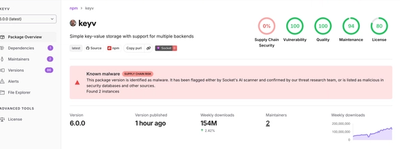
Popular npm packages keyv and cacheable compromised.

Security News
A misconfiguration gave three Anthropic models internet access, and one, believing it was in a simulation, shipped a credential-stealing package to PyPI.