
Research
/Security News
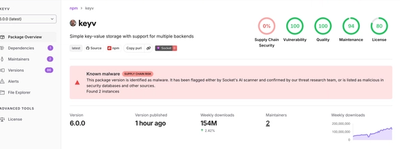
Popular npm Packages in the keyv and Cacheable Namespaces Compromised in Active Supply Chain Attack
Popular npm packages keyv and cacheable compromised.
By Socket Research Team - Aug 04, 2026
Local-first MCP server that snapshots your project's working state (files, git, Notion, local-LLM summary) into a structured context object for any MCP client.
Give any AI agent your project's full working state in one call — without your code ever leaving your machine.
ctxfile is a local-first MCP server that snapshots a project's working state — plan documents, key files, git state, and optionally Notion pages and a local-LLM summary — into one structured context object, served over stdio to Claude Code, Cursor, Claude Desktop, or any MCP client.
Claude Code
claude mcp add ctxfile -- npx -y ctxfile
Cursor — add to .cursor/mcp.json (project) or ~/.cursor/mcp.json (global):
{
  "mcpServers": {
    "ctxfile": {
      "command": "npx",
      "args": ["-y", "ctxfile"]
    }
  }
}
Or click: Add to Cursor
Claude Desktop — download ctxfile.mcpb from the releases page and drag it into Settings → Extensions, or add the JSON above to claude_desktop_config.json.
| Surface | What it returns |
|---|---|
context://current resource | Full ContextObject (JSON) |
context://plan resource | Just the plan document |
context://git resource | Just the git state |
get_context tool | Same data, model-pullable, with optional scope: full | plan | files | git |
save_session tool | The agent summarizes this conversation and stores it, optionally on a named thread; handoff: true enforces a complete takeover package (threads & handoff) |
continue_thread tool | Merged, chronological, provenance-labeled history of a thread — resume work started on any other agent |
list_threads tool | The user's threads with session counts and last-active times |
ingest_context tool | Enveloped bulk door, same schema family — universal session capture for harnesses without a parser (schema + prompt snippets) |
load-context prompt | Injects the snapshot into the conversation |
ctx-save / ctx-continue prompts | One-tap save/resume on clients that surface MCP prompts |
The ContextObject:
{
  "meta": { "version": "0.1.0", "root": "...", "tokenBudget": 50000, "tokensUsed": 12345, "connectors": [...] },
  "plan": "# The Plan ...",            // from PLAN.md / TODO.md / docs/plan*.md
  "keyFiles": [{ "path": "src/index.ts", "tokens": 812, "truncated": false, "redactions": 0, "content": "..." }],
  "gitState": { "branch": "main", "staged": [], "modified": [], "untracked": [], "commits": [...], "diffSummary": "..." },
  "notionPages": [],                    // opt-in
  "sessionSummary": null                // opt-in (local Ollama)
}
Files are selected by rank (plan docs → README → manifests → entry points → recently modified), .gitignore-aware, capped per-file, and greedily fitted to a token budget.
With an active Pro license the server also registers remember / recall / forget (AES-256-GCM encrypted cross-session memory, key in the OS keychain), consult (ask several providers the same question over live context: Anthropic, OpenRouter, any OpenAI-compatible endpoint, or local Ollama), distill_playbook / list_playbooks / get_playbook / rm_playbook (reusable prompts an AI distills from your own saved sessions, stored encrypted), and transcribe_voice (local whisper.cpp) — each gated on its licensed feature, and the snapshot gains sessions: redacted digests of your recent sessions from Claude Code, Cursor, Codex CLI, OpenCode, Gemini CLI, Aider, OpenClaw, and Hermes Agent, so an agent in one tool picks up where an agent in another left off. Licensing is an Ed25519-signed key verified offline (ctxfile activate <key>); no phone-home, ever.
On any other harness (or when a parser breaks), the free fallback is ingest_context: paste a short prompt, the agent digests its own session and pushes it in — strict schema, redacted, provenance-stamped reported_by: agent, reviewable via ctxfile ingest list / rm <id>. Parsers win on conflicts. The prompt is the adapter, so every MCP-speaking harness is supported, including ones that don't exist yet.
Threads make that portable across providers: save a session to a named thread ("Q3 campaign") from one agent, and continue_thread hands the merged, provenance-labeled history to the next one — different harness, different model provider, cold start. When the user hands work to another agent or person, handoff: true makes validation require the full takeover package (state, decisions with rationale, ordered open items, gotchas, artifacts with roles, a suggested first prompt), so any agent produces the same artifact. Pro also gets ctxfile serve: the same five tools over Streamable HTTP with scoped bearer tokens — the local door of the Sync & roaming lane.
ctxfile exportAgents that don't run on your machine (hosted coding agents, CI bots) read a static artifact instead of MCP:
ctxfile export             # writes .ctxfile/context.json + context.md (repo-safe profile)
ctxfile export --stdout    # pipe the JSON envelope anywhere
ctxfile hooks install      # pre-commit: refresh + stage the artifact on every commit
The default repo-safe profile ships plan, git state, and a key-file manifest only — no file bodies, Notion content, or session digests (those need an explicit --profile full, which warns loudly). Every profile re-runs secret redaction, and your absolute local path never appears in an export. The versioned file format is a public spec: the .ctxfile convention.
ctxfile ui
A cockpit bound to 127.0.0.1 (token-gated URL, strict CSP, never network-exposed): run snapshots and watch connectors live, browse the captured context, inspect git state, manage Pro memory, and activate licenses. Press R to snapshot, ⌘K for the command palette.
Nothing leaves your machine by default.
password=/api_key= assignments) is redacted before it enters the snapshot; .env*, key files, and credential files are never read at all.NOTION_TOKEN and list page IDs in config.ollama.summarize: true, and it talks to your local Ollama.telemetry.enabled: true.Optional .ctxfile.json in your project root:
{
  "tokenBudget": 50000,        // total token budget for the snapshot
  "maxFileTokens": 4000,       // per-file cap (head+tail truncation beyond it)
  "exclude": ["fixtures/"],    // extra gitignore-style excludes
  "cacheMaxAgeMs": 30000,      // serve a cached snapshot younger than this
  "notion": { "pageIds": ["<page-id>"] },   // requires NOTION_TOKEN env var
  "ollama": { "summarize": true, "model": "qwen3:4b" },  // OLLAMA_BASE_URL overrides endpoint
  "export": { "profile": "repo-safe" },     // default profile for `ctxfile export`
  "telemetry": { "enabled": false }  // opt-in anonymous weekly install ping; off by default
}
CLI:
ctxfile [--root <dir>] [--config <path>]   # the MCP server (stdio)
ctxfile serve [--port <n>] [--host <h>]    # the HTTP door (Pro): same tools over Streamable HTTP
ctxfile ui [--port <n>] [--no-open]        # local dashboard on 127.0.0.1
ctxfile export [--profile <p>] [--stdout]  # write the .ctxfile convention artifact
ctxfile hooks install|uninstall            # managed pre-commit export refresh
ctxfile ingest list|rm <id>                # review agent-reported sessions
ctxfile threads                            # list threads (durable, resumable work identities)
ctxfile vault create|join|status           # encrypted Sync vault on a relay (passphrase via env)
ctxfile sync                               # push/pull sessions + threads through the vault
ctxfile activate <license-key>             # store + verify a Pro license (offline)
ctxfile --version | --help
Sync is client-side encrypted (Argon2id key derivation, XChaCha20-Poly1305 per blob, opaque blob ids): the relay — hosted at sync.ctxfile.dev, or self-hosted from the open-source @ctxfile/relay — stores ciphertext only. Standard-mode vaults let chat surfaces save and resume threads through the relay's MCP endpoint; Strict-mode vaults trade that roaming for true end-to-end encryption.
Full reference: ctxfile.dev/docs (CLI, MCP surface, configuration, connectors, dashboard, privacy).
| Client | Status |
|---|---|
| Claude Code | ✅ tested |
| Cursor | ✅ (2 core tools, 7 with full Pro — far under the 40-tool cap) |
| Claude Desktop | ✅ via .mcpb or JSON config |
| Cline / Windsurf / custom SDK clients | ✅ generic stdio MCP |
npx @modelcontextprotocol/inspector npx -y ctxfile (use Inspector ≥ 0.14.1).npm install
npm run build # tsup → dist/
npm test # vitest
npm run typecheck && npm run lint
npm run mcpb:pack # build ctxfile.mcpb (platform-specific: bundles native sqlite)
Architecture: src/server.ts is the only module that imports the MCP SDK (spec-churn isolation); connectors in src/connectors/ are independently failable — a broken connector degrades to an error entry in meta.connectors, never a crashed snapshot.
Apache-2.0. "ctxfile" and the ctxfile logo are trademarks of ctxfile; the Apache-2.0 license covers the code, not the name.
FAQs
Local-first MCP server that snapshots your project's working state (files, git, Notion, local-LLM summary) into a structured context object for any MCP client.
The npm package ctxfile receives a total of 104 weekly downloads. As such, ctxfile popularity was classified as not popular.
We found that ctxfile demonstrated a healthy version release cadence and project activity because the last version was released less than a year ago. It has 1 open source maintainer collaborating on the project.
Did you know?

Socket for GitHub automatically highlights issues in each pull request and monitors the health of all your open source dependencies. Discover the contents of your packages and block harmful activity before you install or update your dependencies.
Research
/Security News
Popular npm packages keyv and cacheable compromised.

Security News
A misconfiguration gave three Anthropic models internet access, and one, believing it was in a simulation, shipped a credential-stealing package to PyPI.

Security News
/Company News
Socket has joined the new Composer and Packagist sponsorship program as a launch sponsor, supporting the team that keeps PHP's package ecosystem secure.