
Research
/Security News
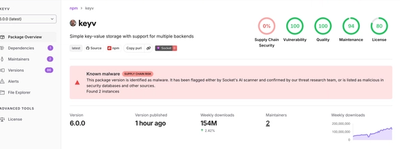
Popular npm Packages in the keyv and Cacheable Namespaces Compromised in Active Supply Chain Attack
Popular npm packages keyv and cacheable compromised.
By Socket Research Team - Aug 04, 2026
debug-recorder-mcp
Advanced tools
MCP server for recording debug sessions — query your debugging history with natural language
Local-first debug memory for MCP clients.
Record incidents, commands, failed attempts, successful fixes, diagnostics, and searchable debugging history in SQLite.







Published docs · Usage · Client recipes · Security · Release flow

Debugging knowledge usually disappears into chat windows, terminals, and commit history. debug-recorder-mcp gives MCP-enabled agents and IDEs a durable local memory so they can answer:
“Have I fixed this before?”
It stores each debugging session, error, command, attempted fix, working fix, tags, and context in a local SQLite database. Search combines SQLite FTS5 with fuzzy reranking, reusable presets, pagination metadata, related-session groups, and optional Markdown exports.
get_diagnostics returns redacted runtime, schema, package, and health signals for support without leaking raw paths, tokens, stack traces, or command output.Requires Node.js 22 LTS or 24 LTS and npm 10+.
npx debug-recorder-mcp
Default database path:
~/.debug-recorder-mcp/sessions.db
Use a custom database path:
DEBUG_RECORDER_DB=/path/to/custom.db npx debug-recorder-mcp
{
  "mcpServers": {
    "debug-recorder-mcp": {
      "command": "npx",
      "args": ["debug-recorder-mcp"]
    }
  }
}
Create or update .vscode/mcp.json:
{
  "servers": {
    "debug-recorder-mcp": {
      "type": "stdio",
      "command": "npx",
      "args": ["debug-recorder-mcp"]
    }
  }
}
More setup examples are in Client setup recipes.
| Tool | Purpose |
|---|---|
start_debug_session | Start tracking a new issue or incident. |
add_fix | Record a failed or successful fix attempt. |
record_command | Save a command, output, exit code, and session link. |
close_session | Mark a session as resolved or abandoned. |
update_session | Edit title, description, or tags. |
delete_session | Permanently delete a session with explicit confirmation. |
search_sessions | Search history with FTS5, fuzzy reranking, pagination, related groups, and optional Markdown export. |
save_search_preset | Store a reusable query, filters, and limit. |
list_search_presets | List saved search presets. |
remove_search_preset | Remove a saved search preset by name. |
find_similar_errors | Ask whether a similar error has appeared before. |
get_session | Fetch full details, fixes, and commands. |
get_session_context | Get an AI-friendly session summary. |
list_sessions | Browse sessions with filters. |
get_stats | Summarize debug history. |
get_diagnostics | Return a redacted operational diagnostics snapshot. |
export_sessions | Export a full JSON backup or a lightweight summary inventory. |
import_sessions | Import a validated export payload. |
Ask your MCP client:
I am getting
TypeError: Cannot read properties of undefined. Have I seen this before?
The client can call find_similar_errors, then inspect the best match with get_session_context.
start_debug_session with the problem title and error details.record_command.add_fix.update_session.close_session.export_sessions with format: "json". The response is marked with
format: "json" and contains the full sessions, fixes, and commands
arrays.import_sessions.payload.For a lightweight inventory, call export_sessions with format: "summary".
Summary responses are marked with format: "summary", include aggregate
stats and abbreviated session rows, and are not restore payloads.
The package also supports local Streamable HTTP:
npm run start:http
Useful routes:
GET /healthGET /versionPOST /mcpHTTP mode is local-first by default. It binds to 127.0.0.1, creates an isolated stateless MCP server/transport per request, validates Host, validates browser Origin when present, and enforces a JSON body-size limit before the MCP transport receives the request.
For deliberate non-loopback exposure, set all of these:
HOST=0.0.0.0
DEBUG_RECORDER_REMOTE_HTTP=true
DEBUG_RECORDER_HTTP_TOKEN=replace-with-a-long-random-token
DEBUG_RECORDER_ALLOWED_HOSTS=debug-recorder.example.com
DEBUG_RECORDER_ALLOWED_ORIGINS=https://debug-recorder.example.com
npm run start:http
Wildcard origins are rejected for remote mode. The static bearer token is private/shared-secret mode: every caller shares one identity, one authority level, and one SQLite dataset. It is suitable for loopback, an encrypted trusted network, or a private authenticating proxy, but it is not OAuth and does not provide per-user scopes or revocation.
Public multi-user HTTP is not supported by the current release. The accepted target architecture uses an external authorization server and MCP-aware gateway with protected-resource discovery, audience-bound tokens, scopes, rate limits, audit events, and subject-aware storage. See Public HTTP authorization and ADR-0006.
| Variable | Description |
|---|---|
DEBUG_RECORDER_DB | Override the SQLite database path. |
HOST | HTTP bind host. Defaults to 127.0.0.1. |
PORT | HTTP port. Defaults to 3000. |
DEBUG_RECORDER_HTTP_TOKEN | Private/shared-secret token; required for non-loopback HTTP, not OAuth. |
DEBUG_RECORDER_ALLOWED_HOSTS | Comma-separated HTTP Host allowlist. |
DEBUG_RECORDER_ALLOWED_ORIGINS | Comma-separated browser Origin allowlist. |
DEBUG_RECORDER_MAX_BODY_BYTES | HTTP JSON body limit. Defaults to 1048576. |
DEBUG_RECORDER_REMOTE_HTTP | Enable non-loopback HTTP with true, 1, or yes. |
DEBUG_RECORDER_REDACT_BEFORE_STORE | Enable pre-store redaction with true, 1, or yes. |
LOG_LEVEL | Minimum structured log level: debug, info, warn, or error. |
FUZZY_THRESHOLD | Override the Fuse.js reranking threshold. |
Boolean configuration also accepts false, 0, and no; values are
case-insensitive, whitespace is ignored, and unsupported values fail fast.
Diagnostics reports the resolved effective values rather than re-reading changed
environment strings.
better-sqlite3.~/.debug-recorder-mcp/sessions.db.
better-sqlite3uses a native addon. If Node versions change and bindings fail, runnpm rebuild better-sqlite3.
docker build -t debug-recorder-mcp:local .
docker run --rm -p 127.0.0.1:3000:3000 \
  -e HOST=0.0.0.0 \
  -e DEBUG_RECORDER_REMOTE_HTTP=true \
  -e DEBUG_RECORDER_HTTP_TOKEN=replace-with-a-long-random-token \
  -e DEBUG_RECORDER_ALLOWED_HOSTS=127.0.0.1:3000,localhost:3000 \
  -e DEBUG_RECORDER_ALLOWED_ORIGINS=http://127.0.0.1:3000,http://localhost:3000 \
  debug-recorder-mcp:local
The image installs with npm ci, preserves reviewed native install scripts, prunes development dependencies, and runs as the non-root node user.
Published documentation is generated by npm run docs:site and published to GitHub Pages:
https://oaslananka.github.io/debug-recorder-mcp/
Important docs:
npm ci
npm run format:check
npm run lint
npm run check:dead-code
npm run test:coverage
npm run test:fuzz
npm run build
npm run test:e2e
npm run audit
npm run check:install-scripts
npm pack --dry-run
npm run check:package-size
npm run check:version
npm run check:mcp
npm run check:security-policy
npm run check:sbom
npm run docs:site
Full local gate:
npm run ci:local
Release readiness:
npm run prepublishOnly
npm run check:mcp-registry
The normal release workflow uses Release Please, builds release assets, generates SBOM/checksums, attests the tarball, uploads GitHub Release assets, and publishes to npm with provenance.
For the first npm package creation, use the manual Initial npm Token Publish workflow with repository secret NPM_TOKEN. After the package exists and npm trusted publishing is configured, the regular Release workflow can publish through GitHub OIDC. Details are in Release flow.
Released under the MIT License. package.json also declares "license": "MIT", and the npm package includes LICENSE.
If this project saves you debugging time, support development here:
Funding metadata is available in both .github/FUNDING.yml and package.json.
This repository owns the product-level agent plugin, MCP runtime configuration, and product-specific skills for debug-recorder-mcp. The central agent-tools repository should catalog this plugin, but the manifest and workflow instructions live here so they stay synchronized with the actual MCP server package.
| File | Purpose |
|---|---|
.claude-plugin/plugin.json | Claude Code-valid product plugin manifest. |
.mcp.json | Claude Code project-local MCP server configuration. |
.codex/config.example.toml | Codex CLI MCP configuration example. |
.vscode/mcp.example.json | VS Code / GitHub Copilot workspace MCP configuration example. |
opencode.example.jsonc | OpenCode project MCP configuration example. |
.opencode/skills/ | OpenCode-native mirrored skill definitions. |
docs/agent-runtime-config.md | Agent runtime setup and validation notes. |
Validate plugin packaging locally:
claude plugin validate .
FAQs
MCP server for recording debug sessions — query your debugging history with natural language
We found that debug-recorder-mcp demonstrated a healthy version release cadence and project activity because the last version was released less than a year ago. It has 1 open source maintainer collaborating on the project.
Did you know?

Socket for GitHub automatically highlights issues in each pull request and monitors the health of all your open source dependencies. Discover the contents of your packages and block harmful activity before you install or update your dependencies.
Research
/Security News
Popular npm packages keyv and cacheable compromised.

Security News
A misconfiguration gave three Anthropic models internet access, and one, believing it was in a simulation, shipped a credential-stealing package to PyPI.

Security News
/Company News
Socket has joined the new Composer and Packagist sponsorship program as a launch sponsor, supporting the team that keeps PHP's package ecosystem secure.