decisionlint-mcp




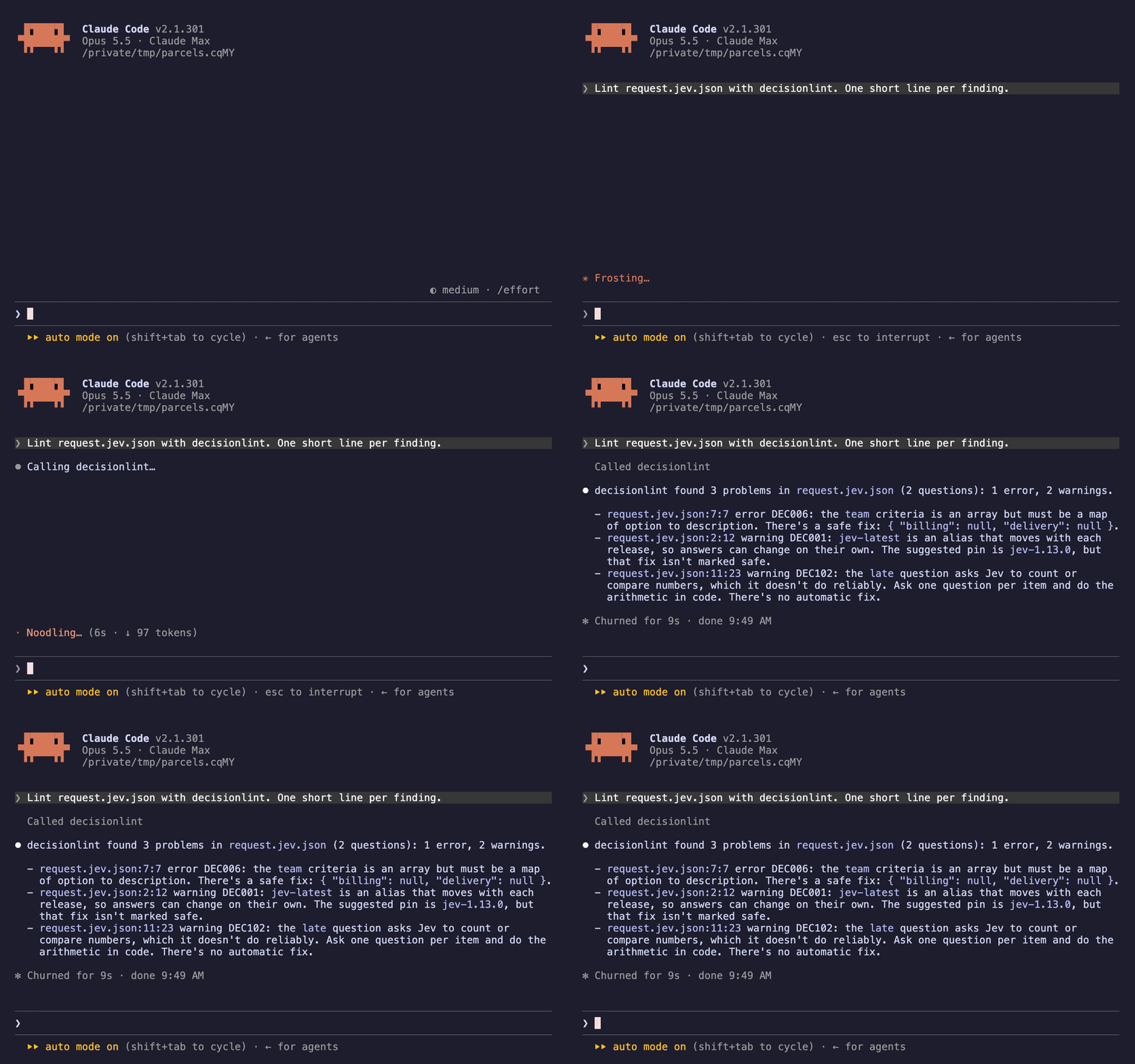
Lint Jev and Luna questions from your agent. An
MCP server that lints the questions a
project sends to TypeSafe's Jev model or to OpenAI's Decisions API
(gpt-6-luna) before they are sent, and mends the ones it can. It is the
engine behind the DecisionLint editor
extension, as eight tools an agent can call.
Linting needs no API key and makes no network calls, and nothing here writes
a file. Two tools ask the model itself, with your key, when you ask them to.
Use it
Point any MCP host at npx decisionlint-mcp.
Claude Code
claude mcp add decisionlint -- npx -y decisionlint-mcp
Anything with a JSON config, such as Cursor, Windsurf or Claude Desktop:
{
  "mcpServers": {
    "decisionlint": {
      "command": "npx",
      "args": ["-y", "decisionlint-mcp"]
    }
  }
}
VS Code needs nothing here. Install the extension instead. It carries
this server and registers it for you:
VS Code Marketplace
· Open VSX
Already running decisionlint in CI? The same server is
npx decisionlint --mcp. This package is the one with no flag to forget: a
client that starts decisionlint bare gets a linter that exits, not a server.
Prefer a global install to npx on every launch:
npm install -g decisionlint-mcp
{
  "mcpServers": {
    "decisionlint": { "command": "decisionlint-mcp" }
  }
}
No configuration of its own, and no key unless you want a check with the
model. To check it before wiring it into anything:
printf '%s\n' \
  '{"jsonrpc":"2.0","id":1,"method":"initialize","params":{"protocolVersion":"2025-06-18","capabilities":{},"clientInfo":{"name":"check","version":"0"}}}' \
  '{"jsonrpc":"2.0","id":2,"method":"tools/list"}' \
  | npx -y decisionlint-mcp
Tools
lint_text | Lints a request body or source code passed as text. Each finding carries the edit that would mend it | nothing |
lint_paths | Lints files or directories on disk | nothing |
fix_text | Returns the text with the safe fixes applied, and the report of what is left. Writes nothing | nothing |
list_rules | Lists every rule with what it means, its default level and its pages | nothing |
explain_rule | A rule's own page as Markdown: an example that is flagged, one that is not, how to fix it and how to silence it | nothing |
plan_ask | What ask_model would send for the text or files: requests, model, tokens, questions held back | nothing |
ask_model | Asks a decision model to check the questions in text or files, and returns the lint report with the model's findings added. platform names where: typesafe for Jev, openai for Luna, openrouter, vercel, llmgateway or liquid, each with its own key variable | the questions, with your key |
probe_question | Sends one question as written and with its layout varied, and reports whether the answer held | about a dozen requests, with your key |
Every tool answers as structured content beside its text. The first six are
read-only and offline, so a host can let an agent call them without asking.
The two that send are marked open-world and not idempotent, each call costs,
and their descriptions tell an agent to call them only when you ask for a
check or a probe. lint_paths and ask_model read the files under the
paths they are given and nothing else. A decisionlint.json near those files
applies as it does on the command line, and rules on any call overrides it.
The key
ask_model and probe_question look for TYPESAFE_API_KEY, or
OPENAI_API_KEY for Luna, in this order, and use the first they find:
- The environment the client started the server with. Most clients take an
env map beside command in their config.
.env.local, then .env, in the directory the client started the server
in, which is the project for every client that runs servers per project.
A key is never taken as a tool argument, so none can land in an agent's
transcript or a host's log, and no answer ever carries one: the report says
where the key came from, not what it was. With no key anywhere the call fails
before anything is sent and says where it looked.
It is listed on the MCP registry as io.github.nolindnaidoo/decisionlint.
License
MIT



