


Security News
Ruby's Bundler 4.0.18 Extends Cooldown to bundle lock and bundle cache
The supply chain control that delays freshly published gems now covers lockfile generation and gem vendoring in Ruby projects.
By Sarah Gooding - Aug 06, 2026
diffgate-review
Advanced tools
A deterministic guardrail your coding agent runs on itself — reviews only the changed lines and returns structured findings before the code reaches disk. Zero LLM tokens, 0 false blocks on a public corpus. Same engine and same verdict in your agent (MCP),





A deterministic guardrail your coding agent runs on itself — before the code reaches your disk.
Every other check fires too late. A review bot needs a PR. A pre-commit hook runs after the agent has finished and moved on. DiffGate is an agent hook: your agent calls it over MCP, gets back structured findings in milliseconds for zero LLM tokens, and fixes the problem while it still has the context — then the same engine, same verdict runs in your editor, your pre-commit hook, and CI. Not a model grading its own homework: the same input always produces the same answer.
It stays quiet by construction. It grades only the lines that changed (🟢 merge · 🟡 glance · 🟠 verify), runs your tests only when a change earns it, and blocks only when it's earned — 0 false blocks on a public, versioned corpus you can rerun yourself with diffgate bench (BENCHMARK.md). Everyone claims low noise; this one ships the corpus.
Across local and frontier models: 0% classic OWASP bugs (SQL injection, XSS, hardcoded secrets) in code written from scratch. But the same frontier model that wrote flawless greenfield code reintroduced security footguns in 13% of edits — an unguarded recursive merge (prototype pollution), a bare cors() (any origin), a path built from request data with no containment check. Editing existing code is most of what an agent does, and the residue lives in the diff, not in the textbook. Rerun it yourself with diffgate marginal. The measurement →
The same shift shows up in third-party maintainability data: GitClear's 2026 analysis finds block duplication up 81% since 2023 (40.3 → 73.0 per million changed lines) and cross-file function connectivity down 35% — agents reinvent code rather than reuse it. That's what the reinvented-helper rule is for (docs/STRUCTURAL-RULES.md).
| Tier | Meaning | What you do | Examples |
|---|---|---|---|
| 🟢 Green | Safe / self-contained | merge freely | comments, local logging |
| 🟡 Yellow | Review (soft dependency) | take a look | deprecated APIs, raw SQL, network calls, dependency edits |
| 🟠 Orange | High-impact, gate it | verify before merge | schema/migrations, hardcoded secrets, auth/crypto, public-API changes, injection sinks |
Every check in the pipeline fires after the code exists, and each one is later than the last:
| Fires when | Problem | |
|---|---|---|
| Review bot (CodeRabbit, Greptile) | a PR exists | the code is finished, defended, and someone is waiting on it |
| Pre-commit hook | you're done and committing | the agent has moved on; you're re-loading context to fix it |
| DiffGate over MCP | the agent is still writing | it fixes its own output before the code lands |
Being early is not the only thing that matters, though — it has to be quiet, or the agent learns to ignore it. Review bots comment after the PR exists; linters and scanners flag everything they see. Neither guarantees the risky line gets discussed: we scanned 350 merged AI-assisted PRs — of the 109 with flagged AI-attributed changes, only 3 drew public discussion from any human besides the author. DiffGate decides what deserves your attention, your tests, or a block, and stays quiet otherwise. That's the whole product:
testCommand and shows the real exit code and output. Green and yellow pass instantly. The pre-commit hook is fast because tests fire only when a change is genuinely high-impact.diffgate bench runs a versioned corpus offline: 100% precision / 0 false blocks on clean changes. Reproduce it yourself — that's the point of shipping the corpus. See BENCHMARK.md.The 0% / 13% numbers aren't a marketing line — they come from a scripted experiment (four models from local to frontier, greenfield vs. edit mode, Wilson confidence intervals) that you can rerun with diffgate marginal. Methodology, per-model tables, and caveats: docs/MEASUREMENT.md. DiffGate's security rules are tuned to that measured residue, not to maximizing rule count.
npm install -g diffgate-review
cd your-repo
diffgate init                    # auto-detects language + test command, writes .diffgate.json
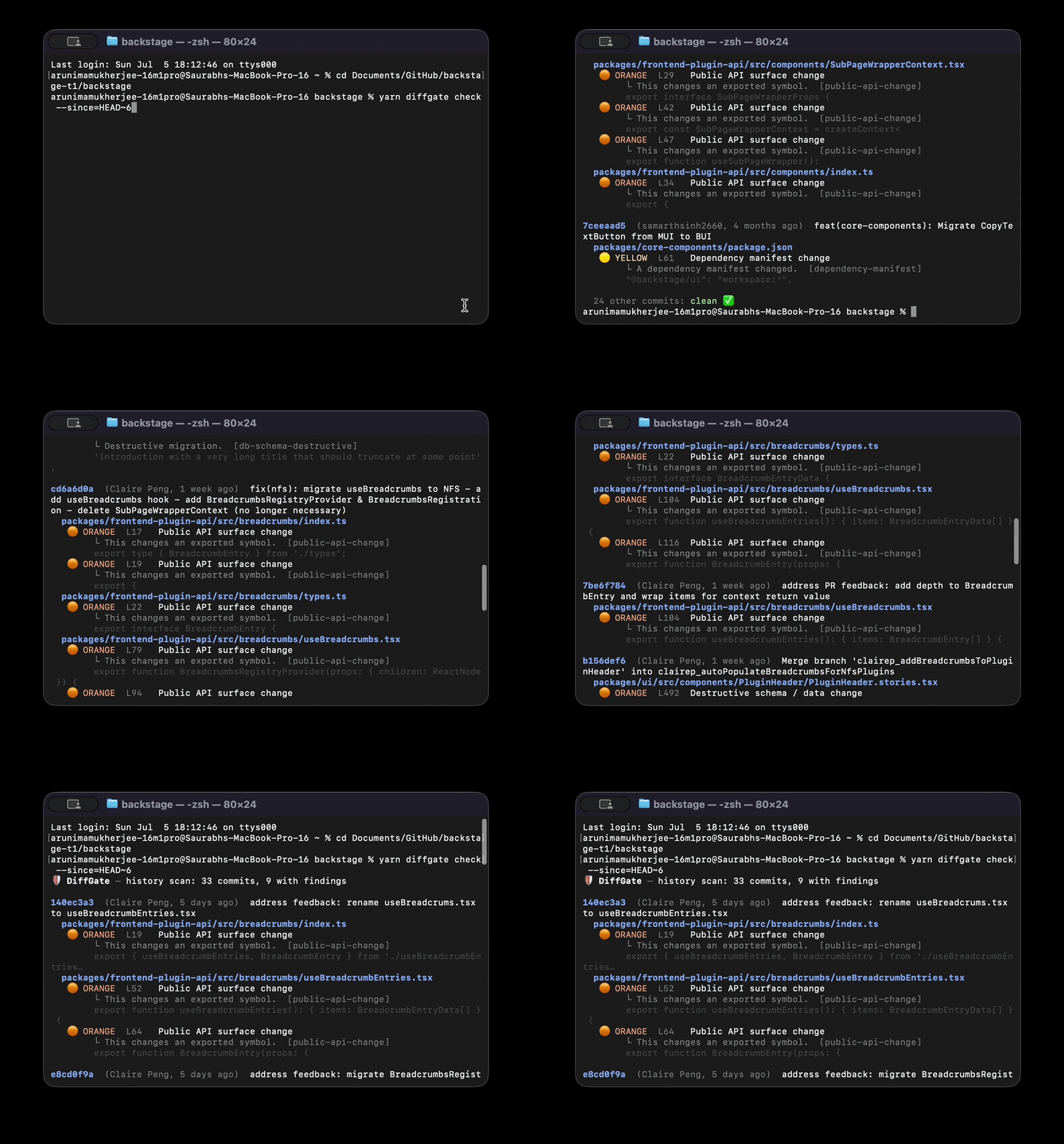
diffgate check --since=HEAD~20   # see what it catches in your own history — no PR required
diffgate check                   # review your pending changes right now
No git history or uncommitted changes yet? See the output on bundled examples first:
diffgate init --demo # live scan, no config or git changes needed
The highest-leverage spot: the agent self-checks generated code before it's written to disk, gets back structured findings (zero LLM tokens), and surfaces what it corrected (original + fix + why) instead of silently rewriting. A trustworthy, deterministic self-check is what makes it safe to grant the agent more autonomy.
# Claude Code — one command:
claude mcp add diffgate -- diffgate mcp

# One-click via Smithery (zero config):
npx @smithery/cli install diffgate-review --client claude

# Cursor — add to MCP settings:
# { "diffgate": { "command": "diffgate", "args": ["mcp"] } }
Or one-click in Claude Desktop: download diffgate.mcpb and open it. The server also exposes prompts and resources; see MCP.md.
Inline squiggles on changed lines, hover cards (why · who owns it · quick-fix), a Risk Review tree, a status-bar summary, and Deep Review (agentic blast-radius analysis for orange findings). The same verdict you'd get from the CLI, on the diff you're reviewing.
Install from the VS Code Marketplace or Open VSX (Cursor / Windsurf / Gitpod).
diffgate check reviews your diff and exits non-zero on high-impact findings: a pre-commit hook locally, the same gate in your pipeline.
diffgate install-hook # adds .git/hooks/pre-commit; only runs tests on 🟠 orange changes
The local loop is the wedge — fix while the context is fresh — and the same engine runs as a PR gate so the verdict carries to where it's enforced for the whole team. See docs/TEAM.md for the GitHub Action, shared learnings, and org policy packs. CI runs can optionally layer an external scanner (Semgrep) through the same gate for broader language coverage — advisory-only, off by default (docs/CONFIG.md).
Common commands:
diffgate check                 # review pending changes (the gate)
diffgate check --staged        # staged-only (pre-commit)
diffgate check --since=HEAD~20 # audit recent history, per-commit (see below)
diffgate check --agent         # machine verdict for coding agents
diffgate scan <path>           # analyze files directly (no git needed)
diffgate watch                 # live review as you edit
diffgate guidelines            # review diff against AGENTS.md / CLAUDE.md etc.
diffgate feedback <rule> <f> <l> --dismiss   # suppress a false positive (shared via git)
diffgate mcp                   # start the MCP stdio server
Audit recent AI-authored history. Point check at commits already in your log — each
finding is attributed to a specific commit, so you get a story, not a repo-wide report card:
diffgate check --since=HEAD~20        # last 20 commits, one block per commit
diffgate check --since="2 weeks ago"  # by date instead of a rev
diffgate check --ai-authored          # only agent commits (Claude/Copilot/Cursor/… — heuristic)
diffgate check --author="Claude"      # matches author *and* Co-authored-by trailers
diffgate check <sha>                  # a single commit by hash
History mode is report-only (it audits the past — it never runs your test command or blocks a
commit) and honors --json and --limit=<n> (default 50). Merge commits are skipped.
Run diffgate --help for the full list (report, bench, stats, graph, marginal, …).
git diff (CLI) or an in-memory LCS diff (editor, accurate on unsaved buffers) finds changed lines; findings only report on those lines.@babel/parser (JS/TS) and tree-sitter (Python, PHP, Go, Ruby, Java, C#, Kotlin — via WASM, no native build) power precise rules: deprecated calls aren't matched inside comments or strings, exported-signature changes are detected structurally, and SQL injection is sink-targeted, parameter-aware, and sanitizer-aware — cur.execute(f"… {uid}") / $pdo->query("… $id") block, while cur.execute("… %s", (uid,)), $pdo->prepare("… ?"), a single-quoted '… $id', and a SELECT in a log line don't.# os.system(x)) isn't flagged; a secret committed inside a comment still is. Docs/prose files (.md, .rst, …) are held to the same standard: the word "oauth2-provider" in a changelog isn't auth code, but a key pasted in a README is still a leak.#{}, Go/Ruby shell-out) escalate to blocking only when the optional code graph proves reachability from an untrusted entry point — community CodeGraph, no Pro taint engine required. (JS/TS, Python, and PHP block on local AST evidence and don't need this.)testCommand and shows the actual exit code and output.diffgate feedback records dismiss/confirm verdicts; dismissed findings (same rule + same code) are suppressed everywhere. Stored in .diffgate/learnings.json; commit it to share across the team.Engine layout: src/core (shared) · src/cli.ts (CLI) · src/mcp.ts (MCP) · extension/ (VS Code).
How deeply DiffGate analyzes a change depends on the file's language — be explicit about this so you can calibrate how much to trust a clean result.
| Tier | Languages | Depth |
|---|---|---|
| Deep (AST) | JS / TS (@babel) | All injection classes + public-API & signature changes + deprecated-API quick-fixes. Prototype pollution and NoSQL injection are JS/TS-only; JS/TS findings are also eligible for code-graph taint confirmation. |
| Deep (AST) | Python, PHP, Go, Ruby, Java, C#, Kotlin (tree-sitter) | Sink-targeted, parameter- and sanitizer-aware injection detection — placeholders, argument-vectors, and escapers are correctly treated as safe. Sink classes per language below. |
Sink classes per Deep-AST language (full detail — every sanitizer and safe-form, plus the code-graph boundary — in docs/SCOPE.md):
SSRF is a cross-language advisory across all eight Deep-AST languages (a request-tainted URL into an outbound-request sink; library-qualified and tainted-only, so static/config URLs aren't flagged). XXE covers the JVM (Java, Kotlin) and .NET (C#), suppressed when the file shows recognized hardening. Permissive CORS now also covers all eight — wildcard Access-Control-Allow-Origin, allow-all framework configs (gin/rs-cors, Spring @CrossOrigin, ASP.NET AllowAnyOrigin(), Ktor anyHost(), rack-cors), and request-reflected origins; explicit allowlists aren't flagged.
| Tier | Languages | Depth |
|---|---|---|
| Floor (pattern) | C/C++, Rust, Swift, Scala, … | Secrets, destructive/schema changes, auth/crypto, dynamic exec / shell-out, raw queries, network calls, TODO. Cross-language injection advisories that escalate via the code graph. |
| Text | YAML, Terraform, JSON, any text | Secrets and TODO/FIXME markers. |
Fast by design — and scoped to match. A review runs in milliseconds on the changed lines, which is exactly what lets the same check sit in the agent and editor inner loop. That speed is a deliberate trade: DiffGate is the deterministic gate on the diff, not an exhaustive whole-repo taint engine. Coverage is per-language (deep where there's an AST, a pattern floor elsewhere), the security rules are tuned to the residue agents actually ship rather than to maximize raw rule count, and a clean result means "nothing matched at this language's tier," not "proven safe." For deep cross-file taint analysis across many languages, pair it with a dedicated SAST. Full per-language detail and the code-graph boundary: docs/SCOPE.md.
diffgate init writes a tailored .diffgate.json at your repo root. Minimal example:
{
  "testCommand": "npm test",          // run for orange changes (the gate)
  "gate": { "mode": "working", "failOn": "orange" },
  "deprecated": [
    { "pattern": "StripeClient.charge", "replacedBy": "StripeClient.createPaymentIntent" }
  ]
}
Any rule — built-in or custom — can be path-scoped with include/exclude globs, the escape hatch for the one file where a forbidden idiom is legitimate (e.g. process.env inside the config loader itself). Full schema, the built-in rule table, LLM providers, and per-rule tuning: docs/CONFIG.md.
.diffgate.json schema, all built-in rules, LLM providers, native precision & test-scope behavior.structural pack — over-engineering rather than vulnerabilities (needless abstractions, pass-through wrappers, complexity spikes), all non-blocking, with per-language thresholds.diffgate marginal).diffgate scan mock_project
You'll see green findings (logging), yellow findings (a deprecated call), and orange findings (a DROP COLUMN migration, a public export).
npm test # builds the extension, runs the full unit/integration suite + extension smoke test
If DiffGate caught something for you — or you just like the idea of a deterministic gate for agent code — star the repo ⭐. It's the signal that tells other people this is worth trying.
See CONTRIBUTING.md. Apache 2.0; see LICENSE.
FAQs
A deterministic guardrail your coding agent runs on itself — reviews only the changed lines and returns structured findings before the code reaches disk. Zero LLM tokens, 0 false blocks on a public corpus. Same engine and same verdict in your agent (MCP),
We found that diffgate-review demonstrated a healthy version release cadence and project activity because the last version was released less than a year ago. It has 1 open source maintainer collaborating on the project.
Did you know?

Socket for GitHub automatically highlights issues in each pull request and monitors the health of all your open source dependencies. Discover the contents of your packages and block harmful activity before you install or update your dependencies.
Security News
The supply chain control that delays freshly published gems now covers lockfile generation and gem vendoring in Ruby projects.

Security News
During a UK cyber test, a Mythos 5 agent used sockpuppets, social engineering, and prompt injection to try to get a maintainer to merge malware.

Company News
Socket is now in the AWS Security Hub Extended plan. Adopt it through AWS, apply committed spend, and block malicious open source packages.