


Security News
Deno Goes the Way of the Dinosaur
Cloudflare is acquiring Deno’s team, which will provide another year of bug fixes and security updates before ending support for the runtime.
By Sarah Gooding - Oct 16, 2026
dsh-plugin-qwen-image
Advanced tools
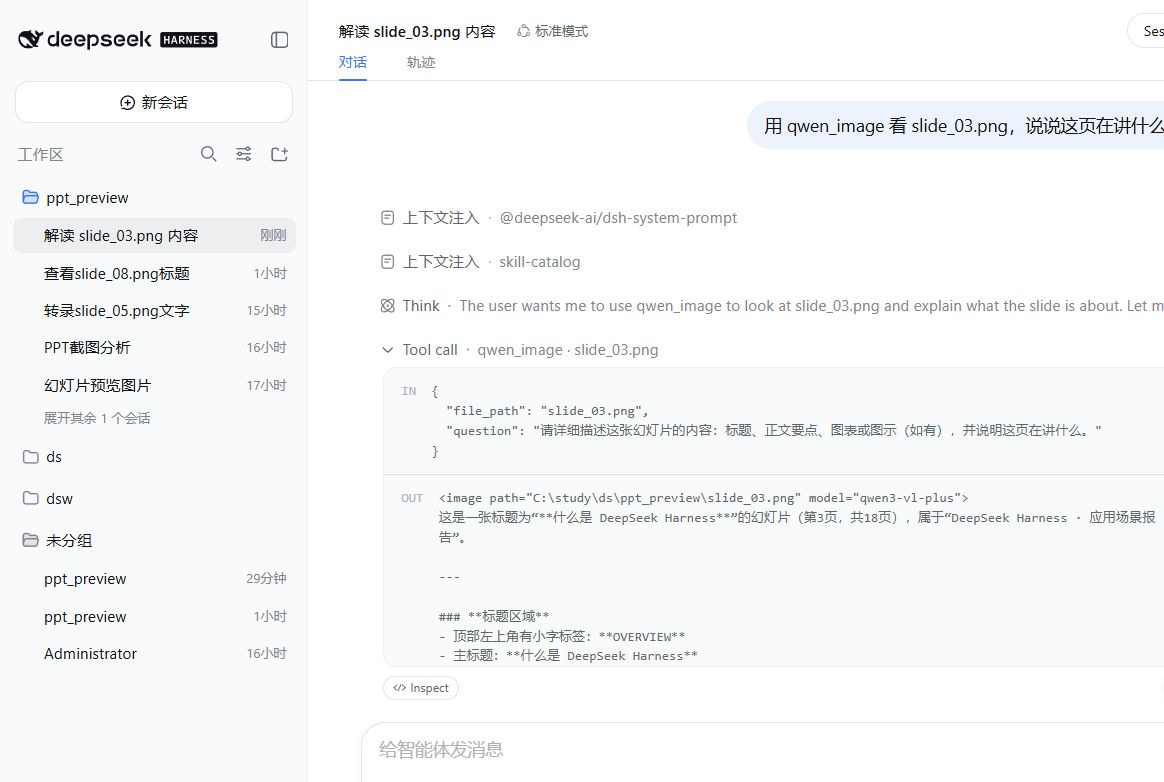
DeepSeek Harness out-of-tree plugin: give a text-only coding model eyes by routing images to a Qwen-VL (DashScope) route through ctx.llm and returning text.


English | 中文
Give a text-only coding model eyes. An image goes to a vision route and comes back as text, so DeepSeek keeps driving the session while Qwen does the looking. Pasting a screenshot into the composer works too — and not one character of your draft is touched.
dsh plugin --profile web add -w dsh-plugin-qwen-image
-w is required. A profile directory is a pnpm workspace root, so without it pnpm refuses with ERR_PNPM_ADDING_TO_ROOT and installs nothing.
No build permission is requested. Pure ESM, no build step, so there is no prepare script. pnpm ≥10 blocks a git dependency's build until you explicitly allowlist it — and that allowance is permission to execute the package's code on your machine at install time. This package never asks for it.
Works on rc.5 and rc.6. The peer range is ^0.1.0-rc.5, so it loads both in the current release and in older desktop shells still pinned to rc.5.
To update later:
dsh plugin --profile web update dsh-plugin-qwen-image
That reaches releases inside the range the install wrote, and needs no -w. On a 0.x version npm's caret stops below the next minor, so ^0.3.0 picks up 0.3.x but not 0.4.0 — crossing a minor means running the install command again. CHANGELOG.md records what each release changed.
The tool needs one model that accepts images.
If your dsh already has one, there is nothing to configure. On the first call the plugin tries the route it is pointed at; when that route is not usable it scans every registered provider, takes the first model that declares image input, and logs which one it chose. The scan runs once per provider topology, not once per call.
If you have none, declare one in $DSH_HOME/settings.yaml:
llm-pi-ai:
  providers:
    dashscope:
      displayName: Qwen DashScope
      apiKeyEnv: DASHSCOPE_API_KEY
      api: openai-completions
      baseURL: https://dashscope.aliyuncs.com/compatible-mode/v1
      models:
        - id: qwen3-vl-plus
          name: Qwen3-VL Plus
          input: [text, image]        # <- without this line the model declares [text] only
and the key in $DSH_HOME/.credentials.yaml, where managed credentials never reach process.env:
DASHSCOPE_API_KEY: sk-...
input: [text, image] is the whole switch. A model entry that omits it is reported as accepting text only, so the plugin will not pick it — an unknown capability is treated as absent rather than guessed at, because guessing turns a settings mistake into a provider 400. A route-level defaultInput: [text, image] works too, for a gateway whose models all accept images.
Settings → Models → Add custom provider does the same thing through the UI and stores the key write-only. The provider id it generates does not have to be dashscope; the scan finds it either way.
When no model anywhere declares image input, the call fails with the route it looked for, every provider it scanned, and the block to add — not a bare error code.
Paste it or drop it in, then just ask.
Without this plugin that fails, and it fails late: the app accepts the image into its own rail, you send, and the Host refuses the whole request — "Model … does not support image input". The image was never the problem; putting it in the conversation was.
So the paste is taken before the app sees it. The bytes are saved under <workspace>/.dsh-pasted/ and the runtime context states that an image is waiting. The conversation still carries no image part, which is exactly why the request goes through.
A "waiting to be read" strip appears above the composer with a thumbnail and a dismiss button. When nothing is waiting, the strip is not there at all.
The boundaries, stated plainly:
Every stored filename is generated by the host: a caller supplies bytes and a media type, never a path or a name, so the channel has no traversal surface. On top of that it is authority: 'loopback', so only a page on this machine can call it. Byte caps come from ctx.attachments.imageLimits, so an image accepted here is one the vision request can actually carry.
If the workspace is a git repository, add this line to .gitignore and pasted screenshots stay out of git status:
.dsh-pasted/
Inside the workspace rather than a temp directory, so the model receives a path it can hand to any other tool, ctx.fs reads it without a sandbox exception, and you can see and delete what accumulated.
CLI and headless deployments are unaffected: connection, sessions and systemPrompt are optional children, so with no browser you get the tool and no paste path.
qwen_image(file_path?, question?)
PNG / JPEG / WebP / GIF. Omit question for a general description plus a verbatim transcription of any text in the image. A relative file_path resolves against the calling session's workspace, not the server's launch directory.
file_path may be omitted — it then reads the most recently pasted image in this session. Omitting it with nothing waiting fails, and says so.
It returns the resolved path, the vision model that answered, and that model's text.
read_imageThe built-in read_image puts the image into the session's own route, so it refuses unless that exact model accepts image input. DeepSeek does not, so you get a refusal.
This plugin inverts it: the image travels to an independent vision route, and only text comes back. The calling model never needs any multimodal capability at all.
Everything it touches is a public seam — ctx.tools, ctx.llm, ctx.fs, ctx.attachments — so it installs into a profile and needs no change to the harness and no desktop rebuild.
Installing puts this package in the profile's dsh.profile.bundles, and its own bundle patch already inserted the qwen-image row. To change settings, override that row by id in the profile's cordis.patch.yml:
- id: qwen-image
  name: dsh-plugin-qwen-image      # optional assertion: a name mismatch skips with a warning
  config:
    provider: dashscope
    model: qwen3-vl-flash
Do not write another insert: — inserting the same id twice fails the boot with duplicate loader entry id. Also config replaces wholesale rather than deep-merging, so spell out every field you want to depart from the defaults.
| Field | Default | Meaning |
|---|---|---|
provider | dashscope | preferred provider id; falls back to any discovered vision route |
model | qwen3-vl-plus | preferred vision model id; falls back the same way |
systemPrompt | see source | system prompt sent to the vision model |
maxOutputTokens | 1024 | output cap for one vision answer |
timeoutMs | 120000 | cooperative timeout budget per call |
provider and model are a preference, not a requirement: naming a route that does not exist costs a log line, not a failure. Name one you actually have when you want a specific model — with several vision routes configured, the scan takes the first registered, which is the deployment's own order and not necessarily the one you meant.
retryPolicy.ctx.attachments.imageLimits; this plugin sets no threshold of its own.The image never enters the caller's context. The tool returns plain text, so the calling model needs no multimodal capability. That is the whole difference from read_image.
The capability check targets the vision route, not the session's — and it runs before any I/O, so a misconfiguration cannot write an attachment first.
Bytes are committed durably through ctx.attachments. An ImageBlock carries a durable attachment reference rather than raw bytes, so this step is required; it also makes the request replayable.
Files are read through ctx.fs, never node:fs. Sandboxing and remote execution follow for free — point the fs provider at a remote sandbox and this plugin moves with it.
Relative paths anchor to the session workspace. Resolution carries exec.agent.session.header.cwd (canonicalized when .. is involved), matching the in-box filesystem tools. Without it, slide_05.png resolves against the dsh process cwd.
It declares kind: 'read' and locations. A resource or deliverables surface can then count the image as a source without knowing this tool's name.
The paste is claimed in the browser, not rewritten in the host. There is no seam for the latter: intercept('/api', …) is a single global seat already held by the API gateway, and no hook exists to rewrite message content before submit. In the browser it takes only a capture-phase listener — the app's own handling is a React onPaste on the textarea plus a document-level drop, both later than capture.
Runtime context, not a prompt section. "An image is waiting" is a fact about right now, not a persona: the harness re-states it each assembly and supersedes it with the next snapshot, so when the waiting list empties the text disappears on its own.
One global registration, different content per session. AssembleContext carries the agent for that assembly, so the text function reads context.agent.id and looks up that session's list — no need to watch agent/created and register once per session.
Not writing to the composer is a hard constraint. The other way to make pasting "work" is to save the file and inject a path line into the draft (no image part in the message, so the Host's gate never fires). This plugin does not do that: the composer is yours. The text half of a mixed paste is handed back for the same reason — those characters are your own clipboard contents, going where you aimed them.
Installing from a local checkout needs the file: prefix:
dsh plugin --profile web add -w "file:/path/to/dsh-plugins/packages/qwen-image"
A bare path breaks peer resolution. A bare directory path takes pnpm's link: semantics and installs a symlink. Node resolves peers from the real path, walking up from your checkout instead of the profile, and the plugin fails to load with Cannot find package '@deepseek-ai/schemastery'. file: puts the package inside the profile's node_modules tree instead — the directory is a junction into pnpm's store, and each file in it is a hard link to the file in your checkout — so parent-walk reaches $DSH_HOME/profiles/node_modules, the installation-level fallback.
After adding or deleting a file, re-link:
dsh plugin --profile web install
FAQs
DeepSeek Harness out-of-tree plugin: give a text-only coding model eyes by routing images to a Qwen-VL (DashScope) route through ctx.llm and returning text.
The npm package dsh-plugin-qwen-image receives a total of 24 weekly downloads. As such, dsh-plugin-qwen-image popularity was classified as not popular.
We found that dsh-plugin-qwen-image demonstrated a healthy version release cadence and project activity because the last version was released less than a year ago. It has 1 open source maintainer collaborating on the project.
Security News
Cloudflare is acquiring Deno’s team, which will provide another year of bug fixes and security updates before ending support for the runtime.

Security News
Anthropic’s free OSS Scanner uses Mythos and other Claude models to find open source vulnerabilities and send maintainers reports with proposed fixes.

Security News
On Front Lines’ Early Adopters: CISO podcast, Andrew Becherer shares lessons from Datadog, weighs the long-term costs of AI-built tools, and explains how founders can actually gain a CISO’s trust.