

Security News
The Code You Didn't Write Is Still Yours to Defend
AI agents are pulling packages into environments no scanner is watching, creating exposure before security teams can see it.
By Brad Arkin - Jun 23, 2026
facebook-login-react
Advanced tools
A React component for Facebook Login
This component is based on the code found here. When I tried to use that component in my project it didn't work for React 17 and it seems like it is no longer maintained, therefore I created this project. This allowed me to use it in my project and as a way to learn how to build React components.
I'm not attempting to pass this off as my own and I'm willing remove this package when the original is maintained.
yarn add facebook-login-react or npm install facebook-login-reactgit clone https://github.com/sb89/facebook-login-react-component.git && cd facebook-login-react-component
npm install
npm start
import React from 'react';
import ReactDOM from 'react-dom';
import { FacebookLoginWithButton } from 'facebook-login-react';

const responseFacebook = (response) => {
  console.log(response);
}

ReactDOM.render(
  <FacebookLoginWithButton
    appId="1088597931155576"
    autoLoad={true}
    fields="name,email,picture"
    onClick={componentClicked}
    callback={responseFacebook} />,
  document.getElementById('demo')
);
import { FacebookLogin } from 'facebook-login-react'

<FacebookLogin
  appId="1088597931155576"
  autoLoad
  callback={responseFacebook}
  render={renderProps => (
    <button onClick={renderProps.onClick}>This is my custom FB button</button>
  )}
/>
The render function will be passed the following properties for you to use:
onClickisDisabledisProcessingisSdkLoadedBy default fontawesome is included, If you don't want to use default fontawesome icons, you can send an element in icon attribute
Fontawesome example:
import React from 'react';
import ReactDOM from 'react-dom';
import { FacebookLoginWithButton } from 'facebook-login-react';

const responseFacebook = (response) => {
  console.log(response);
}

ReactDOM.render(
  <FacebookLogin
    appId="1088597931155576"
    autoLoad={true}
    fields="name,email,picture"
    callback={responseFacebook}
    cssClass="my-facebook-button-class"
    icon="fa-facebook"
  />,
  document.getElementById('demo')
);
Custom element example:
import React from 'react';
import ReactDOM from 'react-dom';
import { FacebookLoginWithButton } from 'facebook-login-react';
import TiSocialFacebookCircular from 'react-icons/lib/ti/social-facebook-circular';

const responseFacebook = (response) => {
  console.log(response);
}

ReactDOM.render(
  <FacebookLogin
    appId="1088597931155576"
    autoLoad={true}
    fields="name,email,picture"
    callback={responseFacebook}
    cssClass="my-facebook-button-class"
    icon={<TiSocialFacebookCircular />}
  />,
  document.getElementById('demo')
);
By default the component, request only 'public_profile' permission, you can change if you send 'scope', that is a string comma separated attribute.
see https://developers.facebook.com/docs/facebook-login/permissions for permissions list
  import React from 'react';
  import { FacebookLoginWithButton } from 'facebook-login-react';

  class MyComponent extends React.Component {
    responseFacebook(response) {
      console.log(response);
    }

    render() {
      return (
        <FacebookLogin
          appId="1088597931155576"
          autoLoad={true}
          fields="name,email,picture"
          scope="public_profile,user_friends,user_actions.books"
          callback={this.responseFacebook}
        />
      )
    }
  }

  export default MyComponent;
| params | value | default value |
|---|---|---|
| appId | string | Required |
| size | string | small - medium - metro |
| scope | string | public_profile, email, user_birthday |
| fields | string | name,email,picture |
| callback | function | resultFacebookLogin |
| returnScopes | boolean | false |
| autoLoad | boolean | false |
| xfbml | boolean | false |
| cookie | boolean | false |
| textButton | string | Login with Facebook |
| cssClass | string | kep-login-facebook kep-login-facebook-[button-size] |
| redirectUri | string | window.location.href (mobile-only) |
| version | string | 9.0 |
| icon | string | element |
| language | string | en_US |
| onClick | function | Initial click on the component |
| isMobile | boolean | detected via userAgent |
| disableMobileRedirect | boolean | false |
| isDisabled | boolean | false |
| tag | string | HTML Element, Ex: 'a', 'button' |
| onFailure | function | optional function to separatere the failed init |
| state | string | optional string to maintain state between the request and callback. This parameter should be used for preventing Cross-site Request Forgery and will be passed back to you, unchanged, in your redirect URI |
| authType | string | optional string to change authentication type |
| responseType | string | optional string to change response type. Default value is 'code' |
FAQs
> A React component for Facebook Login
We found that facebook-login-react demonstrated a not healthy version release cadence and project activity because the last version was released a year ago. It has 1 open source maintainer collaborating on the project.
Did you know?

Socket for GitHub automatically highlights issues in each pull request and monitors the health of all your open source dependencies. Discover the contents of your packages and block harmful activity before you install or update your dependencies.
Security News
AI agents are pulling packages into environments no scanner is watching, creating exposure before security teams can see it.

Security News
GitHub Actions checkout now blocks risky pull_request_target checkouts by default to help prevent pwn request supply chain attacks.
Product
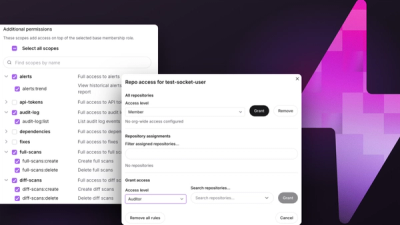
Socket now supports Custom Roles and Repository Access Permissions so organizations can control who can access specific repositories and actions.