

Company News
AWS Security Hub Adds Socket for Supply Chain Security
Socket is now in the AWS Security Hub Extended plan. Adopt it through AWS, apply committed spend, and block malicious open source packages.
By Feross Aboukhadijeh - Aug 04, 2026
flatland-client
Advanced tools
Flatland client — the durable client for the hosted Flatland engine. Your model is a file you own (~/.flatland/models/*.flatland.json), versioned in your own git; the server is a pure function that holds nothing at rest. Includes a local MCP stdio bridge
flatland-client — your model is a file you own.
The durable client for the hosted Flatland engine, and a local MCP bridge for Claude Code / Cursor.
Your model lives at ~/.flatland/models/<name>.flatland.json on your
machine — versioned in your own git, diffable, re-runnable anywhere. The hosted
server is a pure function (/api/v2/*): the client ships the model IR in, the
server computes/transforms and returns, and retains nothing at rest.
flatland-client mcp runs a local MCP stdio server. It holds the model IR on
your machine (durable across sessions) and routes compute to the hosted engine
(metered). The usual way to wire it is:
npx flatland-setup fl_live_YOUR_KEY # configures `flatland-client mcp` by default
Or by hand, in your MCP client config:
{ "mcpServers": { "flatland": { "command": "npx", "args": ["-y", "flatland-client", "mcp"] } } }
The key is read from ~/.flatland/config.json (written by flatland-setup) or
the FLATLAND_API_KEY env var — it is never embedded in the MCP config.
import { create, load, httpTransport } from "flatland-client";

const t = httpTransport({ apiKey: "fl_live_..." });
const h = await create("acme_plan", t);             // writes ~/.flatland/models/acme_plan.flatland.json
await h.bulkAdd([
  { name: "revenue", type: "Currency", value: 1000 },
  { name: "cost", type: "Currency", value: 400 },
  { name: "profit", type: "Currency", formula: "revenue - cost" },
]);
console.log((await h.compile()).values.profit.value);  // metered compute, nothing stored server-side

// new session / a machine that has the file:
const h2 = await load("acme_plan", t);                 // durable across restart
flatland-client mcp              # run the local MCP stdio server
flatland-client list            # list durable models on this machine
flatland-client create <name>   # create a model, persisted locally
flatland-client compile <name>  # compile a local model via the hosted engine
5xx, or a rejected 4xx) raises and
leaves the local file untouched; a failure is never a silent stale-file
"success".load() of a missing file raises; the server never
held your model.{ "flatland_ir_version": 1, "ir": {...} }; a
too-new envelope is refused before it is persisted.X-API-Key
header — never logged.Get a key at https://flatlandfi.com/install.
MIT. Covers the client only — the Flatland engine and API are a separate, proprietary service accessed with a paid API key.
FAQs
Flatland client — the durable client for the hosted Flatland engine. Your model is a file you own (~/.flatland/models/*.flatland.json), versioned in your own git; the server is a pure function that holds nothing at rest. Includes a local MCP stdio bridge
We found that flatland-client demonstrated a healthy version release cadence and project activity because the last version was released less than a year ago. It has 1 open source maintainer collaborating on the project.
Did you know?

Socket for GitHub automatically highlights issues in each pull request and monitors the health of all your open source dependencies. Discover the contents of your packages and block harmful activity before you install or update your dependencies.
Company News
Socket is now in the AWS Security Hub Extended plan. Adopt it through AWS, apply committed spend, and block malicious open source packages.
Research
/Security News
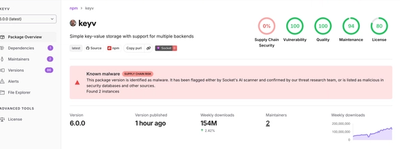
Popular npm packages keyv and cacheable compromised.

Security News
A misconfiguration gave three Anthropic models internet access, and one, believing it was in a simulation, shipped a credential-stealing package to PyPI.