
Research
/Security News
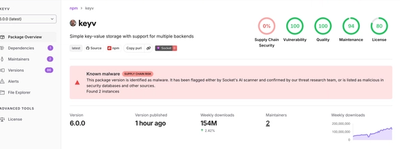
Popular npm Packages in the keyv and Cacheable Namespaces Compromised in Active Supply Chain Attack
Popular npm packages keyv and cacheable compromised.
By Socket Research Team - Aug 04, 2026
formlab-mcp
Advanced tools
Read-only Model Context Protocol server for FormLab — lets Claude (and other MCP clients) read and analyze your FormLab data, from a local export file OR your live cloud workspace.



A read-only Model Context Protocol server for FormLab. Lets Claude (or any MCP-compatible AI assistant) read and analyze your local FormLab database — your formulations, ingredients, batches, samples and test reports — without your data ever leaving your machine.
Local-first + AI-native. Your proprietary recipes stay on your laptop; only the LLM's answer to your question travels.
Listed in the official MCP Registry as io.github.juliu1980/formlab-mcp.
Ask Claude (or another MCP client) things like:
| Tool | Purpose |
|---|---|
list_formulations | Filtered list of recipes |
get_formulation | Full record + flattened wt-% composition (sub-formulas expanded) |
find_similar_formulations | Find formulas using a given ingredient ≥ threshold % |
compare_formulations | Pairwise side-by-side composition diff |
list_ingredients | Filtered list of raw materials. Filters: family, supplier, name_contains, in_stock_only, ingredient_class (small-molecule / surfactant / polymer / extract / fragrance / pigment / sequence / mixture), sequence_contains (e.g. KTTKS → Matrixyl), taxon_contains (e.g. Centella) |
get_ingredient | Full record + supplier / cost ($/kg) / stock / formulations using it, plus GHS safety (pictograms, H/P codes, signal word), per-jurisdiction regulatory status, and inventory lots (balances + expiry). Returns every class-specific sub-object when present: sequence (peptide / oligo), taxon (NCBI ID + scientific name), ingredientClass, extractDetails, sequenceDetails, polymerDetails, surfactantDetails, pigmentDetails, fragranceDetails |
list_lots | Inventory lots across ingredients (each a received batch with its own remaining balance, supplier, expiry). Filters: ingredient_id, expiring_within_days, status |
list_inventory | Portfolio stock rollup — one row per ingredient with on-hand qty, summed lot balance, nearest expiry, and a low-stock flag (on-hand ≤ reorderThreshold, or zero). Filters: low_stock_only, expiring_within_days, family |
list_batches | Filtered list of production / lab-prep events |
get_batch | Full record + actual composition + samples + blend lineage |
list_samples | Filtered list of physical specimens |
get_sample | Full record + canonical variant + test reports + blend lineage |
list_test_results | Filtered list of test reports (by sample, parameter, measured-value range (value_min/value_max), date, or lab) |
get_test_result | Full report: every measurement's value, spec, and the resolved instrument (instrumentSource: row / method / run) |
get_doe_matrix | Pivot matrix (CSV by default) — rows × ingredients × parameters |
find_failures | Pareto-style: parameters that fail acceptance most often |
get_coverage_matrix | Which formulations × parameters have been measured (TEST coverage) |
get_design_space | COMPOSITION design space for one project: which ingredients vary and over what observed wt-% ranges (ranked), an occupied-region summary ("where you've been"), the biggest untested interior gap as ready-to-seed DOE ranges (a combination you could have made but skipped), and an optional standardised 2-component PCA of all varying ingredients — loadings, variance-explained, scree, and a full-dimensional gap. Matches the in-app Design Space Viewer exactly. Answers "where haven't I explored?" / "what should I formulate next?" |
list_doe_designs | Saved DOE designs — the recipe behind each batch of runs: design type, factors + ranges, constraints, run count, D-efficiency. Filters: project, design_type, constrained_only, name_contains |
get_doe_design | One design in full: constraints in plain language, the model it was optimised for, generation settings (run budget, replicates, centre points, seed) and the complete run matrix with the formulation each run became |
find_by_smarts | SMARTS-pattern substructure search across every ingredient with a SMILES. Requires @rdkit/rdkit (optional dependency — install with npm install @rdkit/rdkit in mcp/ if you get a "not installed" error). Examples: c1ccccc1 (any aromatic 6-ring), [OX2H1] (any hydroxyl), C(=O)O (carboxylic acid), [F,Cl,Br,I] (any halogen). |
list_equipment | Filtered list of the Equipment registry (mixers, ovens, viscometers, balances…). Filters: category, status, manufacturer, name_contains |
get_equipment | Full equipment record + a summary of where it's used (panels, step presets, test methods, formulas, batches) |
list_test_methods | Filtered list of Test Methods (the parameter library). Filter by analyte (the property measured, e.g. Viscosity — finds every method for it), category, name_contains, include_retired |
get_test_method | Full method definition (SOP / sample prep / equipment / calculation / acceptance spec) + sibling methods sharing its analyte |
list_step_presets | Filtered list of Step Presets (reusable procedure steps: duration / temp / RPM / equipment). Filters: industry, name_contains |
get_step_preset | Full step-preset record incl. the multi-value equipment list ({name, equipmentId}) |
list_test_panels | Filtered list of Test Panels (reusable column-sets — the parameters measured together on a sample). Filters: industry, name_contains |
get_test_panel | Full panel record — ordered parameter list (each with resolved Test Method UID, unit, spec) + instruments |
list_projects | Filtered list of projects (the buckets formulations are filed under) + per-project formulation count. Filters: status, name_contains |
get_project | Full project record + the formulations filed under it |
list_notebook_entries | ELN feed — dated authored notes attached to records. Filters: entity_type, entity_id, author, text_contains, since, until |
get_notebook_entry | One notebook entry — full body, author, attachment metadata, resolved linked record |
# Run directly without installing — recommended:
npx formlab-mcp /path/to/formlab-export.json

# Or install globally for repeated use:
npm install -g formlab-mcp
formlab-mcp /path/to/formlab-export.json
For local development from this repo:
cd mcp
npm install
node index.js /path/to/formlab-export.json
Requires Node 18+.
formlab-export-YYYY-MM-DD.json to your downloads folderThe MCP server watches the file — re-export from FormLab and the next tool call sees the fresh data without restarting the server.
Instead of an export file, point the server at your live cloud workspace so it's always current.
The config sets a single env var, which switches the server into cloud mode:
| Env var | Value |
|---|---|
FORMLAB_MCP_TOKEN | a dedicated, read-only, revocable token (flmcp_…) |
FORMLAB_SUPABASE_URL | (optional) override the backend URL — defaults to production |
FORMLAB_SUPABASE_ANON_KEY | (optional) override the publishable key — defaults to production |
FORMLAB_REFRESH_SECONDS | (optional) poll interval, default 60 |
When FORMLAB_MCP_TOKEN is present, the server POSTs it to FormLab's mcp-data Edge Function, which returns your workspace scoped to you by row-level security and re-fetches every FORMLAB_REFRESH_SECONDS. It's read-only — enforced at the database (a dedicated mcp_readonly Postgres role with SELECT-only grants), not by trust.
Security. The token grants read-only access to one workspace and holds no account session — only a SHA-256 hash is stored server-side, and it never rotates. Treat the config like a password (don't share or commit it). Revoke or re-mint any time from Settings → Account → AI tools (MCP) → Connect.
Cloud mode has no extra dependency — it's a plain fetch.
Add this to your claude_desktop_config.json (on macOS: ~/Library/Application Support/Claude/claude_desktop_config.json):
{
  "mcpServers": {
    "formlab": {
      "command": "npx",
      "args": ["formlab-mcp", "/Users/you/Downloads/formlab-export-2026-05-30.json"]
    }
  }
}
Or for local-dev (from the repo):
{
  "mcpServers": {
    "formlab": {
      "command": "node",
      "args": [
        "/Users/you/Documents/GitHub/formlab/mcp/index.js",
        "/Users/you/Downloads/formlab-export-2026-05-30.json"
      ]
    }
  }
}
Restart Claude Desktop. You should see a hammer icon indicating tools are available, and FormLab's 33 tools become callable in any conversation.
claude mcp add formlab npx formlab-mcp /Users/you/Downloads/formlab-export.json
Or with a stored env var:
export FORMLAB_EXPORT=/Users/you/Downloads/formlab-export-2026-05-30.json
claude mcp add formlab npx formlab-mcp
The server accepts both FormLab export shapes:
{ "fair": {...metadata...}, "data": {...db...} }{...db...} directlyThe wrapped form is the default since 2026; the legacy form is supported for older exports.
Live file-sync with write tools: create_formulation, update_formulation, log_test_result, create_batch, etc. Mutations from Claude write back to the same JSON FormLab reads. Conflict detection, cascade-safe deletes, schema versioning.
Not yet shipped — see the FormLab roadmap.
MIT
FAQs
Read-only Model Context Protocol server for FormLab — lets Claude (and other MCP clients) read and analyze your FormLab data, from a local export file OR your live cloud workspace.
The npm package formlab-mcp receives a total of 76 weekly downloads. As such, formlab-mcp popularity was classified as not popular.
We found that formlab-mcp demonstrated a healthy version release cadence and project activity because the last version was released less than a year ago. It has 1 open source maintainer collaborating on the project.
Did you know?

Socket for GitHub automatically highlights issues in each pull request and monitors the health of all your open source dependencies. Discover the contents of your packages and block harmful activity before you install or update your dependencies.
Research
/Security News
Popular npm packages keyv and cacheable compromised.

Security News
A misconfiguration gave three Anthropic models internet access, and one, believing it was in a simulation, shipped a credential-stealing package to PyPI.

Security News
/Company News
Socket has joined the new Composer and Packagist sponsorship program as a launch sponsor, supporting the team that keeps PHP's package ecosystem secure.