
Product
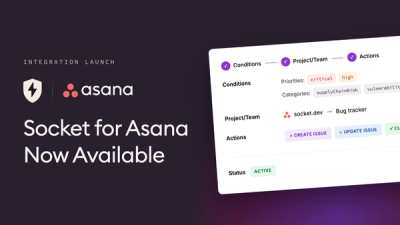
Socket for Asana Is Now Available
Create and manage Asana tasks directly from Socket alerts, with manual task creation, automated ticketing rules, and two-way sync.
By Jeppe Hasseriis - Aug 25, 2026
genai-telemetry-redactor
Advanced tools
Redact sensitive GenAI telemetry before logs, spans, events, and observability export.
Status: Active Scope: backend Repository Type: library Addons: sdk
GenAI Telemetry Redactor is a library and SDK surface for redacting sensitive content from LLM telemetry before it reaches logs, spans, events, or observability backends.
The project focuses on prompt, completion, and tool-argument boundaries. It keeps content capture off by default, maps safe metadata to OpenTelemetry GenAI conventions, and reports redaction counts and reasons without preserving raw user content.
npm install genai-telemetry-redactor
import { withRedactedTelemetry } from "genai-telemetry-redactor";

const result = await withRedactedTelemetry({
  adapter: "openai-compatible",
  request: {
    model: "model_example",
    messages: [
      {
        role: "user",
        content: "Contact user@example.invalid with token_example_value",
      },
    ],
  },
  telemetry: {
    operationName: "chat",
    providerName: "openai",
    requestModel: "model_example",
  },
});

if (!result.ok) {
  throw new Error(result.error.code);
}

console.log(result.value.redactedRequest);
console.log(result.value.telemetry.attributes);
The helper returns redacted request and response payloads plus metadata-only telemetry attributes. It does not call a model provider, own credentials, export spans, store prompts, or guarantee perfect sensitive-data detection.
maxDetectors limits how many detectors may run for one text or object-key
check. maxDetectorRuns limits cumulative detector executions during JSON-like
traversal, including object-key safety checks. maxTotalDurationMs bounds the
whole redaction operation and fails closed with max_total_duration_exceeded
when the budget is exceeded.
createBufferedTextStreamRedactor is an explicit final-flush streaming helper.
It buffers string chunks, omits content from intermediate push(chunk) results,
and returns redacted content only from close(). OpenAI-compatible streaming
adapters remain metadata-only by default.
createBuiltInRollingTextStreamRedactor is a lower-latency core-only helper for
the reviewed built-in detectors. It flushes redacted text only through safe
whitespace boundaries, retains bearer-scheme context, and buffers long
whitespace-free segments. It rejects custom detectors and profiles; those still
require the final-flush helper. Await every push() and close() call because
overlapping operations fail closed.
Redaction reports may include numeric timings such as operation duration,
detector duration, and detector run count. These metrics are safe summaries only:
they do not include matched values, raw content, detector IDs, or field paths.
onReport callback failures do not discard already redacted results. The SDK
returns a report_callback_failed warning so callers can observe the callback
failure without exporting partial or raw payloads.
Custom regex detectors should follow
docs/security/custom-regex-redos-guidance.md. Length limits and async detector
timeouts are guardrails, but synchronous JavaScript regex evaluation cannot be
preempted once a backtracking-heavy pattern is running.
createRedactionProfile(config) validates and snapshots one reusable core
policy. A successful profile can be passed to redactText, redactJsonLike,
redactToolArguments, and createBufferedTextStreamRedactor as
{ profile, signal? }. Profile-backed operations reject per-call detector,
limit, or replacement overrides.
Profile creation fails safely with invalid_redaction_profile for an empty
effective detector set, duplicate detector IDs, invalid limits, or a
maxDetectors value below the configured detector count. Profiles preserve the
existing fail-closed overlap policy; they do not add detector priority or
automatically disable built-ins when custom detectors are present.
The first useful versions support OpenAI-compatible and Anthropic Messages request and response shapes, nested tool arguments and results, a small detector set, replacement-token policy, and safe OpenTelemetry GenAI metadata mapping.
The current implementation starts with packages/core: async redactText,
redactJsonLike, redactToolArguments,
createBufferedTextStreamRedactor, and
createBuiltInRollingTextStreamRedactor; built-in detectors for email, bearer token,
API-key-like strings, and URLs; category-only replacement tokens; redaction
reports; shape-preserving JSON-like traversal with shared-reference reuse; and
fail-closed detector, traversal, buffered-stream, circular-reference, overlap,
and limit behavior.
It also includes packages/openai-compatible: provider-SDK-free request and
response shape helpers for messages, prompt, input, choices, completion
text, message content, and tool-call function arguments. Unsupported shapes fail
closed with unsupported_provider_shape, malformed JSON tool arguments fail
closed with malformed_tool_arguments, and streaming events return metadata-only
streaming_content_omitted results instead of exporting chunk content.
packages/anthropic-messages adds a second provider-SDK-free adapter for the
Anthropic Messages wire shape. It redacts top-level system, message strings,
text blocks, assistant tool_use.input, and user tool_result.content.
Unknown or unreviewed content blocks fail closed instead of being copied through.
Image, document, search-result, thinking, and server-tool blocks remain outside
the supported adapter contract until dedicated fixtures prove them safe.
packages/otel starts the OpenTelemetry boundary with
mapRedactionReportToGenAIMetadata: a pure metadata mapper that accepts redaction
reports and safe GenAI metadata candidates, keeps content capture disabled, and
exports official GenAI operation/provider/model/token attributes plus
library-specific genai_redactor.* redaction metadata without accepting raw
provider payloads or span writer objects.
packages/sdk starts the SDK ergonomics boundary with withRedactedTelemetry:
an explicit-adapter helper that redacts OpenAI-compatible or Anthropic Messages
request and response payloads, returns safe telemetry metadata, and invokes
optional report callbacks without owning provider credentials, retries, routing,
transport, telemetry exporters, or prompt storage.
examples contains executable TypeScript samples for the first safe integration
paths: OpenAI-compatible wrapping, Anthropic Messages system and text redaction,
tool-call argument redaction with a report callback, custom detector
registration, final-flush and built-in rolling redaction, and streaming
metadata-only handling. The contract runner imports
these samples against built package exports so example drift is treated as a
package contract failure.
The MVP must not become a telemetry backend, model gateway, prompt store, legal compliance product, or full DLP platform.
Streaming content export is not part of the first safe path. Streaming telemetry must remain metadata-only until an ADR, rolling-buffer policy, and chunk-boundary fixtures prove redaction behavior.
.editorconfig, .gitattributes, and .gitignore are generated to keep line endings, binary diffs, local files, build outputs, caches, and secret files under control.
Runtime packaging is decided as Node.js >=22.14.0, ESM-only TypeScript, and a
pnpm workspace with one initial npm package named genai-telemetry-redactor.
The OpenTelemetry GenAI semantic-convention source is pinned to an audited
upstream Development snapshot, so official gen_ai.* mappings are reproducible
and custom redaction metadata stays under the genai_redactor.* namespace.
Package exports point at compiled dist JavaScript and declaration files emitted
from the TypeScript source. The product boundary is already decided: redact
before export, capture content only by explicit opt-in, and never treat redaction
as perfect sensitive-data discovery.
FAQs
Redact sensitive GenAI telemetry before logs, spans, events, and observability export.
We found that genai-telemetry-redactor demonstrated a healthy version release cadence and project activity because the last version was released less than a year ago. It has 1 open source maintainer collaborating on the project.
Product
Create and manage Asana tasks directly from Socket alerts, with manual task creation, automated ticketing rules, and two-way sync.

Security News
Open VSX has removed three extension IDs from its malicious-extension list as the legitimate publishers they impersonated move to claim the names for themselves.

Product
Socket’s PHP and Composer support is now in Beta for all customers, with PHP reachability analysis generally available.