

Company News
AWS Security Hub Adds Socket for Supply Chain Security
Socket is now in the AWS Security Hub Extended plan. Adopt it through AWS, apply committed spend, and block malicious open source packages.
By Feross Aboukhadijeh - Aug 04, 2026
Sober: a shared rules-and-tools harness for Claude Code Pro and Codex Plus that cuts wasted AI quota.


Keep your AI coding agent calm, constrained, and evidence-driven.
Sober is a local control harness for Claude Code and Codex CLI. It keeps agents from over-reading, over-editing, and claiming “done” without proof by making them follow a simple working loop:
locate facts → read only what matters → make the smallest safe change → verify → leave a handoff
At the center is one shared AGENTS.md: the workflow contract both runtimes follow.
Your existing config is preserved. Sober only adds or refreshes its managed blocks, symlinks, hooks, and rules. Uninstall removes only Sober-owned files.
Use Sober as the default control layer, then add your own commands, subagents, MCP tools, and project-specific rules on top.
Establish calm working habits for your AI agent in three simple steps.
Choose the installation path that best fits your development environment:
Deploys Sober rules/hooks and interactively checks/guides you through installing optional deterministic tools (jq, ripgrep, ast-grep, Probe, and Context7).
npm install -g getsober@latest
sober setup
Only deploys Sober's core policy and skill files to ~/.sober and links them to the AI runtimes. (Best for updates or if you already have the required tools installed).
npm install -g getsober@latest
sober install
Navigate to your project root and generate the local policy contract (AGENTS.md) and session memory (HANDOFF.md).
cd your-project
sober template .  # Generates local agent contract & handoff templates
sober claude      # or: sober codex
Launch an agent through Sober:
sober codex
sober claude
sober codex --yolo
sober claude --yolo
[!NOTE]
--yolobypasses approvals/permissions. Use it only in isolated environments.
[!TIP] Prompt your agent with clear, scoped requests to see Sober in action:
Fix the login timeout bug.
Find the right lines first, make the smallest safe change, and verify with tests.
Use these commands to diagnose the toolchain status or safely remove configurations:
sober doctor
~/.sober directory, leaving your own runtime configurations in place.
sober uninstall
Sober operates within two distinct, decoupled scopes:
~/) — created by sober setup or sober install
~/.sober: Canonical source of truth for Sober policies, hooks, and skills.~/.claude & ~/.codex: Configuration and rules safely merged with your existing runtime settings../) — created by sober template
[project]/AGENTS.md: The project-specific policy spine governing the agent.[project]/HANDOFF.md: Local session memory ensuring seamless task handoffs between invocations.AI coding agents are powerful, but their default behavior is often too eager.
| Without Sober | With Sober |
|---|---|
| Reads entire files to find one line | Finds the exact file:line first |
| Guesses where code lives | Checks candidates with deterministic tools |
| Rewrites more than the task asked for | Makes the smallest safe patch |
| Formats or cleans unrelated code | Leaves unrelated files alone |
| Says "done" without proof | Runs the closest build, test, or verification |
| Repeats the same failed idea | Stops after repeated failures and re-plans |
| Produces long confident summaries | Reports result, changed files, tests, and risks |
| Loses context between sessions | Leaves a bounded HANDOFF.md |
The goal: keep the model for judgment, while the workflow stays factual, small, and verifiable.
Sober is not another AI agent. It is not a hosted service, a prompt pack, or a token optimizer.
Sober is a local control harness for the AI coding tools you already use: Claude Code and Codex CLI.
It installs a shared AGENTS.md, skills, and hooks that keep your existing agents inside a disciplined workflow:
file:line before opening broad files.HANDOFF.md.After installing, you keep running claude or codex exactly as before.
Don't like it? Run sober uninstall to remove Sober-owned links, hooks, and ~/.sober while leaving your own config in place.
Sober operates on three levels: a visual workflow loop, core architectural principles, and the concrete agent contract.
Sober does not create a new agent; it keeps your existing Claude Code and Codex CLI inside a calm, turn-by-turn execution workflow:
flowchart TD
    classDef step fill:#e0e7ff,stroke:#6366f1,stroke-width:2px,color:#1e1b4b;
    classDef global fill:#f8fafc,stroke:#94a3b8,stroke-width:2px,color:#0f172a;
    classDef exit fill:#fff1f2,stroke:#f43f5e,stroke-width:2px,color:#4c0519;
    classDef startEnd fill:#f0fdf4,stroke:#10b981,stroke-width:2px,color:#064e3b;

    P6([1. Workspace Isolation: P6 Isolation]):::startEnd --> P0[Enter Sober Harness: P0 Context Limits]:::global
    P0 --> P1[2. Search & Locate: P1 Search]:::step
    P1 --> P2[3. Minimal Patch: P2 Edit]:::step
    P2 --> P3[4. Proof Before Done: P3 Verify]:::step

    P3 --> P4{3+ failures repeated? <br> P4 Budget}:::global
    P4 -- Yes --> Stop([Stop & Re-plan]):::exit
    P4 -- No --> P5[5. Session Handoff: P5 Memory]:::step

    P5 --> P8[6. Brief Report Output: P8 Compression]:::step
    P8 --> P7([7. KPI Measurement: P7 Observe]):::global
The loop lives in AGENTS.md, the single rules file both runtimes read. Each policy (P0–P8) is mapped to its operational role within the cycle:
P1 → P2 → P3 → P5)
P0, P4, P8)
P6, P7)
On top of Sober, you can freely add custom commands, subagents, MCP tools, and project-specific rules.
No matter how advanced models become, Sober is designed around these five future-proof, architectural pillars:
HANDOFF.md) instead of opaque databases.At the center of Sober is one shared AGENTS.md. It is the contract Sober installs where Claude Code and Codex CLI look for agent instructions. It constrains the agent's default behavior into a stricter, resource-saving loop:
| Policy | Core Rule | Details & Constraints |
|---|---|---|
P0 Context | Context discipline | Never read whole files; find the exact file:line and adjacent ~2 lines first. Pipe all search results to ` |
P1 Search | Search before reading | Never hand-grep; use ripgrep for exact/regex keyword matches, structural Probe for definitions and call-sites, and semantic mgrep for abstract concepts as a last resort. |
P2 Edit | Small patches only | Touch only what the task requires and minimize LLM rewrites by offloading edits to ast-grep --rewrite for repeated mechanical patches and Serena replace_symbol for type-aware single-symbol updates. |
P3 Verify | Proof before "done" | Nudges the agent to avoid editing based on unverified guesses. Verify candidates/sites first using ripgrep, Probe, or Serena (in a single call), and request the closest possible build/test/verification steps before declaring completion. |
P4 Budget | No repeated failure loops | Strictly respect turn budgets (1 search, 1-2 edits, 3 debugs). Immediately stop to re-plan after 3 failed hypotheses rather than looping on the same guess. |
P5 Memory | Visible handoff | Write session state to HANDOFF.md and persistent architectural facts to .serena/memories for human review (no auto-execution or blind injection). |
P6 Isolation | Reversible isolation | Keep changes within clean git boundaries. Run independent work (like parallel tasks, repo-scale exploration, or fresh review/pre-commit checks) using native git worktrees or subagents. |
P7 Observe | Measure additions | Justify any new tools, rules, or hooks by measuring cost, context fill, and retries. Roll back the change immediately if a metric worsens. |
P8 Compression | Brief reports | Avoid verbose prose or redundant file reprints. Format replies to include the final result, changed files, and test outcomes only, using the caveman compression skill when loaded. |
| Contract Policy | Supporting Component (under ~/.sober/) |
|---|---|
P0 / P1 Limits & Search | search-ladder skill, ripgrep, Probe |
P2 Minimal Patching | edit-deterministic skill, ast-grep, Serena (LSP) |
P3 Proof Before Done | verify-gate hook, verify.sh script |
P4 Exit on Repeated Failures | tool-failure-log hook, analyze-failures.sh command |
P5 Handoff & Continuity | handoff-write hook, HANDOFF.md file |
P8 Compressed Brief Reports | caveman skill |
P7 KPI & Additions Measurement | observe skill, /measure command |
Broad prompts without a stop condition waste the most quota. Always include what "done" looks like.
The single most important habit: tell the agent what to do, what not to touch, and how to verify.
Good prompt:
Change the payment retry timeout from 3s to 5s.
Keep behavior unchanged otherwise.
Verify with the existing payment tests.
Bad prompt:
Clean up this repo.
Skills are not terminal commands. They are small instruction packs that shape how the agent works.
You rarely need to name them directly. Describe the behavior you want.
| Skill | When it helps | Example prompt |
|---|---|---|
karpathy | Every task | "Do only the requested change. Don't clean unrelated files." |
search-ladder | Finding code | "Find the relevant file:line first. Don't read whole files." |
edit-deterministic | Repeated changes | "Use a repeatable rewrite for all similar call sites." |
caveman | Long responses | "Report only result, changed files, tests, and risks." |
observe | Adding tools/rules | "Measure before and after. Keep it only if the metric improves." |
sober-review | Before commit | "Run the sober-review checklist. Report issues only. Don't edit." |
structure-graph | Large or unfamiliar repos with unclear flows, dependencies, or blast radius | "Map with GitNexus CLI for structure hints; before reading deeply or editing, verify the candidate with rg/Probe." |
Don't push harder — redirect.
/analyze-failures. In Codex CLI, ask it to run ~/.sober/scripts/analyze-failures.sh, read only the script output, summarize repeated failure patterns, and propose the next smallest plan.Long conversations get noisy. Before stopping, ask for a bounded handoff:
Summarize only: verified facts, remaining risks, and the next command to run.
Sober's handoff hook automatically writes a small HANDOFF.md with the current branch, last commit, and uncommitted changes when a session ends in a git project.
When you start a new session, ask the agent to read HANDOFF.md first to pick up where you left off.
For non-trivial changes, run a read-only review:
Run the sober-review checklist on this diff.
Report PASS or ISSUES only. Do not edit files.
This checks correctness, scope, complexity, style, verification coverage, and basic security — without touching code.
Before adding any new tool, skill, or rule, run a before/after check.
In Claude Code you can use Sober's /measure command. In Codex, use the same wording as a normal prompt:
/measure baseline
# make exactly one change to your setup
/measure after
Key metrics to watch:
If any metric gets worse, roll back.
Sober works without these tools. Some of them reduce files read, output volume, or retry loops for specific tasks.
sober setup interactively offers the core search/edit toolkit — ripgrep, ast-grep, Probe — plus Context7 setup.
Conditional tools such as GitNexus, Serena, and mgrep are reported by sober doctor and should be added manually only when they pay for themselves.
These tools pay off in most projects. They make Sober's default loop — search, minimal edit, verify, brief report — cheaper and more reliable.
| Tool | Sober role | Trigger |
|---|---|---|
ripgrep | Locate exact text fast | Known symbol, keyword, or regex |
ast-grep | Apply mechanical rewrites | Repeated code-shape changes |
| Probe | Find structural code candidates | Definitions, call sites, code patterns |
Add these only when the task calls for them. They are not part of the default install path; sober doctor reports their status and install hints.
| Tool | Sober role | Trigger |
|---|---|---|
| Serena | Symbol-aware navigation and edits | Type-aware single-symbol changes |
Context7 / ctx7 | Current external docs | Library API uncertainty |
gitnexus | Structure hints for large repos | Unclear flow, dependency, or blast radius |
mgrep | Last-resort concept search | Exact token name is unknown |
Sober does not treat optional tools as always-on power-ups. Tools are selected by trigger, verified by evidence, and rolled back if they increase read volume, output volume, or retry rate.
GitNexus note: Sober treats GitNexus as a structure-hint generator, not a source of truth. Use gitnexus analyze --skip-agents-md --skip-skills --skip-embeddings, then verify candidates with rg or Probe before deep reading.
sober setup       # installs policy, then interactively offers the core toolkit and Context7 setup
sober doctor      # shows current status and install hints for conditional tools
For Context7 directly:
npm install -g ctx7
ctx7 setup --cli --claude
ctx7 setup --cli --universal
For Codex MCP mode, enable Context7 explicitly:
codex mcp add context7 -- npx -y @upstash/context7-mcp --api-key YOUR_API_KEY
git commit.HANDOFF.md file you can read and edit.| Symptom | Fix |
|---|---|
| Agent says a hook is missing | sober doctor, then sober install |
| Search tool not found | Keep working, or run sober setup to install it |
| Verification runs wrong stack | ~/.sober/scripts/verify.sh --path <subdir> |
| Tool failures repeat | /analyze-failures (Claude) or run script (Codex), then re-plan |
| Output too long | Ask: "Show only result, diff, and file:line" |
your-repo/
├─ AGENTS.md          # project-specific header + shared Sober spine
├─ CLAUDE.md          # symlink to AGENTS.md (single source)
├─ HANDOFF.md         # bounded, reviewed session state
└─ sgconfig.yml       # optional, only with --with-sgconfig
┌──────────────────────────────────────────────────────────────┐
│                         Sober                                │
│                    shared home: ~/.sober                     │
│                                                              │
│   ┌──────────────┬──────────────┬────────────────────────┐   │
│   │   AGENTS.md  │   skills/    │        scripts/        │   │
│   │ shared rules │ tool habits  │ safety + handoff hooks │   │
│   └──────────────┴──────────────┴────────────────────────┘   │
│             ↓              ↓                  ↓              │
│        Claude Code      Codex CLI        project template    │
│        ~/.claude        ~/.codex         AGENTS/HANDOFF      │
│             ↓              ↓                  ↓              │
│      merged settings   hooks + rules     local overrides     │
└──────────────────────────────────────────────────────────────┘
~/.sober/AGENTS.md                    # shared policy source
~/.sober/commands/*.md                # Sober-owned Claude slash commands
~/.sober/rules/*.md                   # Sober-owned Claude rules
~/.sober/skills/<skill>/SKILL.md      # one copy of each skill
~/.sober/scripts/                     # local hook and verification scripts
~/.sober/codex-rules/*.rules          # installed copy of .sober/codex/rules

# Claude Code
~/.claude/CLAUDE.md                   # symlink to ~/.sober/AGENTS.md, or managed @import block
~/.claude/AGENTS.md                   # symlink to ~/.sober/AGENTS.md, or managed @import block
~/.claude/commands/<cmd>.md           → ~/.sober/commands/<cmd>.md
~/.claude/rules/<rule>.md             → ~/.sober/rules/<rule>.md
~/.claude/skills/<skill>              → ~/.sober/skills/<skill>
~/.claude/settings.json               # Sober hooks additively merged

# Codex CLI
~/.codex/AGENTS.md                    # contains/refreshes the Sober spine inline
~/.agents/skills/<skill>              → ~/.sober/skills/<skill>
~/.codex/hooks.json                   # Sober hooks additively merged
~/.codex/rules/*.rules                → ~/.sober/codex-rules/*.rules
| Hook | What it does |
|---|---|
critical-action-check | Blocks dangerous shell commands |
verify-gate | Warns before commit/push if changes are unverified; advisory-only |
handoff-write | Writes HANDOFF.md on session stop |
session-start | Loads safe env vars and shows budget reminder |
compact-suggest | Suggests compaction when context gets long |
post-edit-format | Auto-formats edited files if a formatter exists |
tool-failure-log | Logs tool failures locally with secret redaction |
Codex runs the same hooks via ~/.codex/hooks.json. The sober-critical-actions.rules file adds an extra Starlark check for dangerous commands.
Sober ships a review checklist, not a fixed reviewer pipeline.
Use a separate helper only when it pays for itself: reviewing non-trivial changes with fresh eyes, exploring large unfamiliar repos, or running truly independent tasks in parallel.
Avoid fixed multi-agent chains for everyday work. The checklist is in .sober/skills/sober-review; the actual helper can be Claude Code's native subagent, a Codex helper, or a reviewer you already trust.
git clone https://github.com/move-hoon/sober.git
cd sober
npm test
npm pack --dry-run
docs/adr/CONTRIBUTING.mdMIT — see LICENSE.
FAQs
Sober: a shared rules-and-tools harness for Claude Code Pro and Codex Plus that cuts wasted AI quota.
We found that getsober demonstrated a healthy version release cadence and project activity because the last version was released less than a year ago. It has 1 open source maintainer collaborating on the project.
Did you know?

Socket for GitHub automatically highlights issues in each pull request and monitors the health of all your open source dependencies. Discover the contents of your packages and block harmful activity before you install or update your dependencies.
Company News
Socket is now in the AWS Security Hub Extended plan. Adopt it through AWS, apply committed spend, and block malicious open source packages.
Research
/Security News
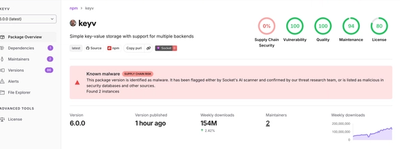
Popular npm packages keyv and cacheable compromised.

Security News
A misconfiguration gave three Anthropic models internet access, and one, believing it was in a simulation, shipped a credential-stealing package to PyPI.