

Company News
AWS Security Hub Adds Socket for Supply Chain Security
Socket is now in the AWS Security Hub Extended plan. Adopt it through AWS, apply committed spend, and block malicious open source packages.
By Feross Aboukhadijeh - Aug 04, 2026
gmail-workspace-mcp-server
Advanced tools
MCP server for Gmail integration with OAuth2 and service account support
An MCP (Model Context Protocol) server that provides Gmail integration for AI assistants. Supports both personal Gmail accounts (via OAuth2) and Google Workspace accounts (via service account with domain-wide delegation).
npm install gmail-workspace-mcp-server
Or run directly with npx:
npx gmail-workspace-mcp-server
This server supports two authentication modes. Choose the one that matches your account type.
Use this for personal @gmail.com accounts or any Google account without Workspace admin access.
Run the built-in setup command:
npx gmail-workspace-mcp-server oauth-setup <client_id> <client_secret>
You can also pass credentials via environment variables:
GMAIL_OAUTH_CLIENT_ID=... GMAIL_OAUTH_CLIENT_SECRET=... npx gmail-workspace-mcp-server oauth-setup
Port conflict? If port 3000 is already in use, specify a different port:
PORT=3001 npx gmail-workspace-mcp-server oauth-setup <client_id> <client_secret>
Desktop app credentials automatically allow http://localhost redirects on any port, so no additional Google Cloud Console configuration is needed.
This will open your browser for Google sign-in and print the refresh token. You only need to do this once — the refresh token does not expire (as long as the OAuth consent screen is published).
| Variable | Required | Description |
|---|---|---|
GMAIL_OAUTH_CLIENT_ID | Yes | OAuth2 client ID from Google Cloud Console |
GMAIL_OAUTH_CLIENT_SECRET | Yes | OAuth2 client secret |
GMAIL_OAUTH_REFRESH_TOKEN | Yes | Refresh token from the setup script |
GMAIL_ENABLED_TOOLGROUPS | No | Comma-separated list of tool groups (default: all) |
{
  "mcpServers": {
    "gmail": {
      "command": "npx",
      "args": ["gmail-workspace-mcp-server"],
      "env": {
        "GMAIL_OAUTH_CLIENT_ID": "your-client-id.apps.googleusercontent.com",
        "GMAIL_OAUTH_CLIENT_SECRET": "your-client-secret",
        "GMAIL_OAUTH_REFRESH_TOKEN": "your-refresh-token"
      }
    }
  }
}
Use this for Google Workspace organizations where a domain admin can grant domain-wide delegation.
https://www.googleapis.com/auth/gmail.readonly (read emails)https://www.googleapis.com/auth/gmail.modify (modify labels)https://www.googleapis.com/auth/gmail.compose (create drafts)https://www.googleapis.com/auth/gmail.send (send emails)| Variable | Required | Description |
|---|---|---|
GMAIL_SERVICE_ACCOUNT_CLIENT_EMAIL | Yes | Service account email address |
GMAIL_SERVICE_ACCOUNT_PRIVATE_KEY | Yes | Service account private key (PEM format) |
GMAIL_IMPERSONATE_EMAIL | Yes | Email address to impersonate |
GMAIL_ENABLED_TOOLGROUPS | No | Comma-separated list of tool groups to enable (default: all groups) |
You can find the client_email and private_key values in your service account JSON key file.
{
  "mcpServers": {
    "gmail": {
      "command": "npx",
      "args": ["gmail-workspace-mcp-server"],
      "env": {
        "GMAIL_SERVICE_ACCOUNT_CLIENT_EMAIL": "my-service-account@my-project.iam.gserviceaccount.com",
        "GMAIL_SERVICE_ACCOUNT_PRIVATE_KEY": "-----BEGIN PRIVATE KEY-----\nMIIE...\n-----END PRIVATE KEY-----",
        "GMAIL_IMPERSONATE_EMAIL": "user@yourdomain.com"
      }
    }
  }
}
Note: For the private key, you can either:
\n for newlines (as shown above)The server supports three tool groups for permission-based access control:
| Group | Tools Included | Risk Level |
|---|---|---|
readonly | list_email_conversations, get_email_conversation, search_email_conversations, list_draft_emails | Low |
readwrite | All readonly tools + change_email_conversation, upsert_draft_email | Medium |
readwrite_external | All readwrite tools + send_email | High |
By default, all tool groups are enabled. To restrict access, set the GMAIL_ENABLED_TOOLGROUPS environment variable:
# Read-only access (no write/send capabilities)
GMAIL_ENABLED_TOOLGROUPS=readonly

# Read and write, but no external sending
GMAIL_ENABLED_TOOLGROUPS=readwrite

# Full access including sending emails (default)
GMAIL_ENABLED_TOOLGROUPS=readwrite_external
Security Note: The send_email tool is in a separate readwrite_external group because it can send emails externally, which carries higher risk than internal operations like modifying labels or creating drafts.
List email conversations from Gmail with optional filtering.
Parameters:
count (number, optional): Number of emails to return (default: 10, max: 100)labels (string, optional): Comma-separated label IDs to filter by (default: "INBOX")sort_by (string, optional): Sort order - "recent" (newest first) or "oldest" (default: recent)after (string, optional): Only return emails after this datetime, exclusive (ISO 8601 UTC, e.g., "2024-01-15T14:30:00Z")before (string, optional): Only return emails before this datetime, exclusive (ISO 8601 UTC, e.g., "2024-01-15T14:30:00Z")Example:
{
  "count": 20,
  "labels": "INBOX,STARRED",
  "after": "2024-01-15T00:00:00Z",
  "before": "2024-01-20T23:59:59Z"
}
Retrieve the full content of a specific email by its ID.
Parameters:
email_id (string, required): The unique identifier of the emailExample:
{
  "email_id": "18abc123def456"
}
Search emails using Gmail's powerful query syntax.
Parameters:
query (string, required): Gmail search query (e.g., "from:user@example.com", "is:unread", "subject:meeting")count (number, optional): Maximum results to return (default: 10, max: 100)Example:
{
  "query": "from:alice@example.com is:unread",
  "count": 20
}
Modify email labels and status (read/unread, starred, archived).
Parameters:
email_id (string, required): The email ID to modifystatus (string, optional): "read", "unread", or "archived"is_starred (boolean, optional): Star or unstar the emaillabels (string, optional): Comma-separated labels to addremove_labels (string, optional): Comma-separated labels to removeExample:
{
  "email_id": "18abc123def456",
  "status": "read",
  "is_starred": true
}
List draft emails from Gmail with optional thread filtering.
Parameters:
count (number, optional): Maximum number of drafts to return (default: 10, max: 100)thread_id (string, optional): Filter drafts by conversation thread IDExample:
{
  "thread_id": "18abc123def456"
}
Create, update, or delete a draft email. Optionally as a reply to an existing conversation.
Parameters:
draft_id (string, optional): ID of an existing draft to update or delete (omit to create a new draft)delete (boolean, optional): Set to true to delete the draft specified by draft_id. All other parameters are ignored when deletingto (string, required for create/update): Recipient email addresssubject (string, required for create/update): Email subjectplaintext_body (string): Plain text body content (at least one of plaintext_body or html_body required for create/update)html_body (string): HTML body content for rich text formatting (at least one of plaintext_body or html_body required for create/update)cc (string, optional): CC recipientsbcc (string, optional): BCC recipientsthread_id (string, optional): Thread ID for repliesreply_to_email_id (string, optional): Email ID to reply to (sets References/In-Reply-To headers)For create/update: at least one of plaintext_body or html_body must be provided. If both are provided, a multipart email is sent with both versions.
Example (create new draft):
{
  "to": "recipient@example.com",
  "subject": "Meeting Follow-up",
  "plaintext_body": "Thanks for the meeting today!"
}
Example (update existing draft):
{
  "draft_id": "r123456789",
  "to": "recipient@example.com",
  "subject": "Meeting Follow-up (revised)",
  "html_body": "<p>Thanks for the meeting today! Check out <a href=\"https://example.com/notes\">the notes</a>.</p>"
}
Example (delete a draft):
{
  "draft_id": "r123456789",
  "delete": true
}
Send an email directly or from an existing draft.
Parameters:
to (string, conditional): Recipient email (required unless sending from draft)subject (string, conditional): Email subject (required unless sending from draft)plaintext_body (string): Plain text body content (at least one of plaintext_body or html_body required, unless sending a draft)html_body (string): HTML body content for rich text formatting (at least one of plaintext_body or html_body required, unless sending a draft)cc (string, optional): CC recipientsbcc (string, optional): BCC recipientsfrom_draft_id (string, optional): Send an existing draft by IDthread_id (string, optional): Thread ID for repliesreply_to_email_id (string, optional): Email ID to reply toExample (plain text email):
{
  "to": "recipient@example.com",
  "subject": "Hello",
  "plaintext_body": "This is a test email."
}
Example (HTML email):
{
  "to": "recipient@example.com",
  "subject": "Hello",
  "html_body": "<p>Check out <a href=\"https://example.com\">our website</a> for more details.</p>"
}
Example (send draft):
{
  "from_draft_id": "r123456789"
}
# Install dependencies
npm run install-all

# Build
npm run build

# Run in development mode
npm run dev
# Run functional tests
npm test

# Run integration tests
npm run test:integration

# Run manual tests (requires credentials)
npm run test:manual
MIT
FAQs
MCP server for Gmail integration with OAuth2 and service account support
The npm package gmail-workspace-mcp-server receives a total of 82 weekly downloads. As such, gmail-workspace-mcp-server popularity was classified as not popular.
We found that gmail-workspace-mcp-server demonstrated a healthy version release cadence and project activity because the last version was released less than a year ago. It has 1 open source maintainer collaborating on the project.
Did you know?

Socket for GitHub automatically highlights issues in each pull request and monitors the health of all your open source dependencies. Discover the contents of your packages and block harmful activity before you install or update your dependencies.
Company News
Socket is now in the AWS Security Hub Extended plan. Adopt it through AWS, apply committed spend, and block malicious open source packages.
Research
/Security News
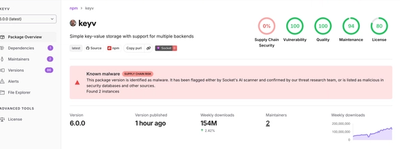
Popular npm packages keyv and cacheable compromised.

Security News
A misconfiguration gave three Anthropic models internet access, and one, believing it was in a simulation, shipped a credential-stealing package to PyPI.