
Product
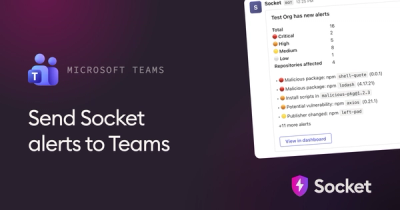
Microsoft Teams Notifications Are Now Available in Socket
Socket can now send alerts and supply chain attack notifications to Microsoft Teams, with filters that route the right updates to each channel.
By Jeppe Hasseriis - Sep 01, 2026
hacker-bob
Advanced tools

A local MCP workflow framework for authorized bug bounty research.






Hacker Bob installs a local MCP runtime into a project directory and connects it to Claude Code, Codex, Kimi CLI, or another MCP-capable host. The runtime coordinates surface mapping, authentication setup, parallel surface testing, finding verification, grading, reporting, and local evidence handling.
Bob is designed for authorized security testing. It can send real network requests, run local surface-discovery tools, import local artifacts, and preserve sensitive run data on disk. You are responsible for using it only where you have permission.
Choose the project directory where you want to run Bob. Install into that project, not into this source checkout unless you are developing Bob itself.
npx -y hacker-bob@latest install /path/to/your/project
cd /path/to/your/project
node -e "require('./mcp/server.js'); console.log('MCP ok')"
Restart your host CLI from the same project directory, then run the matching command:
| Host | Command |
|---|---|
| Claude Code | /bob-evaluate target.com |
| Codex | $bob-evaluate target.com |
| Kimi CLI | /skill:bob-evaluate target.com |
| Generic MCP host | Connect the generated .mcp.json, then follow .hacker-bob/generic-mcp/hacker-bob.md. |
Run a status check before a full evaluate if you want to confirm the integration is loaded:
| Host | Status command |
|---|---|
| Claude Code | /bob-status |
| Codex | $bob-status |
| Kimi CLI | /skill:bob-status |
| Shell | hacker-bob doctor /path/to/your/project |
Only run Bob against targets, accounts, applications, APIs, and infrastructure you own or are explicitly authorized to test. Read the target program's scope and rules of engagement before starting a evaluate.
Bob does not prove authorization, enforce a program policy, or guarantee containment. For session-bound MCP tools, caller target_domain is only a lookup key: Bob authorizes against initialized session state, validates the stored target and target_url, and rejects drift before handlers run. Bob's MCP-scoped HTTP tools additionally require a public target_domain and only send first-party target-host requests; browser auto-signup routes page HTTP requests through a target-host guard but refuses effective block_internal_hosts: true because Chromium resolves network destinations outside Bob's safeFetch transport. Bob does not control arbitrary host shell commands, unrelated browser activity, or external surface-discovery binaries. By default, normal, yolo, and compatible legacy sessions allow public first-party hostnames that resolve to private infrastructure; paranoid sessions default to direct-egress DNS/private-address blocking unless the operator starts the session with --allow-internal-hosts for an explicitly authorized internal/lab program. First-party host scope is not DNS-rebinding or SSRF protection. Bob uses the packaged Public Suffix List via psl to reject public-suffix-only target_domain values and isolate registrable tenant domains. If that packaged list is stale, an operator can set BOB_PSL_OVERLAY_FILE to a local suffix file before running Bob; overlay matches are recorded in HTTP audit rows with public_suffix_source and psl_overlay_file, and the overlay is not a per-request bypass. For tools that support it, pass --block-internal-hosts or block_internal_hosts: true when you need local DNS/private-address blocking outside paranoid mode. The effective value is persisted in state and HTTP audit rows. That stricter mode is only available on direct egress, not proxy-backed egress profiles where target DNS and routing happen outside Bob.
Bob binds the selected egress_profile to the session at bounty_init_session and records a redacted egress_profile_identity_hash in state, HTTP audit, evaluator briefs, signup responses, pipeline events, and analytics. Egress-bound HTTP and signup tools require initialized session state; legacy sessions may default presentation/progress fields, but missing or drifted authority fields such as target, target_url, internal-host policy, or egress identity fail closed for tools that rely on them. Bob hashes the profile name, region, proxy-configured bit, proxy route, and env/source identity, excluding raw credentials and description text; credential rotation on the same proxy route is allowed, but profile, route, or source drift fails closed.
Smart-contract RPC/REST tools use a separate direct-only model: shipped public ladders, explicit endpoints / fork_urls, and BOB_<FAMILY>_RPCS_<NETWORK> env overrides must be public HTTPS endpoints. Bob filters localhost/private/internal literals and performs bounded DNS private-address preflight for SC endpoints. Bob-owned Node SC reads and EVM source fetches then pin the HTTPS socket lookup to one of those preflighted public DNS answers. Fork runners are different: Foundry, Anchor, Aptos, Sui, Substrate, CosmWasm, and Halmos subprocesses run with proxy/RPC/secret env scrubbed, then receive only runner-created fork URL env or CLI args that came from preflighted public endpoints; Bob does not control or DNS-pin the downstream CLI socket. SC RPC does not use egress_profile proxy routing, and private/localnet RPC is unsupported by default until a per-family opt-in policy exists. Returned endpoint evidence and policy rejections redact credentials and query values.
If your Claude Code workflow uses --dangerously-skip-permissions, use it only in a dedicated workspace for authorized security testing.
hacker-bob is the canonical npm package:
npx -y hacker-bob@latest install /path/to/your/project
Adapter-specific installs are available when you want to choose the host explicitly:
npx -y hacker-bob@latest install /path/to/your/project --adapter claude
npx -y hacker-bob@latest install /path/to/your/project --adapter codex
npx -y hacker-bob@latest install /path/to/your/project --adapter generic-mcp
npx -y hacker-bob@latest install /path/to/your/project --adapter kimi
npx -y hacker-bob@latest install /path/to/your/project --adapter all
The installer is idempotent and preserves unrelated host configuration. It writes the shared MCP runtime to mcp/, neutral Bob resources to .hacker-bob/, and adapter-specific files for the selected host.
| Adapter | Installed files |
|---|---|
claude | .claude/ commands, skills, agents, hooks, statusline setup, and MCP settings. |
codex | $bob-* skills in ~/.codex/skills, a local .codex/plugins/hacker-bob plugin, .agents/plugins/marketplace.json, and Codex MCP activation metadata. |
kimi | .kimi/skills, .kimi/mcp.json, and .kimi/bob compatibility metadata. Relies on prompt-side enforcement; no PreToolUse hooks until ~/.kimi/config.toml wiring lands. |
generic-mcp | A root .mcp.json entry plus prompt guide files under .hacker-bob/generic-mcp/. |
When --adapter is omitted, Bob chooses an adapter from prior install metadata, host environment markers, project files, and installed host CLIs. Claude is the final fallback.
The MCP server name is hacker-bob. You will see hacker-bob in .mcp.json, in claude mcp list, and as the prefix on tool names such as mcp__hacker-bob__bob_*. Existing v1.x installs are auto-migrated on the next install or update: the legacy bountyagent server key and mcp__bountyagent__* permission strings are rewritten to the canonical hacker-bob form while operator-managed sibling servers and custom permissions are preserved.
Small wrapper packages are available when you want the host choice encoded in the package name:
npx -y hacker-bob-cc@latest install /path/to/your/project
npx -y hacker-bob-codex@latest install /path/to/your/project
npx -y hacker-bob-kimi@latest install /path/to/your/project
You can also install the CLI globally:
npm install -g hacker-bob
hacker-bob install /path/to/your/project --adapter claude
A global install only adds the hacker-bob command to your PATH; it does not install Bob into every project automatically.
Source installs are for contributors and local development:
git clone https://github.com/vmihalis/hacker-bob.git
cd hacker-bob
./install.sh /path/to/your/project
Claude Code commands:
/bob-evaluate target.com         # start a normal evaluate
/bob-evaluate target.com --deep  # broader surface-discovery and deep lead follow-up
/bob-evaluate resume target.com  # resume an existing session
/bob-status                  # show latest session status
/bob-debug                   # inspect the latest local run
/bob-update                  # preview and install the latest release
/bob-export                  # create a release-scoped improvement bundle
/bob-egress                  # manage operator-controlled egress profiles
Codex uses the same command names with a $ prefix:
$bob-evaluate target.com
$bob-status
$bob-debug
$bob-update
$bob-export
$bob-egress
Kimi CLI uses a /skill: prefix:
/skill:bob-evaluate target.com
/skill:bob-status
/skill:bob-debug
/skill:bob-update
/skill:bob-export
/skill:bob-egress
For install diagnostics:
hacker-bob doctor /path/to/your/project
hacker-bob doctor /path/to/your/project --adapter codex
hacker-bob doctor /path/to/your/project --adapter kimi
Bob follows a structured workflow:
SURFACE_DISCOVERY -> AUTH -> EVALUATE -> CHAIN -> VERIFY -> GRADE -> REPORT
SURFACE_DISCOVERY: Collects subdomains, live hosts, archived URLs, crawled URLs, nuclei signals, JavaScript hints, and optional deep-surface-discovery lead data.AUTH: Attempts authorized account setup when possible and records usable profiles for later differential testing.EVALUATE: Starts parallel evaluators against runtime-prioritized attack surfaces.CHAIN: Evaluates whether individual findings combine into higher-impact scenarios.VERIFY: Runs independent verification passes and collects bounded evidence for surviving reportable findings.GRADE: Scores confirmed findings and decides whether they are ready to submit, should be held, or should be discarded.REPORT: Produces a clean report with verified proof and evidence references.MCP ranking computes runtime priority for status views and evaluator briefs. Imports and public-intel fetches do not rewrite attack_surface.json.
Local open-source project review runs against a checked-out repository instead of a live target domain. It inventories repo files, writes a session-scoped Docker plan, and keeps dependency installs and build repros inside a Docker image when explicitly requested. Docker command replay mounts the repo read-only by default and uses a session-owned writable work directory. Native C/C++ projects get a dedicated parser/protocol/memory-safety surface so evaluators bias toward reachable file/function evidence instead of generic repo audit notes. OSS mode is plumbed through the same v2 governance/frontier/scheduler/claim planes and is exposed as a forward-ported entry point (/bob-evaluate <repo-path> semantics) under the unified lifecycle FSM.
For a local read-only dashboard over multiple concurrent sessions:
hacker-bob dashboard --repo-only
The dashboard binds to 127.0.0.1:4873 by default and reads ~/hacker-bob-sessions (falling back to the legacy ~/bounty-agent-sessions root during the v2.0.x migration window). It shows OSS/repo progress, pending handoffs, claims, verification/evidence/grade state, and cross-session bottlenecks.
curl and python3Optional surface-discovery tools improve coverage when they are installed:
go install github.com/projectdiscovery/subfinder/v2/cmd/subfinder@latest
go install github.com/projectdiscovery/httpx/cmd/httpx@latest
go install github.com/projectdiscovery/nuclei/v3/cmd/nuclei@latest
go install github.com/owasp-amass/amass/v4/...@latest
go install github.com/tomnomnom/assetfinder@latest
go install github.com/projectdiscovery/chaos-client/cmd/chaos@latest
go install -v github.com/projectdiscovery/dnsx/cmd/dnsx@latest
go install github.com/projectdiscovery/tlsx/cmd/tlsx@latest
go install github.com/projectdiscovery/katana/cmd/katana@latest
go install -v github.com/PentestPad/subzy@latest
git clone https://github.com/ticarpi/jwt_tool ~/jwt_tool
python3 -m pip install -r ~/jwt_tool/requirements.txt
Bob still runs without the optional tools; the installed toolset determines which surface-discovery paths are available.
From Claude Code:
/bob-update
From Codex:
$bob-update
From Kimi:
/skill:bob-update
From a shell:
hacker-bob update /path/to/your/project --adapter claude
After an update, fully restart your host CLI in the project directory so it reloads commands, MCP config, hooks, and skills.
Bob also checks for available updates once per day on session start and stores the result under ~/.cache/hacker-bob/update-checks/. Status views read that local cache.
After testing with an installed release, run /bob-export in Claude, $bob-export in Codex, or /skill:bob-export in Kimi. Bob writes a timestamped bundle under:
~/bounty-agent-telemetry/release-bundles/v<version>/
The bundle includes summaries, filtered telemetry, session references, and a handoff document for improving future releases. Export is read-only and does not touch targets.
Use the doctor command first:
hacker-bob doctor /path/to/your/project --adapter all
Common checks:
node -e "require('./mcp/server.js'); console.log('MCP ok')" should pass from the installed project./bob-* commands and MCP settings load.$bob-* skills and local plugin wiring load./skill:bob-* skills and MCP config load..mcp.json should contain an mcpServers["hacker-bob"] entry pointing at the installed project's mcp/server.js. v1.x installs are auto-migrated to this canonical key on next install or update.mcp/lib/tools/ missing, rerun the installer with hacker-bob@latest.Detailed guides:
Bob stores local run state, telemetry, and evidence under ~/hacker-bob-sessions. Legacy ~/bounty-agent-sessions/ is migrated to ~/hacker-bob-sessions/ on first use; preserved until v2.1.0 (--purge-legacy-session-root). Bob copies — never moves — any legacy domain directories into the canonical root on first session access, so the legacy directory remains readable as a fallback for sessions created before the v2.0 rename. Treat both directories as sensitive. They can contain target names, request metadata, notes, credentials metadata, and report evidence from authorized testing.
During a evaluate, Bob may make outbound HTTP requests, run local surface-discovery tools, import HTTP or static artifacts, and use host-side reasoning over the collected context. Optional third-party services and dependencies, such as browser automation dependencies, CAPTCHA solving, public-intel sources, or external surface-discovery tools, are used only when you configure the relevant dependencies or credentials.
The npm packages are published through the project release workflow with npm provenance. hacker-bob is the canonical package; hacker-bob-cc, hacker-bob-codex, and hacker-bob-kimi are small wrapper packages that depend on the matching canonical version.
Read DISCLAIMER.md before using Bob on any target.
For local development on Bob itself:
npm test
npm run release:check
npm run release:check:dependencies
To push the current checkout into a separate test workspace:
./dev-sync.sh /absolute/path/to/test-workspace
./dev-sync.sh /absolute/path/to/test-workspace --adapter codex
./dev-sync.sh /absolute/path/to/test-workspace --adapter kimi
The maintainer workflow is documented in CLAUDE.md.
Pull requests are welcome. Read CONTRIBUTING.md before opening an issue or PR. Report vulnerabilities in Hacker Bob itself through SECURITY.md.
FAQs
Portable autonomous bug bounty evaluating MCP framework with host adapters
The npm package hacker-bob receives a total of 15 weekly downloads. As such, hacker-bob popularity was classified as not popular.
We found that hacker-bob demonstrated a healthy version release cadence and project activity because the last version was released less than a year ago. It has 1 open source maintainer collaborating on the project.
Product
Socket can now send alerts and supply chain attack notifications to Microsoft Teams, with filters that route the right updates to each channel.

Security News
pnpm 12 rewrites the package manager in Rust, cutting install times by up to 90% while preserving pnpm 11 workflows and lockfiles.
Security News
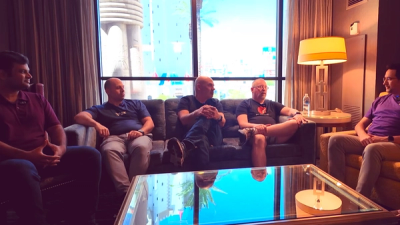
Socket CTO Ahmad Nassri joins AppSec leaders at Black Hat to discuss active malware, package manager risks, and software supply chain defense.