

Company News
AWS Security Hub Adds Socket for Supply Chain Security
Socket is now in the AWS Security Hub Extended plan. Adopt it through AWS, apply committed spend, and block malicious open source packages.
By Feross Aboukhadijeh - Aug 04, 2026
hashproof-mcp
Advanced tools
MCP server for HashProof — issue verifiable credentials (diplomas, certificates, badges) from any AI agent for $0.10 USDC via x402 or an API key. Each credential is registered on-chain on Celo, pinned to IPFS, and verifiable by anyone via QR.
MCP server for HashProof — issue verifiable credentials (diplomas, certificates, badges) from any AI agent for $0.10 USDC via x402 or an API key. Each credential is registered on-chain on Celo, pinned to IPFS, and comes with a PDF + QR anyone can verify for free.
Claude Code:
claude mcp add hashproof -- npx -y hashproof-mcp
Cursor / any MCP client (.mcp.json / mcp.json):
{
  "mcpServers": {
    "hashproof": {
      "command": "npx",
      "args": ["-y", "hashproof-mcp"],
      "env": {
        "HASHPROOF_WALLET_PRIVATE_KEY": "0x..."
      }
    }
  }
}
| Env var | Required | Description |
|---|---|---|
HASHPROOF_API_KEY | one of the two | Prepaid API key (contact hi@hashproof.dev). Takes precedence if both are set. |
HASHPROOF_WALLET_PRIVATE_KEY | one of the two | EVM key of a wallet holding USDC — pays $0.10 per issuance via x402, gasless. Use a dedicated wallet with minimal funds. |
HASHPROOF_X402_NETWORK | no | base (default) or celo — where your USDC lives. |
HASHPROOF_API_BASE | no | Default https://api.hashproof.dev. |
The free tools (get_template_requirements, preview_template, verify_credential) work with no configuration at all.
No wallet yet? Generate a dedicated EVM wallet for the agent (never reuse your main wallet), put its private key in HASHPROOF_WALLET_PRIVATE_KEY, and fund the address with a few USDC on Base or Celo ($0.10 per credential, gasless). Never paste the private key into a chat — write it straight into the config file. Agents: if issue_credential fails with "No payment method configured", walk the human through exactly this.
| Tool | Cost | What it does |
|---|---|---|
get_template_requirements | free | Required fields + layout of an existing template |
preview_template | free | Watermarked PDF from an inline template — iterate field positions without paying or storing anything; the PDF is saved locally so vision-capable agents can inspect and adjust |
issue_credential | $0.10 | Issue one credential: registered on Celo, pinned to IPFS, returns verification_url |
verify_credential | free | 3-layer verification (database, IPFS, blockchain) of any credential id |
fields_json.preview_template → agent inspects the PDF → adjusts → human approves the final preview.issue_credential once per recipient (first call carries the inline template, the rest reuse template_slug).verification_url — the QR on the PDF points there.Full guide (schema, templates, errors): hashproof.dev/skill.md
FAQs
MCP server for HashProof — issue verifiable credentials (diplomas, certificates, badges) from any AI agent for $0.10 USDC via x402 or an API key. Each credential is registered on-chain on Celo, pinned to IPFS, and verifiable by anyone via QR.
The npm package hashproof-mcp receives a total of 41 weekly downloads. As such, hashproof-mcp popularity was classified as not popular.
We found that hashproof-mcp demonstrated a healthy version release cadence and project activity because the last version was released less than a year ago. It has 1 open source maintainer collaborating on the project.
Did you know?

Socket for GitHub automatically highlights issues in each pull request and monitors the health of all your open source dependencies. Discover the contents of your packages and block harmful activity before you install or update your dependencies.
Company News
Socket is now in the AWS Security Hub Extended plan. Adopt it through AWS, apply committed spend, and block malicious open source packages.
Research
/Security News
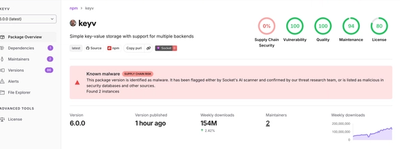
Popular npm packages keyv and cacheable compromised.

Security News
A misconfiguration gave three Anthropic models internet access, and one, believing it was in a simulation, shipped a credential-stealing package to PyPI.