

Security News
The Code You Didn't Write Is Still Yours to Defend
AI agents are pulling packages into environments no scanner is watching, creating exposure before security teams can see it.
By Brad Arkin - Jun 23, 2026
A CLI tool to create React components quickly and easily. It supports OpenAI, Ollama, ChakraUI, MaterialUI, BuilderIO, and more.
Hayde is CLI tool transforms React component creation, supporting frameworks like ChakraUI, MaterialUI, and leveraging AI tools like OpenAI and Ollama for smart, efficient coding. Perfect for developers seeking a fast, intuitive code generation experience.







To use Hayde, simply run the following command:
npx hayde@latest
This will launch the CLI tool and guide you through the process of creating a new React component.
Local Installation
If you want to install Hayde locally, you can run the following command:
npm install hayde --save-dev
or
yarn add hayde --dev
Online Demo
There are two options for running Hayde. Just simply run npx hayde or You can also run Hayde with .hayde.json file. This file allows you to specify default options for Hayde.
Here's an example of what the .hayde.json file might look like:
{
  "plugins": [
    {
      "name": "general",
      "options": {
        "srcFolderLocation": "./src"
      }
    },
    "css",
    {
      "name": "reactJS",
      "options": {
        "createInterface": true,
        "styleLibrary": "chakraUI"
      }
    },
    "chakraUI"
  ]
}
or if you want to use AI only with hayde, you can use .hayde.json file like below:
{
  "plugins": [
    "general",
    "AI"
  ]
}
This file sets the default options for Hayde to avoid having to enter them every time you run the tool. And when you create a new component, Hayde will create react component with Chakra UI and interface support on ./src folder.
After creating .hayde.json file, you can run Hayde with the following command:
npx hayde
For more information on the available options, please check the options page.
If you want to have multiple .hayde file, you can just create the file with your profile. For example; you can create two files called .hayde.json and .hayde.ai.json. And then you can run the following command to use the .hayde.ai.json file.
npx hayde --profile ai
For Examples, please check the examples folder. You can just copy JSON files from this folder and paste to root folder of your project. Then you can just run Hayde. Some examples are;
You can find more examples in the examples folder.
You can create React components with the following libraries, you just need to add the library name to the plugins array in the .hayde.json file.
You can call any script you want before or after component creation! For NPM Scripts, please check the npm scripts page.
For CLI Arguments, please check the CLI arguments page.
For creating custom plugin, please check the custom plugin page. You can create your own libraries' plugin easily with extensive functionality and Handlebars template engine.
Also; you can create your hayde plugin with hayde. Just update your .hayde.json file like below:
{
  "plugins": [
    "createPlugin"
  ]
}
then run the following command:
npx hayde
If you'd like to contribute to Hayde, please check the contributing page. Contributions are always welcome!
If you want to integrate your library/plugin/boilerplate to Hayde, please check the how to create custom plugin page.
Distributed under the GPL-3.0 License. See LICENSE for more information.
FAQs
A CLI tool to create React components quickly and easily. It supports OpenAI, Ollama, ChakraUI, MaterialUI, BuilderIO, and more.
We found that hayde demonstrated a not healthy version release cadence and project activity because the last version was released a year ago. It has 1 open source maintainer collaborating on the project.
Did you know?

Socket for GitHub automatically highlights issues in each pull request and monitors the health of all your open source dependencies. Discover the contents of your packages and block harmful activity before you install or update your dependencies.
Security News
AI agents are pulling packages into environments no scanner is watching, creating exposure before security teams can see it.

Security News
GitHub Actions checkout now blocks risky pull_request_target checkouts by default to help prevent pwn request supply chain attacks.
Product
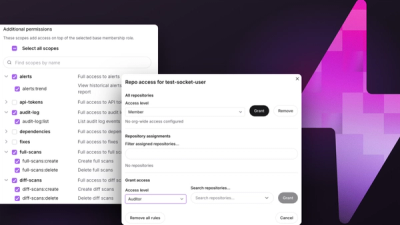
Socket now supports Custom Roles and Repository Access Permissions so organizations can control who can access specific repositories and actions.