

Security News
Federal Audit Finds NIST Wasted Funds With No Plan to Clear NVD Backlog
Federal audit finds NIST lacked a plan to clear the NVD backlog, wasted funds on duplicate work, and delayed use of CISA data.
By Sarah Gooding - Jun 03, 2026

Memory and context orchestration for coding agents
Jumbo is a CLI tool that gives your coding agents persistent memory and structured project context, turning them from makers of workable prototypes into builders of production-quality software.
An elephant never forgets. Neither should 


(a.k.a. What problems does this solve?)
Working with coding agents is amazing. But let's be honest, it' not without frustration. Here are the common issues:
Agent Amnesia: It's a thing. Every session that came before is forgotten. You spend time and energy getting the agent caught up before you even start thinking about your goals.
Slop: AI without guardrails can produce code that kind of works, but it’s rarely production-ready. Worse, it can leave behind a mess that takes hours to untangle. That’s not a productivity boost — it’s a hassle.
Vendor lock-in: If an agent harness holds your memory, switching tools means losing that context. With new models and tools shipping every week, switching is inevitable. Your context should move with you.
Jumbo was created to address these frustrations and unlock the full joy of coding with agents.
Memory: Details about your project are saved, so your agents always have the correct context. Agent Amnesia is, well...forgotten.
Quality: Your coding agents write shippable code on the first shot. You save time and tokens.
Interoperability: Jumbo is harness- and model-agnostic.
Portability: Switch to new models when they're released. Your context stays with you.
Orchestration: Run different agents in parallel. Optimize for capability and cost. Jumbo keeps everything in sync.
Those solve the core problems. These make Jumbo pleasant to use:
Extended context windows: Run agents longer without context rot.*
Automatic: Hooks into your agent session and orchestrates the flow. It just works.
Full control: Jumbo's memories are yours. Stay in control and manage your data directly from the terminal.
Private: All data stays local. Nothing leaves your machine.
Fast: No network calls. No lag. Everything runs locally.
* Only works for harnesses that support hooks.
> npm i -g jumbo-cli
> jumbo
Jumbo will guide you in getting started.
> claude
[Nudge your agent once its running]
> Follow instructions
Jumbo will automatically orient the agent about your project and available goals.
[!NOTE] Goals are the heart of Jumbo. Every memory, guideline, and constraint attaches to a goal — so define your work there first. (see
jumbo goal add --help)Your agent can help define goals too. It knows how to use Jumbo.
[!TIP] Hit the ground running with the Jumbo Memories repo — a curated library of best practice guidelines and invariants ready to drop into any project.
See the Getting started guide for the full workflow.
Jumbo seamlessly integrates with all frontier harnesses and models. Use them interchangeably or in parallel.
It also works with any agent that supports AGENTS.md and truly excels with harnesses that support open agent skills.
Use Jumbo in a harness that supports hooks and you'll never think about context windows again.
It's simple. You just define your goals — describe your objective, criteria, and scope. Then run your agents and Jumbo guides them through the workflow:
You don't have to remember all these steps. Jumbo hooks into your agent sessions and guides the entire flow.
Every time you start Claude Code (or similar) Jumbo will orient the agent about the state of your project. The agent will prompt you with an overview of planned work and ask what you want to work on. Just point at a goal and watch the magic happen.
Jumbo remembers:
Your domain:
Your solution:
Your operations:
Jumbo follows Clean Screaming Architecture — four layers, strict dependency rules, and file names that tell you exactly what they do.
Dependencies always point inward. Swap out the infrastructure and nothing else notices.
Core patterns:
Data lives in two stores:
jumbo db rebuild.When your agent starts a goal, Jumbo assembles a context packet on the fly — pulling in the components, decisions, guidelines, invariants, and architecture linked to that goal through relations. No stale caches. Always current.
better-sqlite3 : Read-model projectionscommander : CLI frameworkinversify + reflect-metadata : Dependency injectionyaml : Context serializationSpread some ❤️ and sponsor the projects or buy them a cup of coffee. I have.
| Resource | Description |
|---|---|
| Quickstart | Get running in 5 minutes |
| Installation | Prerequisites and setup |
| Concepts | Understand sessions, goals, and context |
| What Jumbo Creates | Generated files, folders, and local state |
| Goal Management | Complete guide to tracking work |
| Project Initialization | Configure Jumbo for your project |
| Session Management | Manage pause, resume, and session continuity |
| Advanced Workflows | Command chaining and multi-agent collaboration patterns |
| Command Reference | Full command documentation |
| Shared Memories | Pluggable invariants, guidelines, and patterns to prime your project |
Through hooks, with fallback to AGENTS.md. Your agent calls jumbo session start at the beginning of a session, and Jumbo returns a workflow router plus a bounded backlog preview. The selected workflow then loads the relevant context packet, such as jumbo project show --northstar --format json for goal design or jumbo goal start --id <id> for implementation. New insights are captured in the natural flow of your agent conversations.
Change agents and models at will. Jumbo just picks up where you left off.
Jumbo has been battle-tested with Claude Code, GitHub Copilot, and Gemini. More are to be verified soon...
Theoretically, any IDE with an integrated coding agent that supports hooks or AGENTS.md should work. VS Code running GitHub Copilot has been tested and works well with all supported models. Cursor is to be verified soon...
Locally, in .jumbo/ in your project. Nothing leaves your machine unless you want it to.
Absolutely. You can manage Jumbo directly from the CLI. You control how you want your agent to interact with Jumbo. Stay in the loop by approving each command, or run with pre-approved Jumbo commands for an automated experience.
Not at all. Jumbo prescribes an opinionated workflow that you can always bypass. It works alongside your agent to enhance its capabilities.
Jumbo goes beyond static markdown files. It's an immutable event stream—capturing your entire project history, always current and auditable. You stay in your flow, never repeat yourself—only add new information when you need to. Markdown is a snapshot in time, Jumbo is your project's living memory.
Jumbo adds the .jumbo/ folder to your .gitignore by default. Jumbo employs the event sourcing pattern under the hood, and it is likely to result in conflicts if shared between the team.
Love Jumbo and want to use it in your team? A cloud version is coming soon. Sign up to get notified when it's launched here.
Built in Copenhagen for devs who are tired of repeating themselves, by a dev who was tired of the same.
FAQs
Memory and Context Orchestration for Coding Agents
We found that jumbo-cli demonstrated a healthy version release cadence and project activity because the last version was released less than a year ago. It has 1 open source maintainer collaborating on the project.
Did you know?

Socket for GitHub automatically highlights issues in each pull request and monitors the health of all your open source dependencies. Discover the contents of your packages and block harmful activity before you install or update your dependencies.
Security News
Federal audit finds NIST lacked a plan to clear the NVD backlog, wasted funds on duplicate work, and delayed use of CISA data.
Research
/Security News
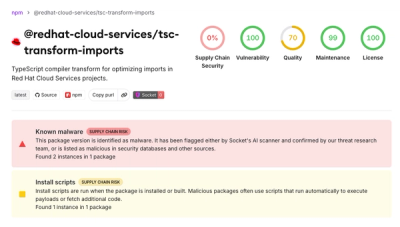
A mini Shai-Hulud campaign compromised Red Hat Cloud Services npm packages to steal developer and CI/CD secrets during installation.

Research
/Security News
The North Korean malware loader hides in a Packagist-listed package and its GitHub branch to fetch and execute remote code in a likely Contagious Interview-style lure.