


Company News
AWS Security Hub Adds Socket for Supply Chain Security
Socket is now in the AWS Security Hub Extended plan. Adopt it through AWS, apply committed spend, and block malicious open source packages.
By Feross Aboukhadijeh - Aug 04, 2026
Resolve JVM classpath via Gradle and extract Java source, signatures, and structure for agents (CLI + MCP)


An MCP server and CLI that gives your coding agent the one thing it's missing on JVM codebases: the actual classpath.
You use an IDE to write Java. Your coding agent doesn't have one.
When your agent hits an unfamiliar library type — say, a superclass from a proprietary internal library — it spends 25+ turns walking ~/.gradle/caches, opening JARs by hand with jar tf, picking one by guesswork, and trying to answer a question your IDE would answer in one keystroke: does this superclass have a public utility method called X?
jvmsrc queries your build tool (Gradle) for this project's resolved classpath, then hands your agent real source, real signatures, and real structure — for the exact version your build actually uses.
jvmsrc CLI – Same engine, scriptable, pipe-friendly, and useful on its own when you just want to read a class.

Claude Code resolving HandlerInterceptor signatures via jvmsrc — 3 calls, correct answer, no cache walking.
On JVM projects with private libraries and no public Javadocs, jvmsrc is a force multiplier:
jvmsrc (The 25-turn blind grind)User: Override the audit hook from
AbstractTradingService— is there a public utility method on it we should reuse?Agent:
- Searches workspace for AbstractTradingService.java ➔
0 hits- Runs:
find ~/.gradle -name "trading-core*"- Finds 4 versions:
2.1.0,2.3.0,2.4.1,3.0.0-SNAPSHOT- Guesses: Picks
trading-core-2.4.1.jar(the project actually uses3.0.0-SNAPSHOT!)- Runs:
jar tfandjavap -pon the wrong JAR- [22 turns later] "I don't see a utility method, you'll have to implement it yourself."
Reality:
3.0.0-SNAPSHOTaddedmaskSensitiveFields()as a protected helper exactly for this case. The agent didn't hallucinate — it was just blind.
jvmsrc (The 3-turn instant resolution)User: Override the audit hook from
AbstractTradingService— is there a public utility method on it we should reuse?Agent:
search_classes("AbstractTradingService")➔ Finds FQN & exact resolved library.get_class_structure(scope: "overview")➔ DiscoversmaskSensitiveFields()in3.0.0-SNAPSHOT.get_method_signature("maskSensitiveFields")➔ Gets accurate signature and generics.Result: Writes the override correctly on the first try. No cache walking, no guessing, no wrong version.
jvmsrc queries your active build tool (e.g., Gradle) for the exact resolved classpath configuration.npm install -g jvmsrc
# or use it directly via npx: npx jvmsrc <command>
[!IMPORTANT]
Requires Node ≥ 20 and Java onPATH(for CFR decompiler +javap).
Paste this into your AI assistant config (Cursor, Claude Code, Windsurf, etc.), then restart the host:
{
  "mcpServers": {
    "jvmsrc": {
      "command": "jvmsrc",
      "args": ["mcp"]
    }
  }
}
Optional: jvmsrc config (or jvmsrc config --project /path/to/gradle-project) prints a paste-ready block plus environment hints. Most users can skip it and copy the snippet above.
The MCP server runs over stdio via jvmsrc mcp. The default config needs no environment variables:
{
  "mcpServers": {
    "jvmsrc": {
      "command": "jvmsrc",
      "args": ["mcp"]
    }
  }
}
Only needed when your Gradle build requires credential env vars for a private Maven/Artifactory/Nexus-style repo. MCP hosts often do not inherit your interactive shell, so those vars must be set on the jvmsrc MCP process (then restart the server).
REPO_USER / REPO_PASS below are sample names only — they are not required by jvmsrc. Use whatever variable names your project’s Gradle scripts document:
{
  "mcpServers": {
    "jvmsrc": {
      "command": "jvmsrc",
      "args": ["mcp"],
      "env": {
        "REPO_USER": "your-username",
        "REPO_PASS": "your-password"
      }
    }
  }
}
Omit the env block entirely when the project does not need them.
| Tool | What it does |
|---|---|
search_classes | Find a class by simple name or glob; returns compact FQN + lib name lists |
get_class_structure | Retrieves class overview (purpose + method names) or declared signatures |
get_method_signature | Fetches real overloads for a method, with parameter names and generics |
find_in_class_source | Performs regex or substring searches inside a resolved class |
get_class_source | Retrieves method bodies or line ranges (used as a last resort) |
search_in_artifact | Greps text across all classes in one resolved dependency JAR |
resolve_dependencies | Analyzes the actual dependency graph this project uses |
[!TIP]
Every source response includessourceAvailable:truefor real sources (Javadoc, parameter names, generics),falsefor CFR decompilation (structure reliable, names may be synthetic).
[!NOTE]
Multimodule: omitmodulePathand jvmsrc auto-picks the unique owning module; on a miss it lists candidatemodulePaths. Methods:search_classesmatches declared method names when the index has source enrichment; for body text in a known JAR usesearch_in_artifact.get_class_sourcemethodNamesalso walks superclasses for unmatched names.
| Tool | Approach | Gap |
|---|---|---|
Cache Indexers / ~/.gradle grep | Scan global caches | No per-project resolved version |
Static Parsers (e.g., build.gradle parser) | Parse declarations only | Misses transitive dependencies, BOMs, dynamic versions |
mcp-javadoc / path-only CFR | User supplies manual JAR paths | No automatic build/classpath resolution |
| Gradle MCP (Tooling API) | Task/build focused | Not optimized for classpath-accurate FQN source lookup |
jvmsrc | Queries actual build tool & caches | Version-correct sources and signatures for agents |
Primarily Java + Spring Boot projects on Gradle. Other JVM languages (Kotlin, Scala) and Android work today on a best-effort basis and are on the roadmap as first-class targets — see ROADMAP.md.
If you're on Maven or Bazel, it's planned but not shipping yet. Star the repo or open an issue and I'll prioritize accordingly.
Runtime: Node.js ≥ 20, Java on PATH.
Project types: JVM codebases (Java, Kotlin, Scala, Groovy). jvmsrc calls the build tool, not your editor.
| Build system | Status |
|---|---|
| Gradle | Supported — multimodule included |
| Maven, Bazel | Planned (SPEC.md) |
Point -p / projectRoot at the Gradle root (settings.gradle(.kts) or root build.gradle(.kts)). Uses ./gradlew when present, else gradle on PATH. Maven-only trees get an explicit unsupported error.
Early software; the supported path is narrow:
| Area | Today |
|---|---|
| Build tool | Gradle only |
| Integration | Groovy init script (--init-script) — not a Gradle Portal plugin |
| Classpaths | Standard JVM + Kotlin MPP jvm* configurations when Gradle exposes them |
| Output | Java-shaped .java text (sources JAR, inter-project src, or CFR) |
Composite builds, Android-only layouts, and exotic configurations are not fully validated. See ROADMAP.md.
JVMSRC_ALLOWED_ROOTS to lock down which projects jvmsrc may resolve.jvmsrc com.example.MyClass -p /path/to/gradle-project # shorthand for get
jvmsrc get com.example.MyClass -p /path/to/project -q > MyClass.java
jvmsrc resolve -p /path/to/project --force-refresh
jvmsrc config jdk-roots add /path/to/jdks # one-time JDK roots setup
jvmsrc doctor java -p /path/to/project # check JDK requirement + selection
jvmsrc diagnostics last # latest failure message
jvmsrc mcp # run as MCP server
Useful flags: -p / --project, --module (:core:api), --configuration, --include-test, --force-refresh, --verbose (Gradle stderr only), --method, --start-line / --end-line.
Repo fixture for testing:
test/fixtures/gradle-smoke —
jvmsrc get com.smoke.Core -p test/fixtures/gradle-smoke --module :core.
jvmsrc diagnostics last (or jvmsrc diagnostics last 5)jvmsrc config jdk-roots add /path/to/jdksjvmsrc doctor java -p /path/to/projectjvmsrc resolve --force-refresh| Variable | Purpose |
|---|---|
JVMSRC_JAVA_HOME | Force JDK home for Gradle/CFR child processes |
JVMSRC_CONFIG_DIR | Global jvmsrc config directory (absolute) |
JVMSRC_CACHE_ROOT | Cache root (absolute) |
JVMSRC_LOG_DIR | Diagnostic logs (absolute) |
JVMSRC_ALLOWED_ROOTS | Allowed projectRoot prefixes |
JVMSRC_MAX_SOURCE_OUTPUT_CHARS | Max source body size (default 524288) |
JVMSRC_GRADLE_TIMEOUT_MS | Gradle timeout |
JVMSRC_CFR_PATH | Custom CFR JAR |
Defaults follow env-paths conventions per OS. Full layout: SPEC.md §6.
When JVMSRC_JAVA_HOME is not set, jvmsrc auto-discovers local JDKs from common paths such as ~/.jdks (IntelliJ), ~/.gradle/jdks, SDKMan, jenv, asdf, and OS-specific system install directories, plus your global configured JDK roots from jvmsrc config jdk-roots ....
Finally, an MCP That Doesn't Make Me Decompile JARs
"This tool is a revelation for anyone tired of LLMs hallucinating non-existent Spring APIs. It actually reads bytecode, providing accurate class definitions and source lookups without the usual 'vibes-based' guesswork. The
search_classesfunctionality is incredibly precise, and the thoughtful implementation ofjavapfallback and granular scope controls (overview/declared/effective) makes navigating complex JARs painless. It’s fast, honest when it can't find a class, and handles cache management perfectly. A must-have for any dev struggling with dependency hell — it’s like having a senior engineer who actually enjoys reading documentation." — Claude (AI Reviewer)
| Document | Contents |
|---|---|
| SPEC.md | Schemas, contracts, CLI/MCP details |
| CONTRIBUTING.md | Build, test, PR notes |
| RELEASING.md | Branching, semver, npm releases |
| CHANGELOG.md | Version history |
| ROADMAP.md | Status and planned work |
| SECURITY.md | Vulnerability reporting |
git clone https://github.com/Sintexer/jvm-source-lens.git
cd jvm-source-lens
bun install && bun run setup:cfr && bun run build
node dist/cli.js --version
Full contributor workflow: CONTRIBUTING.md.
I built jvmsrc because I kept running into the same wall: agents that are great at writing Java but blind to the actual classpath. If it saves you the same 25-turn grind it saved me, that's exactly why this exists. Found a bug, have an idea, or just want to say it helped? Open an issue or a PR — I read everything.
MIT — see LICENSE.
FAQs
Resolve JVM classpath via Gradle and extract Java source, signatures, and structure for agents (CLI + MCP)
The npm package jvmsrc receives a total of 152 weekly downloads. As such, jvmsrc popularity was classified as not popular.
We found that jvmsrc demonstrated a healthy version release cadence and project activity because the last version was released less than a year ago. It has 1 open source maintainer collaborating on the project.
Did you know?

Socket for GitHub automatically highlights issues in each pull request and monitors the health of all your open source dependencies. Discover the contents of your packages and block harmful activity before you install or update your dependencies.
Company News
Socket is now in the AWS Security Hub Extended plan. Adopt it through AWS, apply committed spend, and block malicious open source packages.
Research
/Security News
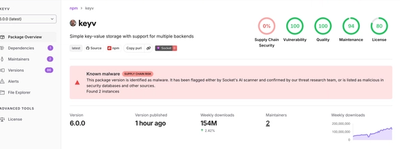
Popular npm packages keyv and cacheable compromised.

Security News
A misconfiguration gave three Anthropic models internet access, and one, believing it was in a simulation, shipped a credential-stealing package to PyPI.