

Company News
AWS Security Hub Adds Socket for Supply Chain Security
Socket is now in the AWS Security Hub Extended plan. Adopt it through AWS, apply committed spend, and block malicious open source packages.
By Feross Aboukhadijeh - Aug 04, 2026
kcp-harness
Advanced tools
KCP Compliance Harness — MCP proxy that enforces deterministic knowledge governance for any agent
Deterministic knowledge governance for any AI agent.
Your agent can read every file in your project. Can it prove why it read what it read?
KCP Harness is an MCP compliance proxy that sits between an AI coding agent and its tools. It intercepts knowledge-related calls, routes them through the kcp-agent deterministic planner (14-gate cascade, no LLM), and produces compliance artifacts — decision traces, audit logs, budget ledgers — as a side effect of normal agent operation.
The agent can't bypass governance because it only talks to the proxy's MCP interface. The proxy decides what knowledge is accessible, tracks spend, and logs every decision. Fail-closed: if the harness can't verify a request, the agent gets nothing.
Agent (Claude Code / Cursor / Copilot / Windsurf / Cline / Crush / OpenClaw / ...)
│
│ MCP tool call
v
┌─────────────────────────────────────────────────────────┐
│ kcp-harness │
│ │
│ classify → govern (14 gates) → execute → audit │
│ │
│ Side outputs: │
│ · Decision traces (per-request, deterministic) │
│ · Audit log (append-only JSONL) │
│ · Budget ledger (itemized, ceiling-enforced) │
│ · Temporal drift (plan validity over time) │
│ · Approval tickets (named-human sign-off, durable) │
│ · Confidence verdicts (post-synthesis gate) │
└─────────────────────────────────────────────────────────┘
│
v
Knowledge manifests (knowledge.yaml)
Enterprises need agents that are defensible — auditable, reproducible, budget-controlled, temporally pinned. Today's agents can't prove why they read what they read. The harness adds a compliance layer without replacing the agent.
| What you keep | What the harness adds |
|---|---|
| Your agent (Claude Code, Cursor, Copilot, ...) | Deterministic knowledge selection |
| Your workflow (coding, reviewing, shipping) | Decision traces (14 gates per unit) |
| Your tools (MCP servers, shell, browser) | Budget enforcement (ceiling, per-currency) |
| Temporal governance (drift detection) | |
| Append-only audit log | |
| Replay / cross-examination | |
| Human-approval gates (named reviewer + policy citation) | |
| Confidence gating (post-synthesis, route-to-human) |
You sell the compliance layer. The agents are pluggable.
npm install -g kcp-harness
Or use without installing:
npx kcp-harness --help
Pre-built binaries (no Node/Deno required) for Linux x64/arm64, macOS x64/arm64, and Windows x64 — grab them from a release. To build one yourself:
npm ci && npm run build
deno compile --allow-read --allow-env --allow-net --allow-run \
  --node-modules-dir=auto --output kcp-harness dist/cli.js
kcp-harness init # creates harness.yaml
kcp-harness integrate claude-code # or: pi, cursor, copilot, windsurf, cline, continue, crush, openclaw
Your agent now routes knowledge access through the harness. Every decision is logged.
| Agent | Config | Integration |
|---|---|---|
| Claude Code | .mcp.json + PreToolUse hooks | kcp-harness integrate claude-code |
| Cursor | .cursor/mcp.json + .mdc rules | kcp-harness integrate cursor |
| GitHub Copilot | .vscode/mcp.json (uses "servers" key) | kcp-harness integrate copilot |
| Windsurf | global config + .windsurfrules | kcp-harness integrate windsurf |
| Cline | MCP settings + .clinerules | kcp-harness integrate cline |
| Continue | .continue/mcpServers/*.yaml | kcp-harness integrate continue |
| Crush | crush.json + PrepareStep | kcp-harness integrate crush |
| OpenClaw | openclaw.json + plugin hooks | kcp-harness integrate openclaw |
| Pi | .pi/mcp.json + project skills | kcp-harness integrate pi |
Each agent has its own MCP config format, rules file, and quirks. The integrate command handles
them all — one governance layer, any agent.
Every tool call flows through a five-stage pipeline:
1. RECEIVE      MCP JSON-RPC request from agent
2. CLASSIFY     Knowledge-navigation or pass-through?
3. GOVERN       14-gate cascade (audience → temporal → budget → ...)
4. EXECUTE      Call downstream tool / return content
5. AUDIT        Log decision to append-only audit log
The classifier examines each tool call and determines whether it targets governed knowledge.
Read("docs/api.md") where docs/ is governed? Route through the planner. Read("package.json")
where package.json isn't governed? Pass through. KCP tools (kcp_plan, kcp_load) are always
governed.
Two automated modes, plus a human gate that outranks both:
kcp_plan first. The harness caches the approved
plan. Subsequent reads are checked against the cached plan — no re-planning.kcp_plan.governance.approvals rule are held for a named
reviewer (pending), no matter what the automated paths would decide. Tickets survive
restarts and resolve via the kcp-harness approvals CLI (or any custom ApprovalProvider
channel). Resolutions require a named reviewer and a policy citation.Every knowledge unit is evaluated through 14 deterministic gates, in order:
audience → not_for → temporal → deprecated → supersession → relevance →
skill_eligibility → attestation → payment → access → strict → max_units →
money_budget → context_budget
A unit must pass all gates. The gate that blocks it is recorded in the decision trace. Same inputs → same plan. No model involved.
For the skill_eligibility gate's subject matter — governed kind: skill units — the
authoring conventions, linter, and conformance vectors live in
Cantara/kcp-skill.
Once connected, agents can use these governance tools:
| Tool | Description |
|---|---|
kcp_plan | Deterministic load plan — which units, in what order, which skipped and why |
kcp_load | Plan + load eligible unit content |
kcp_trace | Full 14-gate decision trace |
kcp_validate | Lint a knowledge.yaml |
harness_status | Current governance state |
harness_session | Approved plans + known units for this session |
harness_budget | Itemized spend tracking |
harness_temporal_check | Plan drift detection |
harness_approvals | Human-approval tickets (pending / approved / dismissed / expired) |
harness_assess | Confidence-gate a synthesized answer before acting on it |
Append-only JSONL. Every decision — governed or pass-through — is logged with sequence number, timestamp, tool, targets, and governance decision:
cat .kcp-harness/audit.jsonl | jq 'select(.governed == true)'
Append-only itemized spend tracking. Per-currency running totals. Ceiling enforcement — a load that would exceed the budget is rejected atomically (no partial loads).
Plans are registered with a temporal watcher. On subsequent calls, the watcher re-evaluates against the current time. If units have drifted (expired, newly valid), the harness emits a drift event. Long-running sessions stay honest.
Calls matching an approval rule open a durable ticket
(pending_review → approved | dismissed | expired). The ticket store survives restarts —
sessions are ephemeral, human review is not. Every resolution records who approved,
when, and which policy it satisfies — evidence generated at approval time, never
reconstructed from logs.
harness_assess runs kcp-agent's post-synthesis
assess() over a synthesized answer before it may be acted on. The planner gates loading,
grounding gates asserting, this gates acting. Below-threshold verdicts on routed configs
open an approval ticket with the full verdict embedded as evidence.
# harness.yaml
version: "1.0"

governance:
  domains:
    - manifest: "./knowledge.yaml"
      paths: ["docs/", "src/"]

  policy:
    fail_closed: true
    audit_all: true
    max_units: 5
    budget:
      amount: 1.00
      currency: USDC

  confidence:                  # optional post-synthesis gate (harness_assess)
    threshold: 0.7
    severity: critical
    route_to_role: account-owner

  approvals:                   # optional human-approval gates
    provider: file
    rules:
      - match: { tools: [Write, Edit], paths: [records/] }
        required_role: account-owner
        expires_after: 72h
        policy_ref: POL-7.2

audit:
  path: ".kcp-harness/audit.jsonl"
kcp-harness serve  [--config harness.yaml]   Start the MCP proxy
kcp-harness init                             Create a harness.yaml template
kcp-harness check  [--config harness.yaml]   Validate configuration
kcp-harness integrate <agent> [options]       Generate agent integration files
kcp-harness integrate --list                  List supported agents
kcp-harness export   [options]               Export compliance evidence (SOC 2 / ISO 27001)
kcp-harness dashboard [options]              Launch the live compliance dashboard
kcp-harness approvals list [--state s]        List human-approval tickets
kcp-harness approvals approve <id> --reviewer <name> --policy-ref <ref>
kcp-harness approvals dismiss <id> --reviewer <name> --policy-ref <ref>
import { classify, govern, BudgetLedger, TemporalWatch } from "kcp-harness";
import { generate, listAgents } from "kcp-harness";

// Classify a tool call
const result = classify("Read", { file_path: "docs/api.md" }, governedDomains);

// Generate integration files
const output = generate("claude-code", { manifest: "./knowledge.yaml", paths: ["docs/"] });
┌──────────────────────────────────────────────┐
│  Layer 3: Integration Packages               │
│  Agent-specific configs + rules files        │
│  (claude-code, cursor, copilot, ...)         │
├──────────────────────────────────────────────┤
│  Layer 2: KCP Compliance Harness             │  ← THIS
│  MCP proxy — deterministic governance        │
├──────────────────────────────────────────────┤
│  Layer 1: kcp-agent (planner core)           │
│  14-gate cascade, decision traces            │
└──────────────────────────────────────────────┘
Forking agents puts you in competition. A harness puts you in composition.
npm test # 314 tests across 20 test files
Covers the classifier, governor (incl. approval precedence), approval state machine + providers, confidence-gate wiring, proxy, audit, budget ledger, temporal watch, evidence export, dashboard, and all agent integrations.
Apache-2.0 · By eXOReaction AS, hosted under Cantara.
FAQs
KCP Compliance Harness — MCP proxy that enforces deterministic knowledge governance for any agent
The npm package kcp-harness receives a total of 534 weekly downloads. As such, kcp-harness popularity was classified as not popular.
We found that kcp-harness demonstrated a healthy version release cadence and project activity because the last version was released less than a year ago. It has 1 open source maintainer collaborating on the project.
Did you know?

Socket for GitHub automatically highlights issues in each pull request and monitors the health of all your open source dependencies. Discover the contents of your packages and block harmful activity before you install or update your dependencies.
Company News
Socket is now in the AWS Security Hub Extended plan. Adopt it through AWS, apply committed spend, and block malicious open source packages.
Research
/Security News
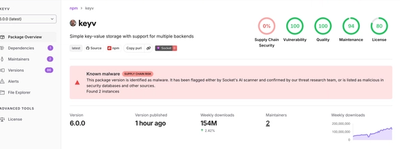
Popular npm packages keyv and cacheable compromised.

Security News
A misconfiguration gave three Anthropic models internet access, and one, believing it was in a simulation, shipped a credential-stealing package to PyPI.