

Product
PHP and Composer Support Is Now in Beta
Socket’s PHP and Composer support is now in Beta for all customers, with PHP reachability analysis generally available.
By Trevor Norris, Benjamin Barslev - Aug 21, 2026
High-performance CLI to prepare a codebase for LLMs, automate reviews, and draft commits. Native Go binary.
Bundle your codebase for LLMs. Strip noise. Ship faster.


| Problem | Kodu |
|---|---|
| Copy-pasting files one by one into ChatGPT | kodu pack bundles your entire project in one command |
| Hitting token limits with comments and docs | kodu clean strips comments deterministically via AST |
| Sending irrelevant files to LLMs | kodu pack --deps traces only the real import graph from your entry point |
Kodu is a single native binary (written in Go). Pick any channel:
# npm (downloads the prebuilt binary for your platform on install)
npm install -g kodu

# Go toolchain
go install github.com/uxname/kodu/cmd/kodu@latest

# Prebuilt binaries (linux/macOS/windows × amd64/arm64)
# https://github.com/uxname/kodu/releases
The npm package ships a thin launcher whose
postinstallfetches the matching binary from GitHub Releases. If the download fails (offline, proxy), it prints a hint to usego installinstead —npm installitself never breaks.
Requires Go 1.25+ and a C toolchain (CGO is used for the tree-sitter parsers).
git clone https://github.com/uxname/kodu.git && cd kodu
task build      # → dist/kodu
task test       # run the test suite
task lint       # gofmt + go vet + golangci-lint
Tasks are defined in
Taskfile.ymland run with Task. Runtask(ortask --list) to see all available targets.
Add .kodu/context.txt to .gitignore so generated context files are never committed:
kodu init
Run once after cloning or setting up the project.
Bundle project files into a single context file optimized for LLMs.
# Pack everything and copy to clipboard
kodu pack --copy

# Pack only specific directories
kodu pack --path src --path tests --copy

# Just see what files would be included
kodu pack --list

# Exclude extra patterns on the fly
kodu pack --exclude "**/*.test.ts" --exclude "docs/" --copy

# Save to a custom path
kodu pack --out /tmp/context.txt

# Use plain text format instead of XML
kodu pack --format text --copy
Instead of bundling the entire project, trace only the files reachable from your entry point:
# Pack src/index.ts and every file it imports (recursively)
kodu pack src/index.ts --deps --copy

# Multiple entry points
kodu pack src/server.ts src/worker.ts --deps --copy

# Limit traversal depth (direct imports only)
kodu pack src/index.ts --deps --deps-depth 1 --list

# See why each file was included
kodu pack src/index.ts --deps --explain

# Combine with --list and --explain for a quick audit
kodu pack src/index.ts --deps --list --explain
Example --explain output:
src/main.ts  ← entry point
src/app.module.ts  ← import from src/main.ts
src/core/config/config.service.ts  ← import from src/core/config/config.module.ts
src/shared/constants.ts  ← import from src/core/file-system/fs.service.ts
--deps resolves the TypeScript/JavaScript import graph (relative imports, file
extensions, index files, tsconfig path aliases, re-exports, and type-only
imports), excluding node_modules. Resolution is best-effort and does not cover
exotic cases like package.json exports maps.
By default, kodu wraps each file in XML tags — the format that LLMs parse most reliably:
<files>
<file path="src/index.ts">
// your code here
</file>

<file path="src/utils.ts">
// more code
</file>
</files>
Use --format text for legacy // file: path style headers.
| Flag | Description |
|---|---|
-c, --copy | Copy result to clipboard |
-o, --out <path> | Output file path (default: .kodu/context.txt) |
-p, --path <path> | Include only this directory/glob (repeatable) |
-e, --exclude <pattern> | Additional exclude pattern (repeatable) |
-l, --list | Print file list only, no content |
-f, --format <xml|text> | Output format (default: xml) |
--clean | Strip comments in-memory before packing (files not modified) |
-t, --template <name> | Wrap output in a prompt template from .kodu/prompts/ |
--deps | Trace import graph from entry point(s) instead of globbing |
--deps-depth <n> | Max import traversal depth (default: unlimited) |
--explain | Print why each file was included (use with --deps) |
Remove comments from source files using AST-based parsing. No AI, fully deterministic.
# Preview what would be removed (with byte/token savings)
kodu clean --dry-run

# Show every removed comment, not just first 3
kodu clean --dry-run --verbose

# Clean only git-staged files
kodu clean --staged

# Clean only git-changed files (staged + unstaged + untracked)
kodu clean --changed

# Target specific files or directories
kodu clean src/utils.ts src/helpers/

# Remove JSDoc too (overrides config)
kodu clean --no-jsdoc

# Backup originals before modifying
kodu clean --backup

# Read from stdin, write to stdout (great for scripting)
cat src/foo.ts | kodu clean --stdin

# Clean all project files
kodu clean
Supports .ts, .tsx, .js, .jsx, .mjs, .cjs, .html. Respects cleaner.whitelist in kodu.json (e.g. //! to preserve important comments).
| Flag | Description |
|---|---|
-d, --dry-run | Show what will be removed without modifying files |
-v, --verbose | Show all removed comments in dry-run (not just first 3) |
-c, --changed | Clean only git-changed files (staged + unstaged + untracked) |
-s, --staged | Clean only git-staged files |
-n, --no-jsdoc | Remove JSDoc comments (overrides keepJSDoc in config) |
-b, --backup | Save originals to .kodu/backup/ before modifying |
--stdin | Read from stdin, write cleaned result to stdout |
Create kodu.json in your project root:
{
  "cleaner": {
    "whitelist": ["//!"],
    "keepJSDoc": true,
    "useGitignore": true
  },
  "packer": {
    "ignore": ["package-lock.json", "dist", "coverage"],
    "useGitignore": true
  }
}
Both commands work without a config file using sensible defaults.
Point prompts.pack at a markdown file to wrap packed context in a prompt:
{
  "prompts": {
    "pack": ".kodu/prompts/pack.md"
  }
}
Available template variables: {{context}}, {{fileList}}, {{tokenCount}}, {{usdEstimate}}.
FAQs
High-performance CLI to prepare a codebase for LLMs, automate reviews, and draft commits. Native Go binary.
We found that kodu demonstrated a healthy version release cadence and project activity because the last version was released less than a year ago. It has 1 open source maintainer collaborating on the project.
Product
Socket’s PHP and Composer support is now in Beta for all customers, with PHP reachability analysis generally available.
Product
Socket is bringing experimental protection to Firefox, scanning 97,000+ extensions in Mozilla's official directory for malware and risky updates.
Research
/Security News
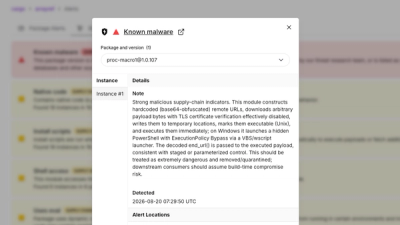
Three compromised Rust crates pulled in a malicious dependency that downloaded and executed cross-platform malware during Cargo builds.