mail-index





mail-index downloads a preview of your whole inbox to your machine, then
smartly fetches the full text of the messages that matter as you use it. That
local index lets your AI agent run true summarization and recall over your
entire mailbox — instead of being trapped behind Gmail's search bar.
It works through a local MCP server, so any agent (Claude, Codex, any MCP
client) can query it. Local-first — the default index never leaves your machine.
Operators who need an always-on connector can instead deploy the optional,
single-tenant remote Worker Deployment in their own
Cloudflare account; mail-index operates no hosting service.
Read-only by default — it never sends or mutates your mail unless you
explicitly opt into archive + label edits (a least-privilege gmail.modify
re-auth; never send or delete). See ADR-0007.

Ask a vague question → one local MCP call → ranked, snippet-first answer.
Interactive version →
Status: v1.5 — published. Progressive sync, the correspondence graph, the
interest engine, curation, the full 23-tool MCP surface, and the write-back
loops are built and tested — and mail-index is live on
npm with a
.mcpb bundle.
Still in progress: the bundled Option A OAuth client and signed one-click
installers. Architecture lives in
docs/PLAN.md; start with docs/INSTALL.md;
every release is recorded in CHANGELOG.md.
[!TIP]
New in v1.5 — the optional remote Deployment. mail-index can now also run
as a single-tenant Cloudflare Worker in your own account: always-on, synced
on a cron, and reachable by remote agents over authenticated MCP (plus a small
A2A surface). It serves the same tool registry as the local server, backed by
a D1 storage driver that passes the same FTS ranking conformance suite, and
it can push — Trigger rules match new mail as it lands and fire signed
webhooks. Long O(N) work becomes a queued Job instead of a command
handback. You can seed a fresh Deployment straight from your existing local
index with mail-index export → D1 import, so it starts with your history
already indexed. The local CLI + stdio path is unchanged and stays the
default, and mail-index still operates no hosting service — the Worker is
code you deploy to infrastructure you own.
See docs/INSTALL-worker.md,
docs/WORKER-SEED.md,
ADR-0008.
Also new locally: every MCP response carries a freshness block and any
stale read now auto-triggers a background sync (previously only the digest
composites did).
[!TIP]
From v1.4 — opt-in mailbox writes + human-readable labels.
mail-index can archive a message and edit its labels directly on
Gmail — via the archive / label CLI commands and the archive_message /
modify_labels MCP tools, on both the gog and gws adapters. It stays
read-only by default: writes are unreachable until you opt in with a
least-privilege gmail.modify grant (never send or delete) — enable per
account with mail-index setup --account <email> --enable-writes or the
bundled scripts/enable-writes.sh. Labels render as their human names
everywhere (the index caches Gmail's label catalogue and resolves
Label_3546… → "Expedition Insure" in both directions), and you can pass a
friendly label name to label --add/--remove.
See ADR-0007.
How it works
- Progressive sync — metadata for the whole mailbox in minutes; bodies
fetched selectively.
- Graph — contacts, domains, threads; centrality + communities over your
human (non-bulk) mail.
- Interest — an engagement score per contact from read/reply/star/importance
signals. A seed for your curation, not an autonomous decision.
- Curate — you (via your agent, or a CLI wizard) confirm who/what matters;
that profile drives which bodies get fetched.
- Query — your agent searches, traverses the graph, and reads the messages
that matter, all locally via MCP.

Important messages prewarm a local index; the MCP reads from it, touching
Gmail again only when a needed body isn't there yet.
Interactive version →
Quick start
Requires Node 24+ and a Gmail MailSource adapter — gog (recommended)
or gws. Reading Gmail needs a Google OAuth client, and you get one two
ways: use the mail-index beta client (skip Google Cloud entirely;
request access
to join the ~100-user test list) or bring your own Google Cloud client (no
cap, no request — we walk you through it). See
docs/INSTALL.md §2
and docs/oauth-and-verification.md.
npm install -g mail-index
mail-index init
mail-index sync --account personal --since 6mo
mail-index graph build --account personal
mail-index search "that contract we discussed"
(Prefer source? git clone …, pnpm install && pnpm build, then run the bins
as node dist/cli/index.js ….)
Add to Claude
The MCP server registers in one step, but it still needs a mailbox connected
first (see the walkthrough). A .mcpb/claude mcp add only adds the server —
it doesn't install the adapter, sign you in, or sync.
Teach your agent the common moves. The MCP server already tells the agent
when to reach for it (purchases, receipts, bookings, "who said what", "catch me
up"), and the repo ships a Claude Agent Skill
with the typical recipes (find purchases, catch up, find a contact's mail,
summarize a sender). Drop it in for Claude Code/Desktop:
mkdir -p ~/.claude/skills && cp -R skills/mail-index ~/.claude/skills/
Full walkthrough (auth, curation, enrichment, scheduled sync, desktop-app
gotchas) → docs/INSTALL.md. Driving setup with an agent →
docs/agent-install.md.
What to expect — time & storage
The index keeps metadata for every message and full text only where it earns it,
so it grows with message count, not mailbox size — about 1.5% of your Gmail.
First sync runs ~50 messages/min (one-time, incremental after); search is instant.
Start with --since 1mo for value in minutes, then expand. Sizing table & growth
path → docs/INSTALL.md §9.
Why it's lighter than Gmail search
Stock Gmail-API MCPs are query-based lookup tools — exact query, a network
round-trip per call, raw payloads dumped into the model's context. mail-index
answers vague questions from a local recall index. Across a 100-question
suite on a real mailbox it answered every question for 15× fewer tokens — and
the gap widens exactly where a query-based MCP has no primitive at all:
summarizing, relationships, and commitments.

Per-category tables, the read-one-message comparison, the tool-by-tool landscape,
and how to reproduce it all → docs/COMPARISON.md.
Stack
TypeScript · node:sqlite (no native deps) · SQLite FTS5 · Graphology ·
@modelcontextprotocol/sdk. Node 24+. Pluggable MailSource adapters; ships two
Gmail transports — gog (recommended) and
Google's gws.
CLI
Two bins ship: mail-index (CLI) and mail-index-mcp (the stdio MCP server).
mail-index init                          Scaffold the operator config + data dir
mail-index sync    --account <a> [--since 30d|1mo] [--all] [--query <q>] [--limit N]
mail-index sync    --all-accounts        Sync every account by its policy presets
mail-index enrich  --account <a> [--profile | --rule direct|all] [--sender <s>] [--match <fts>] [--limit N]
mail-index graph   build [--account <a> | --all-accounts]
mail-index curate  [--account <a>]       Interactive curation wizard (no-agent fallback)
mail-index compact [--account <a>] [--now]   Demote summarized bulk bodies (ADR-0003)
mail-index search  <terms> [--account <a>] [--limit N] [--enrich]
mail-index show    <account:message-id>  Print a message (auto-enriches a meta row)
mail-index open    <account:message-id>  Print the provider web URL (no fetch)
mail-index archive <account:message-id>  Archive (drop INBOX) — opt-in write; needs gmail.modify
mail-index label   <account:message-id> [--add <l>]... [--remove <l>]...  Opt-in write; needs gmail.modify
mail-index status  [--json]              Per-account freshness + counts
Writes are off by default. Enable archive + label edits for an account with
mail-index setup --account <email> --enable-writes (or the bundled
scripts/enable-writes.sh <email>) — a least-privilege gmail.modify grant
(never send or delete). See ADR-0007.
Documentation
- docs/INSTALL.md — generic onboarding (install,
authenticate a MailSource, init, sync, curate, enrich, add the MCP server,
scheduled-sync snippet).
- docs/MCP.md — the 18-tool MCP reference for agent
integrators: args, compact result shapes, the
index_as_of freshness +
command-handback contracts.
- docs/ADAPTERS.md — the
MailSource contract and how to
write + contract-test a new adapter (gws, gog, gmail-rest).
- docs/INSTALL-worker.md — deploy the optional
single-tenant remote Worker to your own Cloudflare account: D1 / Queue / KV
resources, secrets, the operator allowlist, connecting an agent, and a
verification checklist.
- docs/WORKER-SEED.md — seed a fresh Deployment's D1
from an existing local index (
mail-index export → import), instead of
re-syncing the whole mailbox from Gmail.
- docs/PLAN-worker.md — the remote-Deployment design:
locked decisions, milestones, and the local↔remote parity constraints.
- CHANGELOG.md — what changed in every released version.
- docs/PLAN.md — architecture, data model, and the key
decisions (ADR digest).
- SECURITY.md + docs/THREAT-MODEL.md
— privacy posture, trust boundaries, prompt-injection stance, and a
"verify our claims yourself" runbook. The local-only promise is enforced in CI
by an egress guard test — the core (
src/) makes
no network calls; the one exception is the opt-out launch-shim self-updater
(bin/selfupdate.mjs, throttled npm-version check, MAIL_INDEX_NO_AUTOUPDATE=1
to disable), audited by the same guard.
About
Built by Unsold Group — a travel & insurtech
company building the groundwork to operate as an AI-native business: local-first,
agent-native infrastructure that gives AI real, queryable context to work from.
mail-index is one piece of that — giving agents durable memory of a mailbox
without handing them the keys to it.
More: unsold.group/al
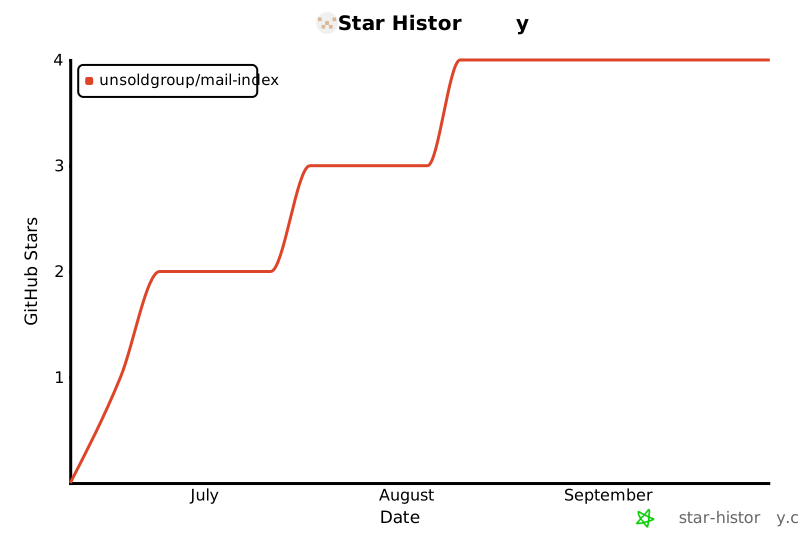
Project growth
Feedback & contact
There's no telemetry — we only know what you tell us, so feedback is
genuinely welcome:
Inside your agent you can also just say "report a mail-index bug" — the MCP
server points the agent to a GitHub link for you to submit (it never sends
anything itself). See SUPPORT.md.
License
MIT