
Research
/Security News
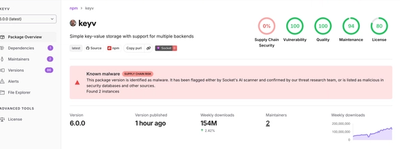
Popular npm Packages in the keyv and Cacheable Namespaces Compromised in Active Supply Chain Attack
Popular npm packages keyv and cacheable compromised.
By Socket Research Team - Aug 04, 2026
marigold-draft
Advanced tools
Local Marigold review loop for agent-authored HTML/SVG drafts — comment in the browser, feedback flows straight back to your coding agent.
marigold-draft)The Marigold review loop, on your machine, in milliseconds. An agent writes a
rich HTML/SVG draft to a file; marigold-draft open serves it in the same
comment shell as cloud Marigold; you highlight, comment, edit in place, and hit
Send feedback to agent — the agent's blocked open --json call returns the
feedback and it revises the file, which live-reloads in your tab.
No Postgres, no render tokens, no OAuth, no network. One warm background daemon
(state in ~/.marigold-local/server.json) is reused across every open, so
per-revision cost is a file write. Comments persist in a sidecar
<file>.marigold.json next to the draft — written before the handoff event
fires, so feedback survives crashed waiters and daemon restarts.
Same anchoring engine as prod (@marigold/core's deterministic
data-marigold-id instrumentation + resolveAnchor), so comments re-anchor
across revisions, in-place edits write through to the source file, and a draft
promoted to cloud Marigold (create_doc with the same HTML) instruments
identically.
npm i -g marigold-draft
marigold-draft agent-setup   # wires up Claude Code (skill) + Claude Desktop (MCP)
Or hand this prompt to your coding agent:
Install Marigold for me using
npm i -g marigold-draft, then read https://marigold.page/draft/setup.md and set yourself up to use it.
From the monorepo instead: pnpm --filter marigold-draft build, then link
packages/local/dist/cli.cjs onto your PATH.
# 1. write draft.html (full document or fragment — fragments get a neutral wrapper)
marigold-draft open draft.html --json          # opens the browser tab, BLOCKS
# 2. reviewer comments / edits in place / hits "Send feedback to agent"
#    → the open call prints the review JSON (openComments with anchoredText,
#      overallComment, per-comment replies) and exits
# 3. edit draft.html — the tab live-reloads, comments re-anchor
marigold-draft reply draft.html c1 "Bumped the chart to 34px"
marigold-draft resolve draft.html c1
# 4. next round (tab already connected, so no new browser tab):
marigold-draft open draft.html --json --no-browser
Run the blocking open as a background process; its exit is the signal that
feedback arrived. Keep stdout clean with --json (status goes to stderr).
.svg files work too — they're inlined into the wrapper so every element is
commentable.
Local drafts never leave your machine. When you want to share one — send it to someone, open it on your phone, or just keep it — graduate it to hosted Marigold. Two rungs:
marigold-draft share draft.html          # prints a share link + a claim link
marigold-draft share draft.html --title "Q3 Review" --origin http://localhost:3000
share POSTs the draft to hosted
Marigold's quick door and prints a URL whose ?k= is the capability —
anyone with the link can view and comment. It's link-visible only (never
listed) and expires ~30 days after the last write. share also prints a
claim link.https://marigold.page/api/mcp.share defaults the title to the file's <title> (or its filename) and posts
to https://marigold.page — override with --origin or
MARIGOLD_ORIGIN. Local comments stay in the local sidecar; the hosted copy
starts a fresh thread on the same anchoring engine, so comments re-anchor across
revisions there exactly as they do locally.
open <file>       serve + open in browser, wait for feedback
                  --json --no-browser --no-wait --timeout <s> --title <t>
listen [path…]    stream submitted rounds as JSON lines; path args (files
                  and/or dirs) scope it to those drafts — scope it when
                  parallel agent sessions run at once (no paths = all drafts);
                  reconnects forever — run under a persistent monitor
share <file>      publish to hosted Marigold + print a share link and claim link
                  --title <t> --origin <url> (default marigold.page)
comments <file>   list threads               [--json]
reply <file> <id> <text…>    reply to a comment (badged AI in the UI)
resolve|reopen <file> <id>   set comment status
start | status | stop        manage the background daemon (default port 4747,
                             override with MARIGOLD_LOCAL_PORT or --port)
mcp               stdio MCP server for chat clients (see below)
marigold-draft mcp speaks MCP over stdio, for clients that can't run shell
commands. Tools: create_draft (html in → file written under
~/.marigold-local/drafts/ → browser opens), open_draft, update_draft
(tab live-reloads), get_feedback (with waitSeconds it blocks until the
reviewer hits "Send feedback to agent"), reply_to_comment,
resolve_comment, read_draft.
Claude Desktop registration (~/Library/Application Support/Claude/claude_desktop_config.json):
{
  "mcpServers": {
    "marigold-draft": {
      "command": "/opt/homebrew/bin/node",
      "args": ["<repo>/packages/local/dist/cli.cjs", "mcp"]
    }
  }
}
For Claude Code, a marigold-draft skill (~/.claude/skills/marigold-draft/)
teaches the agent the CLI loop — saying "spin up marigold draft" in chat does
the whole thing. (The binary answers to both marigold-local and
marigold-draft.)
Any MCP-capable assistant can drive the loop — the server spawns as
{ command: "marigold-draft", args: ["mcp"] }. And any assistant that can run
shell commands can skip MCP entirely and use the CLI directly (add the
AGENTS.md snippet that agent-setup prints so it knows the loop). Registration
per assistant:
~/.codex/config.toml: [mcp_servers.marigold-draft] with
command = "marigold-draft" and args = ["mcp"] (or
codex mcp add marigold-draft -- marigold-draft mcp). Reads AGENTS.md.opencode.json → "mcp": { "marigold-draft": { "type": "local", "command": ["marigold-draft", "mcp"], "enabled": true } }. Reads
AGENTS.md.~/.gemini/config/mcp_config.json) → "mcpServers": { "marigold-draft": { "command": "marigold-draft", "args": ["mcp"] } }. Reads AGENTS.md /
.agents/rules/*.md.GUI apps may not inherit your shell PATH; if the server won't start, use the
absolute path from which marigold-draft. Full copy-pasteable snippets and the
AGENTS.md block:
/draft/setup.md.
The daemon persists a docId→path registry (~/.marigold-local/docs.json) and
lazily re-opens docs on demand, so browser tabs survive daemon restarts; the
shell shows an inline banner while the daemon is unreachable and reconnects
automatically. Comments live in the sidecar and are never lost with the daemon.
src/server.ts): node:http on 127.0.0.1. Watches each opened
file; on change re-instruments, re-anchors every comment (marigoldId → css →
textQuote, orphaning what can't resolve), bumps the version and pushes an
SSE reload to the tab.src/shell.ts): vanilla-JS port of the prod viewer
(apps/web/.../viewer-client.tsx) — same postMessage protocol, same anchor
agent inside a sandbox="allow-scripts" iframe, same marigold styling. The
frame gets the same CSP as the prod render origin, so a draft that works
locally renders identically in cloud Marigold.GET /api/docs/:id/wait?since=<seq> long-poll; Send
feedback persists the round to the sidecar, then resolves waiters. The
since cursor closes the submit-before-wait race.applyInlineEdits) write through to the source file;
fragment drafts are unwrapped back to fragments so the file stays clean.pnpm --filter @marigold/local test
marigold-draft sends anonymous usage counts on five actions (draft.opened,
feedback.submitted, listen.started, share.cloud, agent-setup.run).
The entire payload per event is:
{ "event": "draft.opened", "version": "0.9.0", "platform": "darwin", "nodeMajor": 22 }
No arguments, paths, file names, doc content, hostname, username, locale, or hardware info — and no client-side identifier of any kind: nothing is persisted to identify your machine. Approximate unique counts come from a salted, truncated server-side hash of the request IP (never reversible, raw address never stored) — the same posture as every anonymous signal on marigold.page.
Turn it off any of these ways (any one wins):
marigold-draft telemetry off (persisted; on/status also available)MARIGOLD_TELEMETRY=0DO_NOT_TRACK=1 (the console.dev standard)MARIGOLD_TELEMETRY_DEBUG=1 prints every payload to stderr as it is sent.
Sends are fire-and-forget with a 1.5s cap and can never slow, block, or break
a command. The implementation is src/telemetry.ts —
audit it. If you point MARIGOLD_ORIGIN at a self-hosted instance, pings go
there, not to us.
MIT — free forever. See LICENSE. Source on GitHub:
github.com/immuneeb/marigold-collab
(directory packages/local).
FAQs
Local Marigold review loop for agent-authored HTML/SVG drafts — comment in the browser, feedback flows straight back to your coding agent.
The npm package marigold-draft receives a total of 51 weekly downloads. As such, marigold-draft popularity was classified as not popular.
We found that marigold-draft demonstrated a healthy version release cadence and project activity because the last version was released less than a year ago. It has 1 open source maintainer collaborating on the project.
Did you know?

Socket for GitHub automatically highlights issues in each pull request and monitors the health of all your open source dependencies. Discover the contents of your packages and block harmful activity before you install or update your dependencies.
Research
/Security News
Popular npm packages keyv and cacheable compromised.

Security News
A misconfiguration gave three Anthropic models internet access, and one, believing it was in a simulation, shipped a credential-stealing package to PyPI.

Security News
/Company News
Socket has joined the new Composer and Packagist sponsorship program as a launch sponsor, supporting the team that keeps PHP's package ecosystem secure.