

Company News
AWS Security Hub Adds Socket for Supply Chain Security
Socket is now in the AWS Security Hub Extended plan. Adopt it through AWS, apply committed spend, and block malicious open source packages.
By Feross Aboukhadijeh - Aug 04, 2026
material-simulator-mcp
Advanced tools
No-key MCP server for Material Simulator steel equilibrium, kinetics and measured-data tools.
No-key MCP server for Material Simulator's public steel API. It exposes task-named tools for Fe-Fe3C equilibrium states, educational eutectoid TTT/CCT kinetics, sourced phase boundaries, measured datasets and glossary explanations.
npx material-simulator-mcp
No API key, signup or configuration is required. By default the server calls
https://materialsimulator.com/api/v1. For local development only, set
MATERIAL_SIMULATOR_BASE_URL.
{
  "mcpServers": {
    "material-simulator": {
      "command": "npx",
      "args": ["material-simulator-mcp"]
    }
  }
}
interpret_steel_stateInterpret the equilibrium state of plain-carbon steel at a given carbon content and temperature: stable phases, microstructure constituents (pearlite, proeutectoid ferrite or cementite), lever-rule phase mass fractions, qualitative mechanical property tendencies and typical applications. Use for questions like "what phases does 0.45% carbon steel have at 700 C", "what is the microstructure of slowly cooled eutectoid steel", or "why is high-carbon steel brittle". Educational equilibrium model (Fe-Fe3C, 0-2.14 wt% C, 20-1147 C) with explicit assumptions, refusal boundaries and verification needs in every response. Does NOT predict quenching or cooling-rate effects — use interpret_continuous_cooling or interpret_isothermal_hold for that.
interpret_continuous_coolingInterpret what forms when eutectoid plain-carbon steel (~0.76 wt% C) is cooled at a constant rate to room temperature: fractions of pearlite, bainite, martensite and retained austenite, via Scheil additivity over a published TTT dataset and Koistinen-Marburger martensite kinetics. Accepts an explicit cooling rate (0.005-2000 C/s) or a named quench preset: furnace, air, oil, or water. Use for questions like "what happens if I quench eutectoid steel in oil", "how fast must steel cool to become fully martensitic", or "will air cooling give pearlite". Educational tier, eutectoid composition only; every response carries the assumed process history, assumptions, refusals (including section-size effects and other compositions) and verification needs.
interpret_isothermal_holdInterpret an isothermal hold (TTT / austempering-style treatment) of eutectoid plain-carbon steel: quench to a hold temperature, hold for a given time, then quench to room temperature. Returns transformation start/finish times at that temperature, the JMAK transformed fraction, and product fractions (coarse/fine pearlite, upper/lower bainite, martensite, retained austenite) at the hold and after final quench. Use for questions like "what forms if steel is held at 350 C for 100 seconds" or "how long until transformation finishes at 600 C". Educational tier, eutectoid composition only, with explicit process history, assumptions, refusals and verification needs.
get_phase_boundariesGet the A1, A3 and Acm transformation temperatures of the Fe-Fe3C phase diagram for a given carbon content, with the sourced curve model shown (Andrews 1965 sqrt-of-carbon A3 shape normalized to the diagram's fixed points; Acm interpolated over published anchor points — sources and anchor tables included in the response, not a black box). Use for questions like "at what temperature does 0.3% carbon steel become fully austenitic" or "what is the A3 temperature of C45". Omit the carbon parameter to get the fixed points (G, S, E) and full curve model.
lookup_measured_steel_dataLook up MEASURED (not modeled) steel datasets transcribed from published sources, each with full citation, license, ready-made attribution string and extraction provenance down to the table or figure of origin. Covers dilatometric CCT hardness data for named steel heats, continuous-cooling phase fractions, isothermal/parametric cooling kinetics, and historical digitized TTT data (including the founding 1930 Davenport & Bain eutectoid dataset) — sources are CC-BY or public domain. Use when the user needs real measured hardness or transformation values with a citable source rather than a model estimate — e.g. "what measured hardness does S960MC reach at 30 C/s". Call without arguments for the current list of available datasets (the list grows over time); pass dataset_id for full records.
get_steel_glossaryGet a structured glossary of steel phases, microstructure constituents and related terms (ferrite, austenite, cementite, pearlite, bainite, martensite and more), each explained at three levels: simple, technical and scientific. English, Slovak and Czech. Use when explaining metallurgy concepts at an audience-appropriate depth.
materialsimulator://overviewmaterialsimulator://kinetics-model-cardmaterialsimulator://schemas/material-stateTool results pass through the public API JSON body as structured content and pretty-printed text. Refusals, verification needs, assumptions, disclaimers, license fields and source attribution are not summarized or rewritten by this server.
FAQs
No-key MCP server for Material Simulator steel equilibrium, kinetics and measured-data tools.
We found that material-simulator-mcp demonstrated a healthy version release cadence and project activity because the last version was released less than a year ago. It has 1 open source maintainer collaborating on the project.
Did you know?

Socket for GitHub automatically highlights issues in each pull request and monitors the health of all your open source dependencies. Discover the contents of your packages and block harmful activity before you install or update your dependencies.
Company News
Socket is now in the AWS Security Hub Extended plan. Adopt it through AWS, apply committed spend, and block malicious open source packages.
Research
/Security News
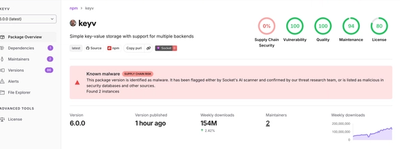
Popular npm packages keyv and cacheable compromised.

Security News
A misconfiguration gave three Anthropic models internet access, and one, believing it was in a simulation, shipped a credential-stealing package to PyPI.