

Company News
AWS Security Hub Adds Socket for Supply Chain Security
Socket is now in the AWS Security Hub Extended plan. Adopt it through AWS, apply committed spend, and block malicious open source packages.
By Feross Aboukhadijeh - Aug 04, 2026
mcp-connectwise-psa
Advanced tools
MCP server for ConnectWise PSA (Manage) — tickets, time entries, companies, and configurations for technicians, with per-tech API keys (BYOK) so writes are attributed to the real member
An MCP (Model Context Protocol) server for ConnectWise PSA (Manage) — curated tools across 7 toolsets covering technicians, dispatchers, and billing, plus an opt-in escape hatch for the rest of the API, so an AI assistant works PSA the way each role does:
x-cw-toolsets header (or CW_TOOLSETS); presets tech / dispatch / invoicing / all. Default tech keeps the surface small. Each tool also reports its toolset as _meta.group, so an aggregator (the MSPStack gateway) can group and switch tools by capabilitynpm install && npm run build
CW_SITE=na.myconnectwise.net \
CW_COMPANY_ID=yourcompany \
CW_CLIENT_ID=<integration clientId> \
CW_PUBLIC_KEY=xxxx CW_PRIVATE_KEY=yyyy \
CW_MEMBER_IDENTIFIER=jdoe \
node dist/index.js
Claude Desktop / Claude Code config:
{
  "mcpServers": {
    "connectwise": {
      "command": "node",
      "args": ["/path/to/mcp-connectwise-psa/dist/index.js"],
      "env": {
        "CW_SITE": "na.myconnectwise.net",
        "CW_COMPANY_ID": "yourcompany",
        "CW_CLIENT_ID": "<clientId>",
        "CW_PUBLIC_KEY": "xxxx",
        "CW_PRIVATE_KEY": "yyyy",
        "CW_MEMBER_IDENTIFIER": "jdoe"
      }
    }
  }
}
A clientId is required by the ConnectWise API — register a (free) integration at developer.connectwise.com. API member keys are created in ConnectWise under My Account → API Keys (per member) or System → Members → API Members (integration accounts).
CW_SITE=… CW_COMPANY_ID=… CW_CLIENT_ID=… \
node dist/index.js --transport http --port 3000
Or with Docker: docker build -t mcp-connectwise-psa . && docker run -p 3000:3000 -e CW_SITE -e CW_COMPANY_ID -e CW_CLIENT_ID mcp-connectwise-psa
| Route | Purpose |
|---|---|
POST/GET/DELETE /mcp | MCP streamable-http endpoint |
GET /health | Liveness probe |
Sessions are held in memory — run a single instance (or sticky sessions).
Over HTTP there is no MCP-level role system. Each session presents its own ConnectWise member API keys, and ConnectWise itself is the access control: the member's security role decides what succeeds, and every note and time entry is attributed to that member.
Send your keys on the initialize request (and on every subsequent request in the session):
x-cw-public-key:  <public key>
x-cw-private-key: <private key>
x-cw-member-id:   <your member identifier>   (optional — enables "my tickets"/"my time")
401; both key headers are required together.403.Local stdio is single-user and uses the CW_PUBLIC_KEY/CW_PRIVATE_KEY from the environment instead of headers.
Tools are grouped into toolsets so a session only sees the capabilities it needs — a dispatcher doesn't need the invoicing tools, and a small tool surface keeps the assistant focused (and its context cheap). Whether a write actually succeeds is still governed by the member's ConnectWise security role.
| Toolset key | Tools |
|---|---|
tickets | cw_search_tickets, cw_my_tickets, cw_get_ticket, cw_create_ticket, cw_update_ticket, cw_add_ticket_note, cw_list_boards, cw_get_board, cw_list_priorities, cw_list_ticket_time, cw_list_ticket_tasks |
time | cw_create_time_entry, cw_update_time_entry, cw_list_my_time, cw_list_work_roles, cw_list_my_timesheets, cw_submit_timesheet |
companies | cw_search_companies, cw_get_company, cw_search_contacts, cw_get_contact, cw_list_company_sites |
configurations | cw_list_configurations, cw_get_configuration |
schedule | cw_list_schedule_entries, cw_my_schedule, cw_schedule_ticket, cw_update_schedule_entry, cw_delete_schedule_entry, cw_member_availability, cw_list_members, cw_get_member |
finance | cw_list_invoices, cw_get_invoice, cw_list_agreements, cw_get_agreement, cw_list_unbilled_time |
advanced | cw_find_endpoint (search the full CW API — ~1,150 endpoints), cw_get (read-only GET on any path) |
Presets bundle keys per persona: tech = tickets + time + companies + configurations · dispatch = tickets + schedule + companies + configurations · invoicing = finance + time + companies · all = everything (incl. advanced).
The advanced toolset is an opt-in escape hatch (not in any persona preset): cw_find_endpoint searches a bundled catalog of the whole ConnectWise API, and cw_get performs a read-only GET on any path — so an assistant can reach the long tail (procurement, sales, projects, system…) the curated tools don't wrap. Enable it explicitly (x-cw-toolsets: advanced or all).
Select toolsets with a comma list mixing keys and presets:
x-cw-toolsets header, per session: x-cw-toolsets: dispatch or x-cw-toolsets: tech,finance.CW_TOOLSETS env var or --toolsets flag: CW_TOOLSETS=invoicing.The default is the tech preset — the same tools this server exposed before toolsets existed, so nothing changes for existing clients until they opt in. Unknown keys in CW_TOOLSETS/--toolsets fail fast; unknown tokens in the x-cw-toolsets header are ignored. The only destructive tool is cw_delete_schedule_entry (dispatch); finance is read-only.
| Variable | Default | Purpose |
|---|---|---|
CW_SITE | — | ConnectWise host (cloud or on-prem; full URLs accepted) |
CW_COMPANY_ID | — | Login company id |
CW_CLIENT_ID | — | Integration clientId |
CW_PUBLIC_KEY / CW_PRIVATE_KEY | — | API member keys — required for stdio; unused on HTTP (BYOK) |
CW_MEMBER_IDENTIFIER | — | Member the stdio keys belong to (my-tickets/my-time) |
TRANSPORT / PORT | stdio / 3000 | Transport selection |
CW_TOOLSETS | tech | Enabled toolsets (keys/presets); HTTP overrides per session via x-cw-toolsets |
/system/myAccount is missing on some on-prem versions — provide the member identifier explicitly (CW_MEMBER_IDENTIFIER or x-cw-member-id) for "my tickets"/"my time".npm install
npm run dev # stdio via tsx
npm run dev:http # http via tsx
npm test # vitest
npm run build # tsc → dist/
FAQs
MCP server for ConnectWise PSA (Manage) — tickets, time entries, companies, and configurations for technicians, with per-tech API keys (BYOK) so writes are attributed to the real member
We found that mcp-connectwise-psa demonstrated a healthy version release cadence and project activity because the last version was released less than a year ago. It has 1 open source maintainer collaborating on the project.
Did you know?

Socket for GitHub automatically highlights issues in each pull request and monitors the health of all your open source dependencies. Discover the contents of your packages and block harmful activity before you install or update your dependencies.
Company News
Socket is now in the AWS Security Hub Extended plan. Adopt it through AWS, apply committed spend, and block malicious open source packages.
Research
/Security News
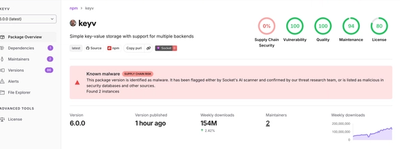
Popular npm packages keyv and cacheable compromised.

Security News
A misconfiguration gave three Anthropic models internet access, and one, believing it was in a simulation, shipped a credential-stealing package to PyPI.