

Company News
AWS Security Hub Adds Socket for Supply Chain Security
Socket is now in the AWS Security Hub Extended plan. Adopt it through AWS, apply committed spend, and block malicious open source packages.
By Feross Aboukhadijeh - Aug 04, 2026
MCP server giving AI coding agents progressive, on-demand access to .NET C# NuGet package source code.
Code context for AI coding agents. Progressive, on-demand access to your internal .NET / NuGet package source — agents browse, search, and read private C# libraries autonomously, with zero workspace pollution.
⚠ Scope: .NET / C# only. mcp-digger indexes NuGet-style repos containing
.csprojpackages and.cssource files. It is not a general-purpose source indexer — other languages (TypeScript, Python, Java, Go, etc.) are out of scope.
Public NuGet packages have documentation ecosystems — API references, tutorials, community Q&A. Tools like context7 serve that well.
Internal .NET packages often have source code as their primary documentation. mcp-digger turns that source into structured, searchable, token-efficient context that any MCP-compatible agent can consume — bridging the documentation gap in private C# library ecosystems.
Without it:
git clone + find + grep + cat chains burn tokens on infrastructure before useful context is retrieved.With it:
Ten purpose-built tools, escalating from broad to deep. The agent picks the cheapest tool that answers its question.
                                                           ┌─→ 📦 dig_package_overview ─┐
                                                           │   (docs, key types)        │
   🩺 dig_status  →  📋 dig_list  →  📖 dig_repo_overview  ┤                            ├─→  🔎 dig_lookup     →  📄 dig_file
   (health)          (discover)      (README + summaries)  │                            │   (symbol → file)       (full source)
                                                           ├─→ 📁 dig_package_files ────┤
                                                           │   (file listing)           │
                                                           └────────────────────────────┴─→  📝 dig_signatures
                                                                                            (stripped API)

   Operational:  🔄 dig_refresh   (force cache invalidation, on demand)
   Bootstrap:    🌱 dig_init      (only when no config exists)
| Tier | Tool | What it does |
|---|---|---|
| Health | 🩺 dig_status | Config summary, connectivity check per repo, index health stats |
| Discovery | 📋 dig_list | Lists configured repos + their packages with one-line .csproj summaries |
| L1 Overview | 📖 dig_repo_overview | Repo README.md (filtered to architecture sections) + package count |
| L1 Overview | 📦 dig_package_overview | Package docs, key interfaces, abstract classes, file count |
| L1 Overview | 📁 dig_package_files | .cs file listing for a package, with directory summary header |
| L2 Search | 🔎 dig_lookup | Indexed symbol search — symbol, implements, or references mode. Cross-package supported. |
| L2 Search | 📝 dig_signatures | Stripped C# public API surface filtered by keyword (no method bodies) |
| L3 Source | 📄 dig_file | Full source of a single file (capped at 1 MB) |
| Operational | 🔄 dig_refresh | Force-rebuild caches for one or all repos |
| Bootstrap | 🌱 dig_init | Creates starter .digger/config.json (registered only when no config is found) |
Search modes for dig_lookup:
| Mode | Finds |
|---|---|
symbol (default) | Type/method declarations matching a name substring |
implements | Classes/structs implementing an interface or extending a base class |
references | Files referencing a given type name (word-boundary, case-sensitive) |
npm install -g mcp-digger
# or run directly
npx mcp-digger
Requires Node.js 20+, git on PATH, and a .NET / C# source repo (NuGet packages with .csproj + .cs sources).
Create .digger/config.json in your workspace root:
{
  "repos": [
    {
      "name": "my-libraries",
      "url": "https://github.com/org/shared-libs.git",
      "packageFilter": "MyCompany.*",
      "auth": {
        "strategy": "pat",
        "PAT-EnvVarName": "GIT_PAT"
      }
    }
  ]
}
Don't have a config yet? Start the server, then call dig_init to scaffold one.
Add to .claude/settings.json or project settings:
{
  "mcpServers": {
    "digger": {
      "command": "npx",
      "args": ["-y", "mcp-digger"]
    }
  }
}
Add to ~/.codex/config.toml (or .codex/config.toml for project-scoped):
[mcp_servers.mcp-digger]
command = "npx"
args = ["-y", "mcp-digger"]
Add to claude_desktop_config.json:
%APPDATA%\Claude\claude_desktop_config.json~/Library/Application Support/Claude/claude_desktop_config.json{
"mcpServers": {
"digger": {
"command": "npx",
"args": ["-y", "mcp-digger"]
}
}
}
Add to .vscode/mcp.json (workspace) or your user mcp.json:
{
"servers": {
"digger": {
"type": "stdio",
"command": "npx",
"args": ["-y", "mcp-digger"]
}
}
}
Add to .cursor/mcp.json (project) or ~/.cursor/mcp.json (global):
{
  "mcpServers": {
    "digger": {
      "command": "npx",
      "args": ["-y", "mcp-digger"]
    }
  }
}
Once connected, ask your agent to call dig_status — it reports config validation, per-repo connectivity, and index health.
A repos[] entry has three ways to declare packages:
| Option | Behavior |
|---|---|
"packages": ["A", "B"] | Explicit list — these packages plus any local sibling project they pull in via <ProjectReference> (transitive, sibling-only). |
"packageFilter": "MyCompany.*" | Wildcard — narrows to packages matching the prefix, found via .sln/.slnx/Directory.Packages.props workspace scan. Follows transitive ProjectReference links automatically. |
| (omit both) | Auto-discover all non-test .csproj directories under sourceRoot (recursive — nested layouts supported). |
sourceRoot defaults to "src" — set it to whichever directory holds your package folders. The walk is recursive, so nested layouts like src/Group/Foo/Foo.csproj are picked up.
By default, managed clones use the repo's default branch. Pin to a specific one:
{
  "repos": [
    {
      "name": "my-libraries",
      "url": "https://github.com/org/shared-libs.git",
      "branch": "develop"
    }
  ]
}
The branch is used for both initial clone and subsequent fetches. Only applies to managed clones — for local repos, you control the checked-out branch yourself.
Skip managed cloning when the repo is already on disk. The local path is read-only — mcp-digger never fetches or modifies it.
{
  "localRepos": {
    "my-libraries": "C:/repos/shared-libs"
  },
  "repos": [
    {
      "name": "my-libraries",
      "sourceRoot": "src"
    }
  ]
}
| Strategy | Behavior |
|---|---|
auto (default) | Try unauthenticated, fall back to PAT if set |
pat | Always use PAT (fatal if not set) |
none | Never authenticate |
PATs can be inline ("PAT": "...") or via environment variable indirection ("PAT-EnvVarName": "MY_TOKEN"). The .env file in your workspace root is loaded automatically — values containing # should be quoted.
| Variable | Default | Purpose |
|---|---|---|
DIGGER_CONFIG | .digger/config.json | Override config file path |
MANAGED_SOURCE_DIR | .digger/source | Override managed clone directory |
CACHE_DIR | .digger/cache | Override cache directory |
Secrets (PAT values) belong in .env or the real environment — never as env vars in this table.
| Symptom | First call | Then |
|---|---|---|
| Connection / auth issues | dig_status | Reports auth attempts, exact error, actionable hints |
| "No matches" but you expect some | dig_refresh <repo> | Force-rebuilds index, picks up new extraction logic |
| Server starts but no tools visible | dig_status | If unconfigured, only dig_status + dig_init are registered |
| Need a config from scratch | dig_init | Scaffolds .digger/config.json (atomic — won't overwrite existing) |
Enable debug logging in your config:
{ "debug": true, "repos": [...] }
Logs go to .digger/debug.log (capped at 5 MB, auto-truncated). Critical errors and crash output land in .digger/error.log.
Tried mcp-digger on your codebase? Share what worked, what broke, what's missing in GitHub Discussions. Bug reports go in Issues.
MIT License — see LICENSE.
FAQs
MCP server giving AI coding agents progressive, on-demand access to .NET C# NuGet package source code.
We found that mcp-digger demonstrated a healthy version release cadence and project activity because the last version was released less than a year ago. It has 1 open source maintainer collaborating on the project.
Did you know?

Socket for GitHub automatically highlights issues in each pull request and monitors the health of all your open source dependencies. Discover the contents of your packages and block harmful activity before you install or update your dependencies.
Company News
Socket is now in the AWS Security Hub Extended plan. Adopt it through AWS, apply committed spend, and block malicious open source packages.
Research
/Security News
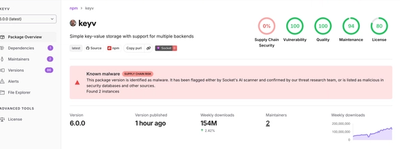
Popular npm packages keyv and cacheable compromised.

Security News
A misconfiguration gave three Anthropic models internet access, and one, believing it was in a simulation, shipped a credential-stealing package to PyPI.